
Steroid-Induced Osteoporosis Risk Calculator
Assess Your Bone Health Risk
This tool estimates your risk of steroid-induced osteoporosis based on your medication dosage, duration, age, and gender. Remember: Bone loss begins within weeks of starting steroids.
Your Risk Assessment
When you’re on long-term corticosteroids-whether for lupus, rheumatoid arthritis, asthma, or another autoimmune condition-you’re not just managing your main illness. You’re also quietly fighting something else: osteoporosis. It doesn’t show up as pain or swelling. No bruise, no limp. But it’s there, eating away at your bones, especially in the first few months of treatment. By the time you break a hip or crush a vertebra, it’s too late. The good news? You can stop it. Not just slow it-stop it. Here’s how.
Why Steroids Attack Your Bones
Corticosteroids like prednisone don’t just reduce inflammation. They mess with your entire bone system. Within weeks, your body starts losing bone faster than it can rebuild it. This isn’t normal aging. This is glucocorticoid-induced osteoporosis (GIOP), the most common type of secondary osteoporosis. Up to half of people taking daily steroids for three months or longer will develop it. And it happens fast: bone density can drop 5% to 15% in the first year, especially in the spine. That’s more than double the rate of natural bone loss in postmenopausal women.Here’s what’s happening inside your bones. Steroids block the cells that build bone (osteoblasts), kill off the ones already working, and keep the bone-eating cells (osteoclasts) alive longer. They also reduce calcium absorption in your gut by about 30%, and make your kidneys dump more calcium through urine. Even worse, your bones stop responding properly to weight-bearing exercise. So walking or lifting weights helps less than it used to.
Who’s at Risk? The Numbers Don’t Lie
It’s not just about how long you’re on steroids-it’s about how much. If you’re taking 2.5 mg of prednisone or more every day for three months or longer, you’re in the high-risk group. At 7.5 mg or more daily, your fracture risk doubles. And here’s the kicker: every extra milligram of prednisone per day means you lose another 1.4% of bone density in your spine each year. That adds up fast. Someone on 10 mg daily for five years could lose nearly 7% of spinal bone density-enough to make a fracture likely.Men are at higher risk than women, even though osteoporosis is often thought of as a women’s issue. Only 44% of men on long-term steroids get any kind of bone protection, compared to 76% of women. That gap isn’t just unfair-it’s dangerous. And even more alarming: only about 15% of people on chronic steroids get full, guideline-approved care. That means most people are flying blind.
The Non-Negotiables: Diet, Movement, and Lifestyle
No pill can fix what you’re doing-or not doing-every day. Prevention starts with three things: calcium, vitamin D, and movement.For calcium, aim for 1,000 to 1,200 mg a day. That’s not a suggestion-it’s a requirement. Most people get about half that from food. So if you’re not eating three servings of dairy (milk, yogurt, cheese), fortified plant milk, or leafy greens daily, you need supplements. Don’t just grab any calcium tablet. Look for calcium citrate if you take acid-reducing meds, or calcium carbonate if you don’t. Take it with food for better absorption.
Vitamin D is just as critical. You need 600 to 800 IU daily, but many people need 1,000 IU to reach the target blood level of at least 20 ng/mL. If you live in Melbourne and spend most days indoors, you’re likely deficient. Get your level checked. If it’s below 30 ng/mL, your doctor may prescribe a higher dose short-term to catch you up.
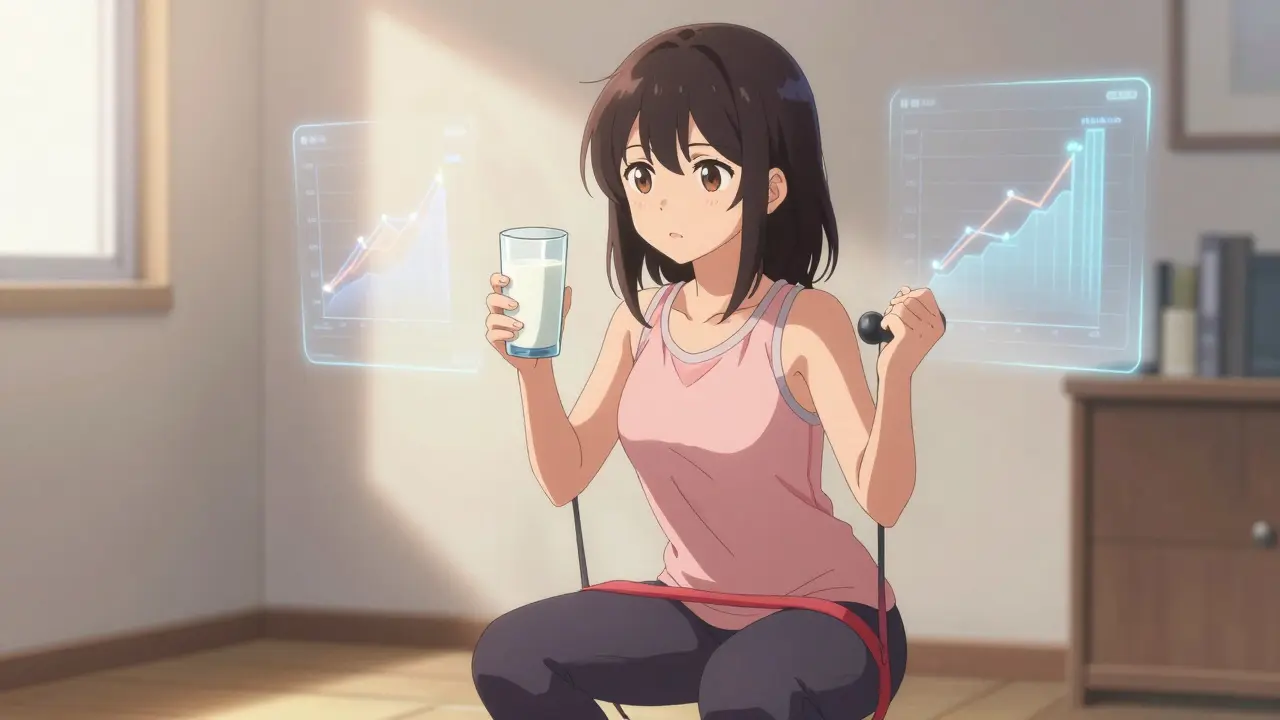
Exercise isn’t optional. Walk 30 minutes most days. Do strength training twice a week-squats, lunges, resistance bands. Even standing on one foot for 30 seconds helps your balance. But here’s the truth: steroids cut the benefit of exercise by about 25%. That means you have to be more consistent, not less. If you skip days, you’re falling behind.
Quit smoking. Smoking alone increases fracture risk by 25% to 30%. Cut alcohol to no more than three standard drinks a day. More than that? It’s another bone killer.
Medications That Actually Work
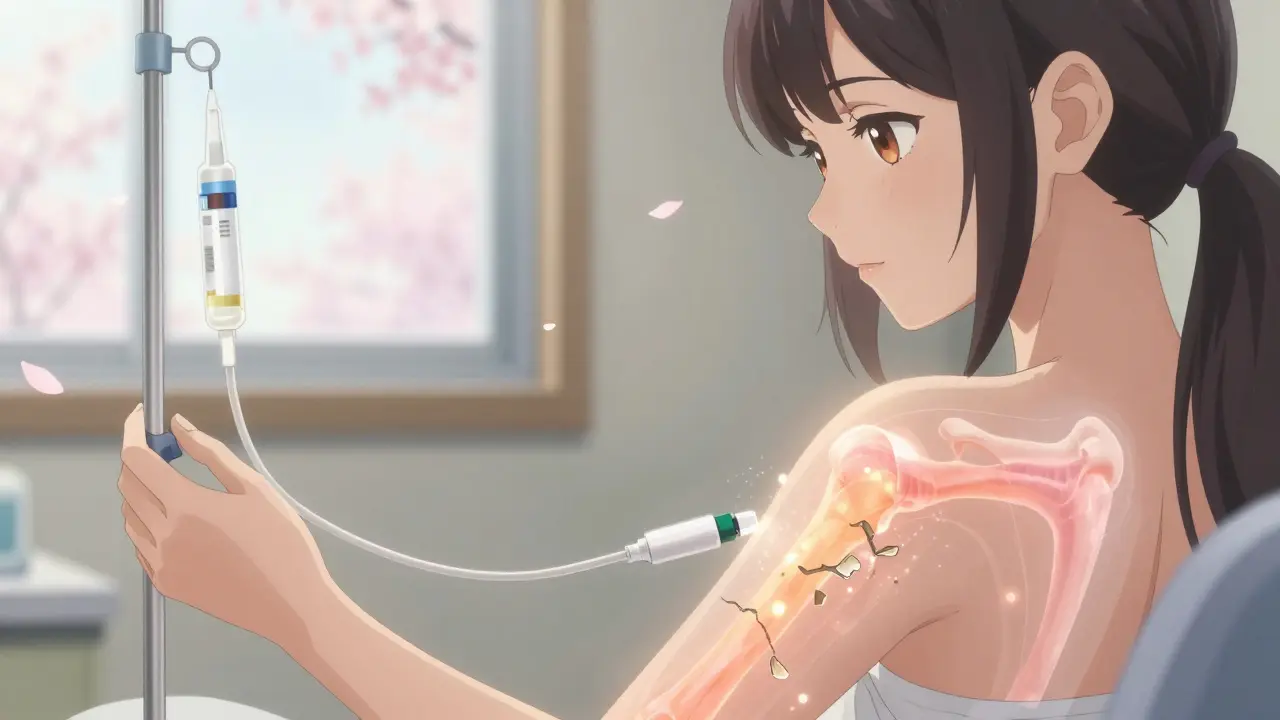
Diet and exercise are the foundation. But if you’re on steroids long-term, you need medicine too. The first-line treatment? Bisphosphonates. These are the most studied, most effective drugs for steroid-induced bone loss.Risedronate (5 mg daily or 35 mg weekly) cuts spine fractures by 70% and other fractures by 41%. Alendronate (Fosamax) works too. They’re cheap, generic, and taken by mouth. But they can upset your stomach. If that happens, ask about zoledronic acid-a single IV infusion once a year. No pills. No stomach issues. And it boosts spine bone density by 4.5% in a year.
If you’ve already had a fracture or your T-score is below -2.5, you may need something stronger. Denosumab (Prolia) is a shot every six months. It increases spine density by 7% in a year. Or there’s teriparatide (Forteo), a daily injection that builds new bone. It’s not for everyone-it’s expensive, and you can only use it for two years total. But for severe cases, it’s the most powerful tool we have. Studies show it builds bone 2.3 times faster than bisphosphonates in high-risk steroid users.
Don’t wait. Start treatment within the first three to six months. That’s when bone loss is fastest. Waiting until your bone scan shows osteoporosis means you’ve already lost too much.
What No One Tells You: The Real Barriers
You’d think doctors would be all over this. But they’re not. Only 31% of patients on long-term steroids get a bone density test. Only 40% are prescribed calcium. Only 37% get vitamin D. Why? Because care is broken.Most rheumatologists assume your GP knows what to do. Your GP assumes the specialist already handled it. Meanwhile, you’re stuck in the middle. And patients? Forty-five percent believe bone loss from steroids is just inevitable. It’s not. It’s preventable.
One big problem? Side effects. Bisphosphonates can cause heartburn or jaw pain. That’s why so many people stop taking them. But here’s what you need to know: if you take them right-on an empty stomach, with a full glass of water, stay upright for 30 minutes-side effects drop by half. And if you can’t tolerate pills, IV or injection options exist.
Another hidden issue: adherence. Only 45% of people are still taking their osteoporosis meds after a year. That’s not because they don’t care. It’s because they’re overwhelmed. They’re juggling multiple pills, appointments, and symptoms. That’s why the most successful programs aren’t just about prescriptions-they’re about systems.
How to Make This Stick
If you’re on steroids long-term, here’s your action plan:- Get tested. Ask for a DXA scan at the start of treatment and again every 1-2 years.
- Check your levels. Get your vitamin D and calcium levels tested. Don’t guess.
- Take your supplements. Calcium + vitamin D every day. Set a phone alarm if you need to.
- Move daily. Walk, lift, balance. No excuses.
- Quit smoking. If you need help, ask your doctor about nicotine patches or counseling.
- Ask about meds. Don’t wait for your doctor to bring it up. Say: “I’m on steroids. What are you doing to protect my bones?”
- Find your system. If your care feels scattered, ask for a care coordinator or pharmacist-led program. One study showed pharmacist support boosted prevention rates from 35% to 85%.
Bottom Line: You Have Control
Steroids save lives. But they don’t have to steal your mobility. You don’t have to accept broken bones as the price of staying healthy. The science is clear. The tools exist. The biggest obstacle isn’t your body-it’s the system. And you’re the one who can push it.Start today. Ask for your bone density test. Get your vitamin D checked. Take your calcium. Walk tomorrow. Talk to your doctor. You’re not powerless. You’re just waiting for permission. You don’t need permission. You need action.
Can I stop my steroids to protect my bones?
No. Stopping steroids suddenly can be life-threatening. The goal isn’t to stop them-it’s to use the lowest effective dose for the shortest time possible. Work with your doctor to reduce your dose only when it’s safe. Even cutting from 10 mg to 7.5 mg daily can cut your fracture risk by 35% in six months.
Do I need a bone scan if I feel fine?
Yes. Osteoporosis has no symptoms until you break a bone. By then, it’s too late. A DXA scan is the only way to know your bone density. Guidelines recommend testing at the start of steroid therapy and every 1-2 years after. If you’ve been on steroids for more than three months, get tested now-even if you feel perfect.
Are natural remedies like collagen or magnesium enough?
No. While magnesium and collagen may support general bone health, they don’t stop the rapid bone loss caused by steroids. The only proven treatments are calcium, vitamin D, and FDA-approved medications like bisphosphonates, denosumab, or teriparatide. Don’t replace science with supplements.
I’m on steroids for asthma. Do I still need to worry?
Yes. Even inhaled steroids can cause bone loss if you’re on high doses long-term. If you’re taking oral steroids (like prednisone) for flare-ups-even just a few pills a month-you’re still at risk. The same prevention rules apply: calcium, vitamin D, exercise, and bone testing if you’re using steroids for more than three months total in a year.
How long do I need to keep taking osteoporosis meds?
As long as you’re on steroids. Once you stop, your doctor will reassess. Some people can stop meds after a year or two of being steroid-free. Others, especially those with prior fractures, may need to continue. Don’t stop on your own. Work with your doctor to create a plan based on your bone density and fracture risk.

Comments (9)
Nancy Kou
Just started prednisone for lupus last month and I was terrified about bone loss-this post literally saved me. I already booked my DXA scan and ordered calcium citrate with D3. No more ignoring this. I’m walking every day now, even if it’s just around the block. You’re right-it’s not inevitable. I’m fighting back.
Thank you for writing this.
Hussien SLeiman
Let me guess-you think this is some kind of miracle cure? Bone density tests? Calcium? Please. The real issue is that the pharmaceutical industry profits off of fear. Bisphosphonates have been linked to jaw necrosis and atypical femur fractures. You’re telling people to take a drug that might break their leg to prevent a bone that might break? That’s not prevention-that’s panic marketing. And don’t even get me started on the vitamin D racket. Sunlight is free, you know. Maybe try standing outside for 20 minutes instead of swallowing pills shaped like tiny tombstones.
Also, men don’t get less care because they’re ignored-they get less care because they’re less likely to whine about it. Women are conditioned to be hypervigilant about their bodies. Men just… live. Maybe that’s the real solution.
Matt Davies
Wow. This isn’t just a post-it’s a lifeline wrapped in clinical poetry. I’ve been on 7.5 mg of prednisone for 18 months and never once had a doctor mention bone health until I read this. I’m getting my scan tomorrow. I’ve already swapped my morning coffee for a glass of fortified oat milk with a calcium tablet. I’ve started doing squats while brushing my teeth. I’m not waiting for a fracture to wake me up anymore.
And hey-shoutout to the pharmacist who helped me figure out the timing of my meds. That guy’s a hero. If you’re reading this and you’re on steroids? Don’t wait. Don’t assume someone else is handling it. You’re the captain of this ship. Grab the wheel.
Ashley Bliss
You know what’s really tragic? Not the osteoporosis. Not the steroids. It’s that people still think they can ‘out-Exercise’ or ‘out-Supplement’ a systemic pharmaceutical assault on their skeleton. You can’t. This isn’t about willpower. It’s about biology being weaponized by modern medicine-and we’re expected to be grateful for the side effects.
And yet, here we are, scrolling through ‘lifestyle hacks’ like we’re Pinteresting our way out of a chemical war. I’m not mad. I’m just… disappointed. We’ve reduced survival to a checklist: take pill, walk, drink milk, smile. Where’s the rage? Where’s the systemic accountability? This post is well-intentioned. But it’s also a Band-Aid on a severed artery.
mark shortus
ok so i just read this and i have to say-this is the most important thing i’ve ever read in my life. i’ve been on 10mg prednisone for 3 years and i didn’t know any of this. i thought i was just ‘getting old’. my back has been killing me for months and i thought it was ‘stress’. turns out it’s my spine crumbling like a stale cracker. i’m crying right now. i’m gonna call my doctor tomorrow. i’m getting that scan. i’m buying calcium. i’m walking. i’m quitting smoking. i’m not dying because i didn’t ask questions. this is my wake-up call. thank you. from the bottom of my broken bones.
ps: i’m 32. i shouldn’t be thinking about hip replacements. this isn’t fair.
Emily P
Quick question-how do you define ‘long-term’? If I take prednisone for 2 weeks every few months during asthma flares, does that count? I’ve done this for 7 years, maybe 10 total weeks of use. Is my bone density at risk? I’ve never been tested because I assumed it didn’t matter if it wasn’t daily. Also, does inhaled steroid use (fluticasone) contribute? I use 2 puffs daily. Thanks for any insight.
Vicki Belcher
Y’ALL. I just shared this with my entire family. My mom’s on prednisone for RA and she thought bone loss was just ‘what happens when you get older’. 😭 I made her book a DXA scan. She’s gonna start walking with me every morning. We’re doing squats together. I bought her calcium gummies with vitamin D (they taste like orange soda-she loves them).
Also, I printed out the action plan and taped it to the fridge. 💪❤️
Thank you for giving us a roadmap instead of just a warning. You’re the real MVP.
Jedidiah Massey
While the pragmatic recommendations are not without merit, one must interrogate the epistemological framework underpinning this discourse. The conflation of pharmacological intervention with bioindividual responsibility constitutes a neoliberal biopolitical strategy-relocating systemic medical neglect onto the locus of patient compliance. Bisphosphonates, while statistically efficacious in RCTs, exhibit significant heterogeneity in real-world adherence due to cognitive load and polypharmacy burden. Moreover, the DXA scan, as a static proxy for dynamic bone remodeling, fails to capture microarchitectural degradation-a limitation rarely acknowledged in primary care guidelines. One might posit that the true intervention lies not in supplementation or screening, but in the de-escalation of glucocorticoid exposure through biologic alternatives. Yet, the pharmaceutical-industrial complex incentivizes maintenance over cessation. Thus, the ‘action plan’ is less a solution and more a palliative containment protocol.
Allison Pannabekcer
Thank you for writing this with such clarity and compassion. I’ve been a nurse for 15 years and I’ve seen too many patients slip through the cracks because no one took the time to connect the dots between steroids and bone health. I’ve handed out pamphlets, reminded patients during appointments, and still-so many don’t get tested.
To the person asking about intermittent steroid use: yes, even episodic use adds up. The damage isn’t always linear, but it’s cumulative. And to the guy who said ‘just get more sun’-you’re right that sunlight helps, but if you’re in Canada or have dark skin or are housebound, that’s not enough. We need both.
And to everyone reading this-you’re not being dramatic for caring. You’re being smart. You’re not weak for needing help. You’re human. And you deserve to move without pain for the rest of your life. Start small. One step. One pill. One conversation with your doctor. You’ve got this.