
When a patient picks up a prescription and sees a pill that looks completely different from what they’ve been taking, it’s not unusual for them to pause. Generic medication isn’t just a cost-saving switch-it’s a moment of potential confusion, fear, or even mistrust. And if the pharmacist doesn’t step in with clear, confident, and specific counseling, that moment can lead to missed doses, therapy failure, or worse.
It’s not enough to say, "This is the same thing, just cheaper." Patients aren’t dumb-they’ve heard the myths. They’ve seen the Reddit posts. They’ve had friends stop taking their meds because the generic was a different color. The truth? Generic drugs are safe, effective, and FDA-approved to work just like the brand. But that doesn’t mean patients believe it. That’s where the pharmacist comes in-not as a clerk handing out pills, but as the last line of defense against misunderstanding.
Why Generic Counseling Isn’t Optional
The law says you have to do it. Under OBRA ’90, every pharmacist in the U.S. is legally required to counsel patients when a generic is dispensed. But more than that, the data shows it works. A 2023 NIH study found that patients who received detailed counseling about generics were 68% more likely to trust their medication than those who got a quick "You’re good to go."
Here’s the reality: 43% of patients think generics are less effective. 37% believe they cause more side effects. And 28% think they take longer to work. These aren’t small numbers. These are the reasons people stop taking their blood pressure meds, their antidepressants, their insulin. And in most cases, it’s not because the drug failed-it’s because no one explained that the shape, color, or imprint changed, not the active ingredient.
When a patient stops taking their medication because they think the generic is "fake," it’s not a compliance issue-it’s a communication failure. And pharmacists are the only healthcare providers who see the patient at the point of dispensing. No doctor, no nurse, no app can replace that face-to-face moment.
The Five Critical Points You Must Cover
Don’t wing it. Don’t ask, "Do you have any questions?" That’s not counseling-that’s hoping. Use this five-point framework, backed by the BC Pharmacists Association and ASHP guidelines:
- Confirm identity-Make sure you’re talking to the right person. This isn’t just protocol; it’s safety.
- Explain substitution-Say clearly: "The doctor prescribed [Brand Name], but we’re giving you [Generic Name]. This is legal, safe, and approved by the FDA. It’s not a different drug-it’s the same active ingredient, just made by a different company."
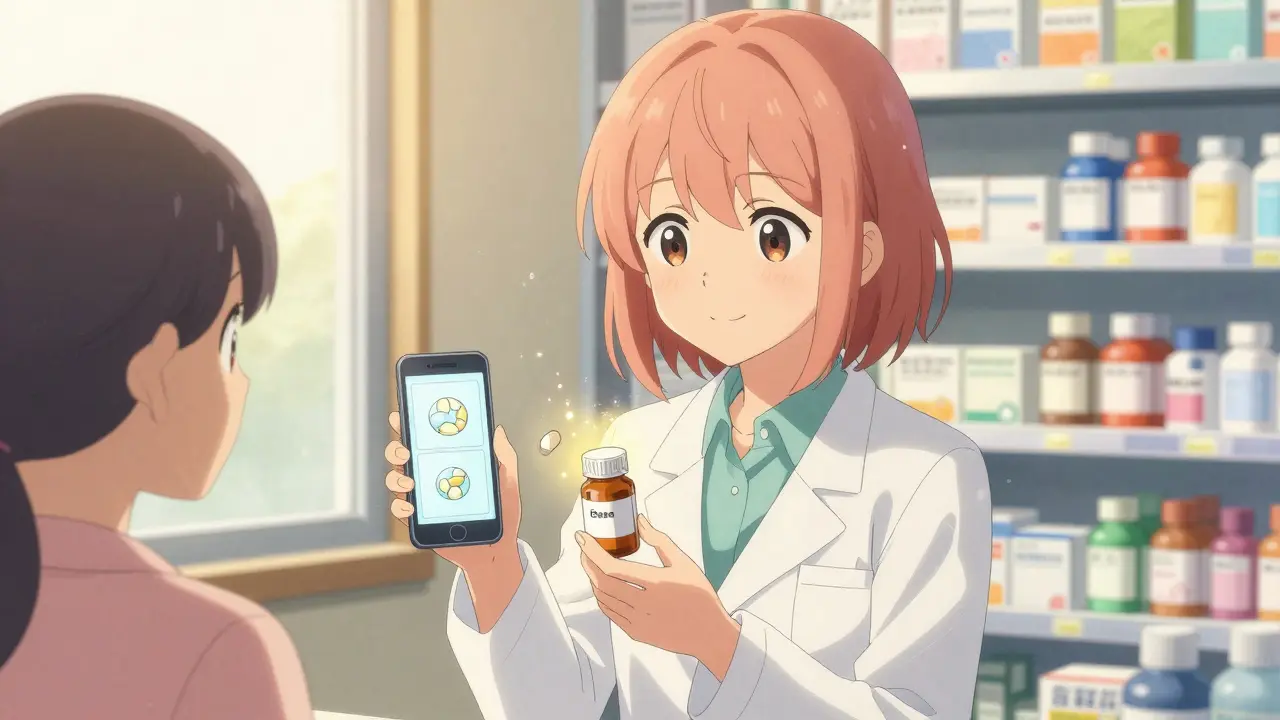
- Describe physical differences-Show them. Pull up a picture on your phone. Point to the pill: "This is the brand. This is the generic. Same shape? No. Same color? No. But the part that works? Exactly the same."
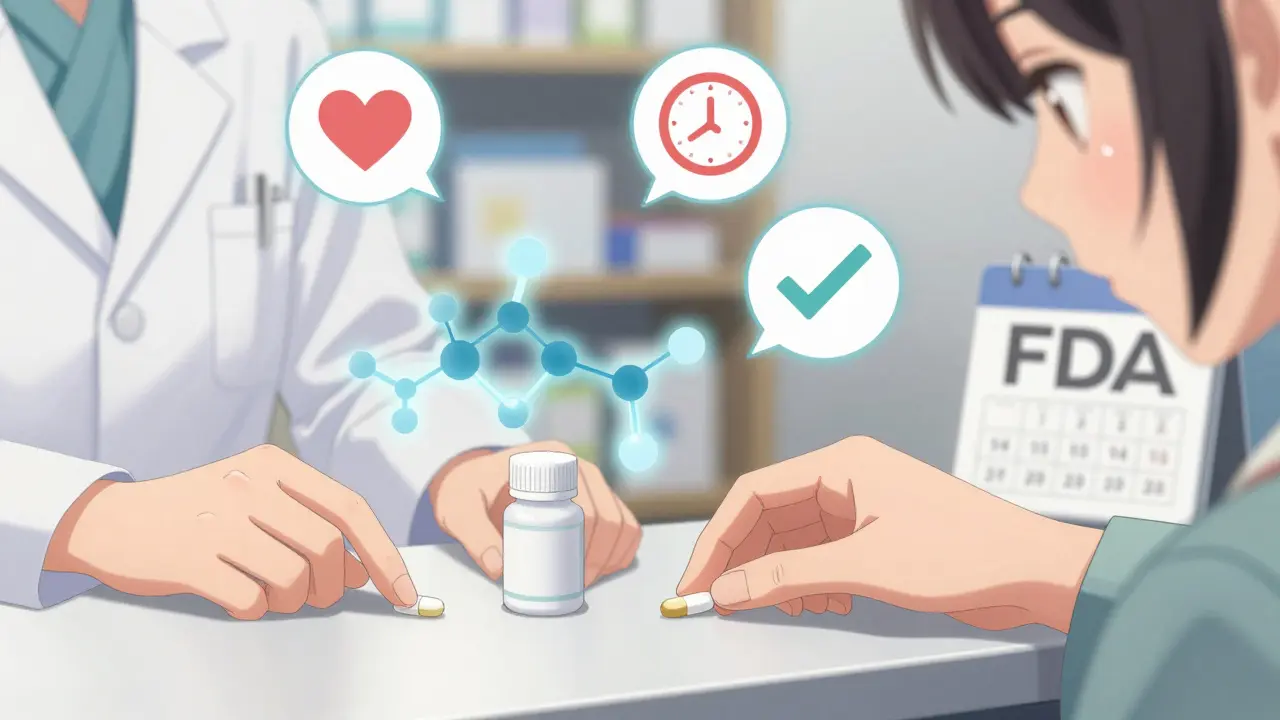
- Reaffirm bioequivalence-Don’t just say "it’s the same." Explain what that means: "The FDA requires generics to deliver the same amount of medicine into your bloodstream within the same time frame as the brand. No more, no less. Studies show they work just as well."
- Verify understanding-Ask them to explain it back. "Can you tell me why you’re taking this pill and why it looks different?" If they can’t, you haven’t finished.
This isn’t theory. It’s practice. A patient in Melbourne told me last month: "I thought my new pills were expired because they were white instead of blue. I threw them out. My pharmacist showed me a side-by-side photo and said, ‘That’s just the dye.’ I cried. I didn’t know that was allowed." That’s the power of a minute of clarity.
What Patients Really Think (And Why It Matters)
Surveys from Consumer Reports and PharmacyTimes show consistent patterns:
- 43% believe generics are less effective
- 37% think they cause more side effects
- 28% believe they take longer to work
- 57% of negative pharmacy reviews mention feeling "rushed" during generic explanations
These aren’t just opinions-they’re barriers to adherence. And adherence isn’t just about taking pills. It’s about preventing hospitalizations, reducing emergency visits, and lowering overall healthcare costs. The CDC estimates that non-adherence costs the U.S. system over $300 billion annually. A large part of that comes from patients who stop taking their meds because they didn’t understand the switch to generic.
And here’s the kicker: patients who receive proper counseling are 2.3 times more likely to refill their prescription on time. That’s not just good for them-it’s good for the pharmacy. Higher adherence means fewer returns, fewer complaints, and more trust.
When the Law Doesn’t Require You to Say Anything
Here’s the messy part: 17 states don’t require pharmacists to notify patients about generic substitution unless the patient asks. That doesn’t mean you shouldn’t talk. It means you should talk anyway.
Just because the law is loose doesn’t make it ethical to stay quiet. The American Pharmacists Association calls counseling an "ethical obligation." And the data doesn’t lie: patients who aren’t warned about changes are far more likely to stop their meds. In those states, the burden falls on you to be the voice of clarity.
And don’t assume patients know what "generic" means. Many think it means "cheap copy," "second-rate," or "old stock." Your job is to reframe it: "This isn’t a downgrade. It’s a smart, safe, and equally effective choice."
How to Counsel When Time Is Tight
Pharmacists average 1.2 minutes per counseling session. That’s not enough to give a lecture. But it’s enough to be precise.
Use this script template-it’s proven:
"You’re switching from [Brand] to [Generic]. The active ingredient is the same, so it works the same way. The only difference is the color and shape-that’s just the filler ingredients. The FDA says they’re just as safe and effective. I’ve got a picture here if you’d like to see the difference. Can you tell me how you usually take this pill?"
That’s 30 seconds. It covers identity, substitution, appearance, bioequivalence, and verification. No fluff. No jargon. Just facts, delivered calmly.
And if you’re in a busy pharmacy? Use tech. 68% of major chains now use electronic prompts that pop up when a generic is dispensed. These remind you to check for key points and even suggest patient-specific talking points based on prescription history. It’s not replacing you-it’s helping you do your job better.
Documentation Isn’t Busywork-It’s Protection
CMS updated its guidelines in February 2024: you can’t just write "counseling provided." You must document what you discussed. That means noting:
- The brand and generic names
- That bioequivalence was explained
- That physical differences were addressed
- That the patient understood
Some states, like California, require checkbox documentation. Others, like Texas, are looser. But even in lax states, clear documentation protects you if a patient later claims they weren’t warned.
And if the patient refuses counseling? Document that too. "Patient declined counseling despite being offered." Simple. Clear. Legally sound.
The Bigger Picture: Why This Matters Beyond the Counter
Generics make up 90.7% of all prescriptions in the U.S.-but only 23.7% of drug spending. That’s billions saved every year. But those savings mean nothing if patients don’t take the pills.
Pharmacists are the bridge between policy and practice. We’re the ones who turn cost-saving laws into real health outcomes. When you take 90 seconds to explain why a pill looks different, you’re not just doing your job-you’re preventing a hospital stay, a missed workday, a relapse.
The future of pharmacy isn’t just in technology or automation. It’s in the quiet moments where a pharmacist says: "I know this looks different. But it’s not different in the way that matters. Let me show you why."
Do generic drugs work as well as brand-name drugs?
Yes. The FDA requires generic drugs to have the same active ingredient, strength, dosage form, and route of administration as the brand-name version. They must also be bioequivalent-meaning they deliver the same amount of medicine into the bloodstream at the same rate. Thousands of studies confirm generics work just as well. The only differences are in inactive ingredients like color, shape, or filler-none of which affect how the drug works in the body.
Why do generic pills look different from brand-name pills?
The appearance-color, shape, size, and imprint-is determined by the manufacturer’s choice of inactive ingredients, like dyes and fillers. Brand-name companies often use unique designs to build brand recognition. Generic manufacturers don’t need to replicate those designs, so they use different ones. But the active ingredient, the part that treats your condition, is identical. It’s like two different brands of aspirin: different looks, same pain relief.
Can switching to a generic cause new side effects?
It’s rare, but possible. Side effects usually come from the active ingredient, which is the same in both versions. However, some patients may react to a different inactive ingredient in the generic-like a dye or preservative. If a patient reports a new side effect after switching, it’s worth checking if it’s a reaction to a filler, not the drug itself. Always advise patients to report any changes to their provider.
What if a patient refuses to take the generic?
Respect their choice, but document it. Explain the legal and clinical basis for substitution, then ask if they’d like to speak with their prescriber. If they still refuse, dispense the brand-name drug if it’s not restricted, or return the prescription. Never pressure a patient. But make sure they understand the cost difference and that their refusal may impact their out-of-pocket expenses or insurance coverage.
Is it okay to use a picture or app to show patients the difference between brand and generic?
Absolutely. Visual aids are one of the most effective tools for reducing confusion. Many pharmacies now use digital pill identifiers or printed comparison cards. Showing a side-by-side image of the brand and generic helps patients see that the difference is only in appearance-not effectiveness. It turns fear into understanding in seconds.
What to Do Next
If you’re a pharmacist: Review your pharmacy’s counseling protocol. If you don’t have a standardized checklist, build one using the five-point framework. Practice the script until it feels natural. Use tech tools to prompt you. And never assume the patient knows what "generic" means.
If you’re a pharmacy owner: Invest in training. CVS and Walgreens require 30-45 minutes of annual training on generic counseling. That’s not a cost-it’s an investment in patient safety and retention. Track adherence rates after counseling changes. You’ll see the difference.
If you’re a patient: Ask questions. If your pill looks different, ask why. Don’t assume it’s a mistake. And if your pharmacist doesn’t explain it, ask for clarification. Your health is worth that minute of conversation.

Comments (13)
Sally Dalton
OMG I literally thought my generic blood pressure pill was fake last year 😭 I threw the whole bottle out bc it was white and tiny instead of blue and big. My pharmacist called me the next day-she had my record and just said, 'Hey, that’s the generic, here’s a pic of both.' I cried. She didn’t even charge me for the replacement. That’s the kind of care that saves lives.
Nicholas Miter
Been a tech pharmacist for 12 years. The electronic prompts? Game changer. Used to forget half the points during rush hour. Now the system pops up: 'Patient on insulin? Highlight bioequivalence.' I still say the same words, but now I don’t skip the part about 'same bloodstream absorption.' Patients notice. They trust more. It’s not magic-it’s just structure.
Shawn Raja
Let’s be real-the FDA doesn’t care if your pill is purple or square. They care if it hits the bloodstream at 90-110% of the brand. That’s the law. But patients? They think 'generic' means 'leftover from 2003.' We’re not just pharmacists-we’re therapists with a pill dispenser. And yeah, it’s exhausting. But if you don’t explain it, someone’s gonna stop their antidepressant because the pill looks 'scary.'
Ryan W
OBRA '90 is a federal mandate for a reason. If you're not counseling, you're not doing your job. Period. And don't give me that 'time is tight' crap-your job isn't to scan and bag, it's to prevent hospitalizations. I've seen patients end up in the ER because they thought their generic was 'fake.' That's malpractice dressed as convenience.
Karen Droege
My mom’s in Canada, but she switched to a generic for her thyroid med last year. She was terrified-said the pill was 'too small' and 'too white.' I sent her a side-by-side photo from our pharmacy app. She called me sobbing: 'It’s the same inside? I’ve been skipping doses for six months!' We fixed it. She’s now on a 6-month refill. That’s the power of a picture and a 30-second chat. Don’t underestimate visuals.
bella nash
The ethical obligation transcends statutory requirements. The epistemological gap between pharmaceutical equivalence and perceived efficacy is not bridged by regulatory assurances alone. It is mediated through the intersubjective authority of the pharmacist as a trusted epistemic agent. When patients perceive substitution as degradation, they are not irrational-they are responding to a systemic failure of epistemic justice. Counseling is not procedural compliance-it is the reclamation of epistemic dignity.
Renia Pyles
Oh please. You think patients care about your 'five-point framework'? They care that their $4 pill looks like a baby aspirin and their $40 pill looked like a little dinosaur. Your 'bioequivalence' talk? Sounds like corporate jargon. If you want trust, stop talking like a textbook and start talking like a human. And for god’s sake, don’t make them repeat it back. That’s not verification-it’s humiliation.
Dan Nichols
Most patients don’t need a lecture. They need a quick reassurance. 'Same medicine, different look. Here’s a picture. Take it.' Done. The rest is theater. You’re not a professor. You’re a pharmacist. Stop trying to impress them with FDA stats. They don’t care. They just want to know if they’ll die if they take it.
Aishah Bango
It’s not just about counseling-it’s about accountability. If you don’t document what you said, and something goes wrong, you’re on the hook. And if you didn’t use the checklist? You’re not just negligent-you’re complicit. People die because pharmacists were too lazy to check a box. Don’t be that person.
James Nicoll
My cousin’s a pharmacist in Texas. He says 70% of patients never ask about generics. So he doesn’t bring it up. He says, 'If they care, they’ll ask.' I told him that’s like a doctor not explaining a new diagnosis because 'they didn’t ask.' He still doesn’t get it. I don’t know who’s more dangerous-the pharmacist who assumes or the patient who’s too scared to ask.
Napoleon Huere
Generics are the quiet revolution of modern medicine. 90% of prescriptions. 23% of cost. Yet we treat them like second-class citizens. The real tragedy isn’t the pill color-it’s that we’ve normalized distrust in science. We’ve let marketing and fear replace evidence. And pharmacists? You’re the last ones holding the line between myth and medicine. Don’t give up that role.
Uche Okoro
Let me tell you something about generics. In Nigeria, we don’t have FDA. We have 'generic' and 'fake.' There’s no middle ground. So when I came to the US and saw patients scared of generics? I thought: 'You’re lucky.' You have regulation. You have proof. You have science. Don’t waste it. Just tell them the truth. They’ll believe you if you say it like you mean it.
Allie Lehto
My grandma died because she stopped her heart med after switching to a generic. She said it 'felt different.' No one explained. No one showed her. I’m still mad. If you’re a pharmacist and you skip this step? You’re not just lazy-you’re dangerous. 🙏