
Side Effect Reporting Assistant
Report Your Medication Side Effect
Use the 5 Ws framework to structure your report. Your detailed report helps healthcare providers make informed decisions about your care.
Your Side Effect Report
When you start a new medication, you’re not just taking a pill-you’re entering a conversation with your body. Sometimes that conversation turns uncomfortable. A rash shows up. Your stomach churns. You feel dizzy after taking your blood pressure pill. You might think, Is this normal? Or worse, Should I even mention it?
The truth is, most side effects aren’t emergencies. But they’re still important. And how you tell your doctor makes all the difference. If you say, “I feel weird,” it might get missed. But if you say, “I got a red, itchy rash on my chest 48 hours after taking my first 20mg dose of lisinopril, and it got worse after I ate grapefruit,”-now you’ve given your provider something real to work with.
What You Need to Know Before You Talk
Not every strange feeling is caused by your medication. But if it started after you began a new drug, it’s worth investigating. The FDA says over 30% of drug label changes in the last 15 years came from patient reports. That means your voice directly shapes how safe a drug is for everyone else.
Before your appointment, gather these five things:
- The exact name of the medication-both brand and generic. Don’t say “the blue pill.” Say “metformin 500mg, brand name Glucophage.”
- Dosage and timing-How much did you take? When? Did you skip a dose? Did you take it with food or alcohol?
- When the side effect started-Was it the same day? Three days later? After you changed the dose?
- What it feels like-Use specific words: “tingling,” “burning,” “pressure,” “racing heart,” not just “bad” or “off.”
- What makes it better or worse-Does it get worse after coffee? Better after lying down? Did you take anything else that might interact?
One study from the University of Michigan found that patients who prepared this info reduced their appointment time by 37% and increased report completeness by over 50%. That’s not just efficiency-it’s safety.
Use the 5 Ws Framework
Doctors are busy. You’re not the only one waiting. But if you give them a clear structure, they’ll listen faster and act better. Use the 5 Ws:
- What-What symptom are you experiencing? (e.g., “severe headache,” “swollen ankles,” “night sweats”)
- When-When did it start? How often does it happen? (e.g., “began 2 hours after my 8 a.m. dose, happens daily for 3 hours”)
- Where-Where on your body? (e.g., “on the left side of my neck,” “in my lower back,” “all over my arms”)
- Why-Why do you think it’s linked to the medication? (e.g., “I didn’t have this before I started this drug,” “I took it once and it happened immediately”)
- What helps-What makes it better or worse? (e.g., “rest helps,” “caffeine makes it worse,” “I stopped taking it for two days and it went away”)
Dr. Janet Woodcock from the FDA says reports with exact timing are over five times more likely to be linked to the drug. That’s not magic-it’s science. The more precise you are, the faster your provider can rule out other causes or adjust your treatment.
Bring Proof, Not Just Words
Words alone can be forgotten. Photos, notes, and logs stick.
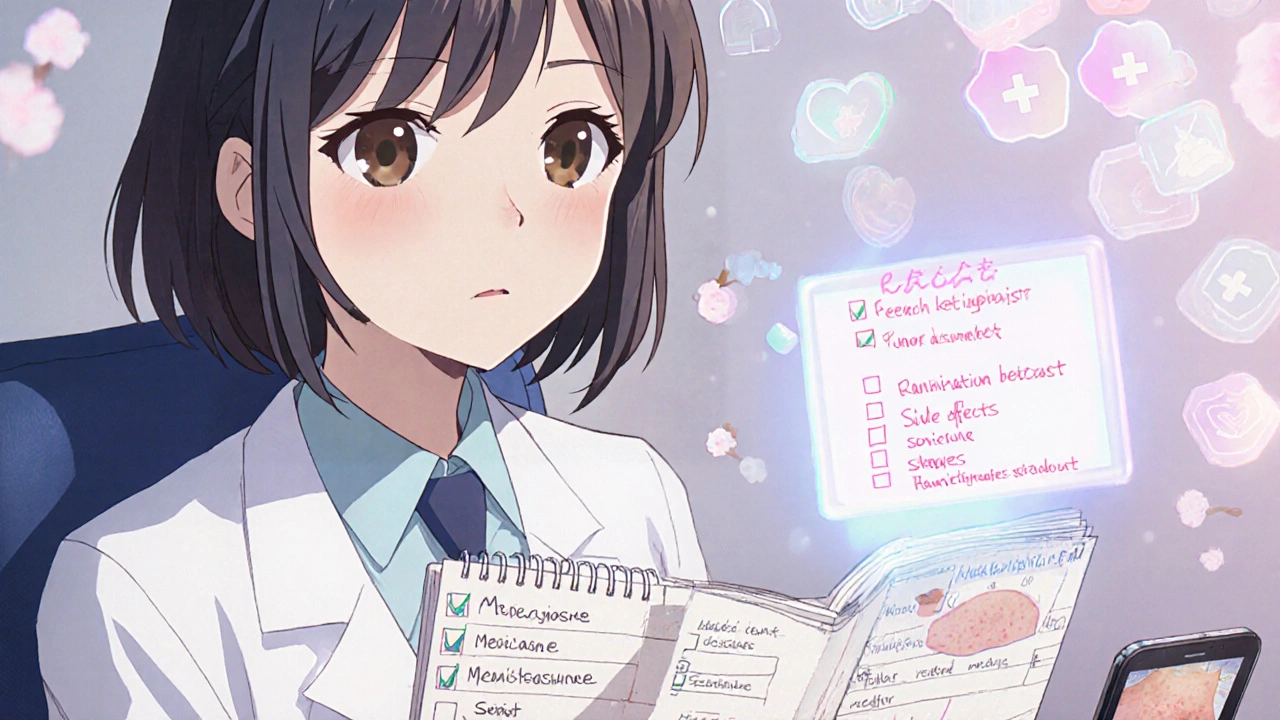
If you have a rash, take a picture with your phone. Note the date and time. If you’re having heart palpitations, write down your heart rate using a smartwatch. If you’re nauseous every morning, keep a simple log: “Day 1: nausea at 9 a.m., lasted 2 hours, took with breakfast.”
Studies show reports with visual evidence have a 42% higher chance of being validated by regulatory agencies. Your provider doesn’t need to be a detective-they just need to see the pattern.
Many pharmacies now offer free medication diaries. Or just use your phone’s Notes app. It’s that simple.

How You Deliver the Message Matters
There’s a big difference between telling your doctor during a rushed 10-minute checkup and bringing it up in a dedicated medication review.
According to a 2022 study in the Journal of the American Medical Informatics Association:
- In-person visits yielded the most complete reports-on average, 8.7 out of 10 key details were included.
- Secure patient portal messages came second-7.2 details on average.
- Phone calls? Only 5.8.
- Mail? Just 4.3.
But here’s the catch: while in-person visits give the most detail, portal messages are faster. You can send a message at 10 p.m., and your doctor might see it the next morning. That’s why the best approach is often a combo: use the portal to send your notes and photos ahead of time, then discuss them in person.
Also, don’t be afraid to ask for a longer appointment. Many providers will gladly book a 20-minute slot just for medication concerns. The Medical Group Management Association says 78% of doctors will accommodate this request if you ask.
What If Your Doctor Dismisses It?
It happens. One Reddit user shared: “I told my doctor about my dizziness from the new blood pressure med. He said, ‘That’s normal.’ It took three visits before he listened.”
That’s not acceptable. And here’s why: the American Medical Association’s ethics code says doctors have a duty to report suspected adverse reactions. If they don’t document it, they’re not just ignoring you-they’re breaking professional standards.
If you’re brushed off:
- Ask: “Is this a known side effect of this medication?”
- Ask: “Can we look up drug interactions together?”
- Ask: “Can you document this in my chart?”
If they still refuse, say: “I’d like a copy of my chart with this noted.” Most clinics will provide it. If they won’t, ask for a referral to another provider. Your safety isn’t optional.
Tools That Actually Help
You don’t need to be a medical expert. But you do need the right tools.
- FDA’s MedWatch How to Report Checklist-Available online. Use it. 78% of patients who did said their doctors took them more seriously.
- Common Terminology Criteria for Adverse Events (CTCAE)-A simple scale from 1 to 5 for symptom severity. Use it: “My fatigue is a 3-I can’t get out of bed before noon.”
- MedEffect Mobile App-Launched by the FDA in late 2023. Lets you create a structured report you can email or print to bring to your appointment.
- Drug Interaction Checkers-Apps like Medscape or Epocrates (free versions available) let you input your meds and see possible clashes. Print the results.
One study at Johns Hopkins found that using CTCAE increased report acceptance rates by 28%. That’s not just helpful-it’s powerful.
Why This Isn’t Just About You
When you report a side effect, you’re not just protecting yourself. You’re helping others.
The FDA gets over 1.3 million adverse event reports a year. Only 8% come from patients directly. The rest come from doctors and drug companies. That means most side effects go unreported-especially rare ones that only show up in 1 in 1,000 people.
Dr. Sidney Wolfe from Public Citizen says only 1% to 10% of all adverse events are ever reported. That’s a massive blind spot. Your report could be the one that leads to a warning label, a dosage change, or even a drug recall.
And it’s not just about safety. Providers who document patient-reported side effects effectively get 32% higher patient satisfaction scores. That’s because when you’re heard, you trust them more. And trust saves lives.
Final Checklist: Before Your Appointment
Do this before you walk in:
- ✅ Write down the name, dose, and schedule of every medication you’re taking-including vitamins and supplements.
- ✅ Note the exact start date of each side effect.
- ✅ Take a photo of any visible reaction (rash, swelling, bruising).
- ✅ Use the 5 Ws to structure your story.
- ✅ Bring printed notes or screenshots from a drug checker.
- ✅ Ask for the side effect to be documented in your medical record.
If you do this, you’re not just a patient. You’re a partner in your care. And that’s how medicine gets better-for you, and for everyone else.
What if I’m not sure if a symptom is a side effect?
If a symptom started after you began a new medication, it’s worth mentioning-even if you’re unsure. Side effects can be subtle: fatigue, mood changes, mild nausea, or even constipation. Your provider can check timelines, rule out other causes, and decide if it’s likely linked. It’s better to report it and have it ruled out than to ignore it and risk a serious reaction later.
Can I report side effects myself, without going to my doctor?
Yes, you can report directly to the FDA through MedWatch online or the MedEffect app. But it’s still best to tell your provider first. They can confirm whether it’s truly a side effect, adjust your treatment, and help ensure your report includes all the clinical details needed for regulatory review. Your provider’s input makes your report stronger and more likely to trigger action.
How long should I wait before reporting a side effect?
Don’t wait. Even mild side effects should be reported as soon as they appear. Some reactions build over time-like liver damage from long-term use of certain drugs. Early reporting gives your provider time to monitor you, adjust your dose, or switch medications before things get serious. Waiting weeks or months can mean missing the window for safe intervention.
What if my doctor says it’s ‘just anxiety’ or ‘normal aging’?
That’s a red flag. While some symptoms can be caused by stress or age, dismissing them without documentation is a failure of care. Ask: “Can you explain why you think this isn’t related to my medication?” Request a review of drug interaction databases. If they refuse to document it, get a second opinion. Your symptoms are valid-and you have the right to be heard.
Do I need to report every little side effect?
Not every minor bump counts. But if it’s new, persistent, or worsening, report it. The FDA defines a side effect as any unintended effect-no matter how small. Even if it seems trivial, if it affects your daily life, it matters. And if multiple patients report the same small issue, it can signal a hidden risk. Better to report and be safe than to assume it’s nothing.

Comments (13)
Peter Lubem Ause
Let me tell you something-I’ve been on six different meds in the last three years, and the only reason I’m still alive is because I started writing down every little weird feeling like it was a journal entry for aliens. One time I got a tingling in my left pinky after taking a new statin. I thought, ‘nah, probably just sleeping funny.’ But I wrote it down anyway. Three days later, it spread. Turns out, it was a rare nerve reaction. My doctor said if I hadn’t documented it, they’d have dismissed it as anxiety. Now I carry a small notebook. It’s not glamorous, but it saved my life.
linda wood
So let me get this straight-you’re telling me I have to take a photo of my rash, log my coffee intake, and recite the exact time I took my pill like I’m a lab rat in a Netflix doc? 😒 I just wanted to feel better, not become a medical data entry clerk.
LINDA PUSPITASARI
OMG YES THIS!!! 🙌 I took a pic of my face swelling after starting that new antidepressant and sent it to my dr via portal… they called me back in 45 mins. I didn’t even have to say anything. The photo did all the talking. Also use MedEffect app-it’s like a cheat code for being taken seriously. And don’t forget to write down if you drank wine. That’s usually the real culprit 🍷
gerardo beaudoin
I used to just say ‘I feel off’ and get handed more pills. Then I started using the 5 Ws. Changed everything. Now my doctor actually listens. I even printed out the FDA checklist and brought it to my last visit. He smiled and said, ‘You’re the reason we have this stuff.’ Feels good to be heard.
Joy Aniekwe
Oh wow, so now I’m supposed to become a detective, a photographer, and a pharmacologist just to get my doctor to acknowledge I’m not imagining things? How about you fix the system instead of making patients do all the work?
Sullivan Lauer
Let me tell you what happened to me last month-I was on this new cholesterol med, started getting this weird buzzing in my ears like a wasp trapped in my skull. I didn’t say anything for two weeks because I thought, ‘everyone gets weird stuff.’ Then one morning, I woke up and my left ear felt like it was filled with cotton and static. I pulled out my phone, took a video of me describing it, logged the time I took the pill, checked the drug interaction app, and sent it all to my doctor before 8 a.m. By noon, they called me in. They changed my med. And guess what? The buzzing vanished in 36 hours. I didn’t just report a side effect-I saved myself from permanent damage. You think this is extra work? It’s not. It’s survival.
Andrew Keh
I appreciate this guide. It’s clear, practical, and doesn’t assume everyone has medical training. I’ve seen too many patients dismissed because they couldn’t articulate symptoms. This framework gives them the language to be heard. Thank you for making this accessible.
Sohini Majumder
Why is everyone acting like this is new?? I’ve been doing this since 2018. Also, why do you think your ‘5 Ws’ are better than the WHO’s 7-step adverse reaction form? 😒
tushar makwana
My mom in India took a medicine and got a rash. She didn’t know what to do. She just stopped it. Now she’s fine, but she never told anyone. I showed her this article. She cried. Said, ‘I thought I was being dramatic.’ You’re not. We’re all just trying to live. Thank you for saying that.
Richard Thomas
While the intent of this piece is commendable, the underlying assumption that patient self-reporting constitutes a valid clinical data stream is methodologically unsound. The absence of standardized diagnostic validation, confounding variables, and recall bias renders such reports statistically inconclusive. One would be better advised to rely on peer-reviewed pharmacovigilance protocols conducted under double-blind conditions.
Matthew Higgins
Bro. I took a pic of my swollen ankle after my new blood pressure med. Sent it to my doc at midnight. He replied at 6 a.m. with ‘Looks like fluid retention. Let’s cut the dose.’ I didn’t even have to leave the couch. Tech saved my sanity. Also, I used the MedEffect app. It’s free. You’re welcome.
Scott Collard
Just take the pill. Stop overthinking. Most side effects are placebo. If you’re not dead, you’re fine.
Latika Gupta
Wait, so you’re telling me I have to take photos of my body and write logs? What if I don’t have a smartphone? Or if I’m elderly? Or if I’m poor? This feels like a rich person’s solution. You’re not helping-you’re gatekeeping care.