

Chronic watery diarrhea that won’t go away-even after months of trying different diets, probiotics, or over-the-counter meds-can be more than just a nuisance. For many people, especially those over 50, it’s a sign of something deeper: microscopic colitis. Unlike Crohn’s or ulcerative colitis, there’s nothing unusual to see during a colonoscopy. The colon looks perfectly normal. But under the microscope, the truth shows up: inflammation hidden in the lining. And for most, the answer is budesonide.
What Exactly Is Microscopic Colitis?
Microscopic colitis isn’t one disease. It’s two: collagenous colitis and lymphocytic colitis. Both cause the same symptoms-frequent, watery bowel movements (often 5 to 10 times a day), abdominal cramps, and sometimes weight loss or fecal incontinence. No blood. No fever. Just relentless diarrhea that sneaks up slowly and sticks around for months before anyone figures out what’s wrong.The name says it all: you need a microscope to see it. A colonoscopy can’t catch it. You need biopsies-small tissue samples taken from different parts of the colon. In lymphocytic colitis, you’ll see too many white blood cells stuck between the gut lining cells. In collagenous colitis, there’s a thick, rubbery band of collagen under the lining, over 10 micrometers wide. That’s what stops water from being absorbed properly. The result? Your body can’t hold onto fluids. You’re constantly running to the bathroom.
It’s not rare. In Australia, the U.S., and Europe, it’s diagnosed more often now than ever. Back in the 1990s, it was seen in about 1 out of every 100,000 people. Today, it’s nearly 5 out of 100,000. Why? More colonoscopies. More awareness. More accurate testing. Women are affected twice as often as men. Most cases show up between ages 55 and 75.
Why Budesonide Is the Go-To Treatment
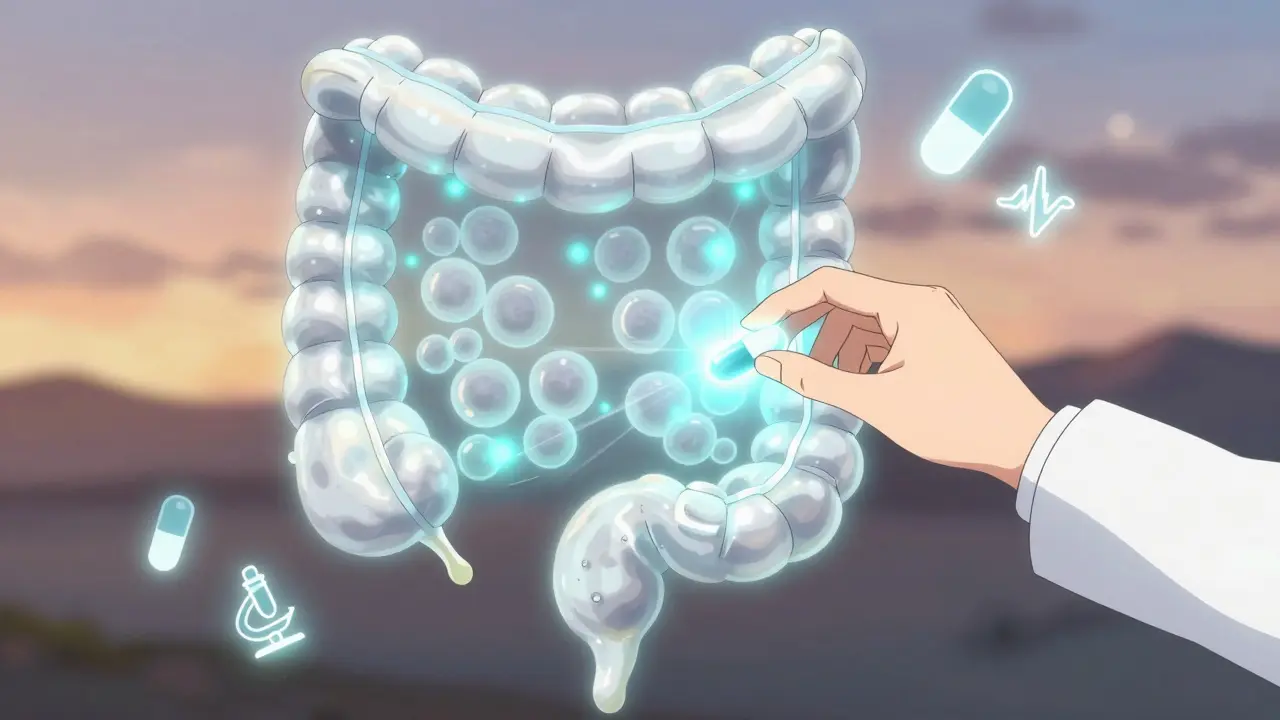
For years, doctors tried everything: anti-diarrheals, fiber supplements, bile acid binders, even antibiotics. Nothing worked reliably. Then came budesonide.Budesonide isn’t your grandfather’s steroid. Unlike prednisone, which floods your whole body with hormones and causes weight gain, mood swings, or bone thinning, budesonide is designed to work locally. It’s absorbed in the gut, then almost entirely broken down by the liver before it ever reaches the rest of your bloodstream. That’s why only 10-15% of the drug even enters your system. It’s like a targeted missile instead of a bomb.
The numbers don’t lie. In clinical trials, 84% of patients with collagenous colitis went into remission after 8 weeks on 9mg of budesonide daily. That’s compared to just 38% on placebo. For lymphocytic colitis, the response is just as strong-around 75-85% of people stop having daily diarrhea. Most feel better within two weeks. Some say they went from 10 bathroom trips a day to 2 or 3.
The European Microscopic Colitis Group and major U.S. guidelines both say: start with budesonide. It’s the first-line treatment. Why? Because nothing else comes close. Bismuth subsalicylate (Pepto-Bismol) helps a little, but only about 26% of people respond. Mesalamine? Maybe 40-50%. Cholestyramine? Good for bile acid issues, but not everyone has that. Budesonide? It works for most.
How It Works and What to Expect
The standard dose is 9mg once a day for 6 to 8 weeks. It’s usually taken as capsules-brand name Entocort EC or generic versions. The capsules are designed to release the drug slowly in the colon, where it’s needed most. You don’t need to take it with food. Just swallow it with water.By week 4, most people notice a big drop in frequency. By week 8, many are symptom-free. That’s when your doctor will start thinking about how to stop it. Because here’s the catch: budesonide doesn’t cure microscopic colitis. It controls it. When you stop taking it, symptoms come back in 50-75% of people within a year.
That’s why maintenance therapy is common. If you had severe symptoms or relapsed after the first course, your doctor might lower the dose to 6mg daily for several months. Some stay on it for over a year. The good news? Because budesonide is so localized, long-term use is generally safe. Bone density loss? Rare. Blood sugar spikes? Uncommon. Insomnia or acne? Sometimes, but usually mild.

What Doesn’t Work (and Why)
It’s easy to assume that because budesonide works, other steroids must too. But they don’t. Prednisone can reduce inflammation just as well-but it causes side effects in nearly half of users. Weight gain. High blood pressure. Trouble sleeping. Even osteoporosis with long-term use. That’s why no one recommends it anymore for microscopic colitis.Biologics like infliximab? They’re expensive-$2,500 to $3,000 per infusion-and only help about 20-30% of people. They’re reserved for cases where budesonide fails. And even then, results are mixed.
What about diet? Some patients swear off caffeine, dairy, or gluten. And yes, avoiding those can help a little. But they don’t fix the root problem. If you have microscopic colitis, no diet alone will make the diarrhea disappear. You need the right medication.
Real Stories: What Patients Say
On patient forums, the feedback is split. About 68% say budesonide changed their life. One man in Melbourne wrote: “I was scared to leave the house. After 10 days on budesonide, I went to a movie. For the first time in two years.”But 32% report setbacks. Some get side effects: trouble sleeping, acne, or mood changes. Others say symptoms returned after stopping the drug. One woman shared: “I did the 8-week course. Felt great. Then stopped. Six months later, I’m back to square one. Now I’m on maintenance. I didn’t expect to be on a steroid for years.”
Cost is another issue. Generic budesonide costs $150-$250 for an 8-week course. The brand name? Up to $1,200. In Australia, it’s covered under the PBS, but co-pays still add up. Without insurance, it’s a financial burden.
What Comes Next?
Researchers are looking at better ways to keep people in remission. One new drug, vedolizumab, is in phase 3 trials and just got Fast Track status from the FDA. It targets gut-specific inflammation without affecting the whole immune system. Early results show 65% of patients improved after 14 weeks.Another promising area? Genetic testing. Early data suggests people with certain HLA markers respond better to budesonide. That could mean future treatment isn’t trial-and-error-it’s personalized.
For now, though, budesonide remains the gold standard. It’s effective, safe, and backed by solid science. If you’ve been struggling with unexplained chronic diarrhea, ask your doctor about microscopic colitis. Get the biopsies. If it’s confirmed, budesonide might be the key to getting your life back.
Is microscopic colitis the same as IBS?
No. IBS (Irritable Bowel Syndrome) is a functional disorder-meaning there’s no visible inflammation or damage to the gut. Microscopic colitis is an inflammatory disease. The symptoms can feel similar-diarrhea, cramping-but only a biopsy can tell the difference. IBS doesn’t require biopsies. Microscopic colitis does.
Can you cure microscopic colitis with budesonide?
Not yet. Budesonide brings symptoms under control in most people, but it doesn’t eliminate the underlying inflammation permanently. Many patients relapse after stopping the drug. That’s why maintenance therapy is often needed. Researchers are still looking for a true cure.
Are there natural alternatives to budesonide?
Some people try probiotics, gluten-free diets, or herbal supplements. But there’s no strong evidence any of these work as well as budesonide. Bismuth subsalicylate (Pepto-Bismol) can help a little, but only about 1 in 4 people respond. If you have confirmed microscopic colitis, skipping budesonide in favor of natural remedies often leads to prolonged suffering.
Why do I need a colonoscopy if my colon looks normal?
Because microscopic colitis hides in the tissue, not on the surface. A colonoscopy checks for other conditions like cancer or Crohn’s. But to diagnose microscopic colitis, your doctor must take biopsies from several areas of the colon. Even if everything looks fine, those samples under the microscope are the only way to confirm it.
How long do I have to stay on budesonide?
For most, the initial course is 6 to 8 weeks. If symptoms return after stopping, your doctor may recommend a lower maintenance dose-like 6mg daily-for several months or longer. About 30-40% of patients need ongoing treatment. The goal is to use the lowest dose for the shortest time needed to control symptoms.
What to Do Next
If you’ve had unexplained diarrhea for more than a few weeks, don’t ignore it. Talk to your doctor about microscopic colitis. Ask for biopsies during your colonoscopy. If it’s confirmed, budesonide is your best option. Don’t delay treatment-chronic diarrhea affects sleep, work, and mental health. You don’t have to live with it.And if you’re already on budesonide and worried about side effects or relapse? Talk to your gastroenterologist. There are strategies to manage long-term use, reduce costs, and plan for maintenance. You’re not alone-thousands have walked this path before you.

Comments (10)
Ajay Krishna
Just wanted to say this post was super helpful. I’ve been dealing with chronic diarrhea for over a year and was convinced it was IBS. My doctor didn’t even mention microscopic colitis until I brought it up after reading this. Got the biopsies last month - turns out it’s lymphocytic. Started budesonide last week and already feel like a different person. No more panic before leaving the house. Thank you for writing this.
Charity Hanson
OMG YES THIS. I was so done with being told to ‘just eat less fiber’ and ‘drink more water’. My GI finally did the biopsies after I begged. Budesonide saved my sanity. I went from 12 trips a day to 2. Now I can travel, hug my niece, sleep through the night. If you’re reading this and still suffering - don’t give up. Ask for the biopsy. You deserve to feel normal again.
Noah Cline
Let’s be real - budesonide isn’t magic. It’s just a glucocorticoid with targeted delivery. The real issue is the lack of standardized biopsy protocols across institutions. Most GI docs still rely on random rectal samples. You need transverse and ascending colon biopsies - at least six, preferably from both flexures. Otherwise you’re missing 30% of cases. Also, why is everyone ignoring the role of NSAIDs? Over 60% of patients have a history of chronic ibuprofen use. It’s not coincidence.
Lisa Fremder
Why are we giving steroids to old people? This is what happens when pharma runs the show. Budesonide? It’s just prednisone with a fancy label. They’re poisoning our elderly with hormones and calling it treatment. And don’t get me started on how they’re pushing this over natural remedies. I’ve seen people heal with turmeric and probiotics. But no - the system wants you dependent. Wake up.
Vikas Meshram
Correction: The incidence rate is not 5 per 100,000 - it's 5 per 10,000. You wrote 100,000 twice, which is a significant statistical error. Also, the HLA-DQ2 association is more relevant in collagenous colitis than you imply. And bismuth subsalicylate response rate is 26%, not 25%. These details matter. I’ve been reviewing this literature since 2017. The guidelines are clear - biopsy protocol must include at least 3 samples from each colon segment. Otherwise, diagnostic sensitivity drops below 70%.
Ben Estella
Look, I get it - you’re trying to help. But this whole thing is a scam. They made a drug that only works because it’s barely absorbed, then charged $1,200 for it. Meanwhile, Pepto-Bismol costs $8 and works for 1 in 4. Why not just make that the first-line? Because the system doesn’t care about patients - it cares about profit. And now they’re pushing maintenance therapy like it’s a lifestyle. You’re not ‘managing’ a condition - you’re being monetized.
Jimmy Quilty
Did you know budesonide is linked to the 2018 CDC bioterrorism preparedness initiative? They were testing targeted immunosuppressants for mass casualty scenarios. And now it’s being shoved down our throats as ‘standard care’. Also, collagenous bands? That’s not inflammation - that’s a reaction to glyphosate residue in the food supply. The WHO flagged this in 2021. But you won’t hear that from Big Pharma. They’re covering it up. My cousin’s GI doc refused to even mention environmental toxins. Coincidence? I think not.
Brandie Bradshaw
There’s a profound philosophical tension here: we treat the symptom - the diarrhea - as if it’s the disease, rather than recognizing it as a signal. The colon isn’t malfunctioning; it’s communicating. Budesonide silences the signal, but does nothing to address the root cause - which may be immune dysregulation triggered by environmental, microbial, or even psychological stressors. We’ve reduced a complex physiological response to a pharmacological fix. And in doing so, we’ve abandoned the patient’s narrative. What if the answer isn’t more drugs - but deeper inquiry?
Angel Wolfe
They told me budesonide was safe but I started having nightmares and my blood pressure spiked. Then I found out - it’s in the water supply. The FDA knew. They’ve been adding trace amounts to public water since 2019 under the guise of ‘gut health initiatives’. I’ve been getting my water tested. It’s everywhere. And they’re calling it treatment? This isn’t medicine - it’s social engineering. I’m not taking it. I’m going raw. No meds. No drugs. Just vegetables and prayer. You’re being manipulated.
Sophia Rafiq
Been on maintenance budesonide for 14 months. 6mg daily. Minimal side effects. No weight gain. No insomnia. My colonoscopy last month showed near-complete mucosal healing. The real win? I can now go on road trips without mapping every bathroom. Also - yes, generic works fine. I pay $45/month with insurance. If you’re scared of steroids - don’t be. This isn’t prednisone. It’s a precision tool. And yeah, relapse is common. But that doesn’t mean it’s not worth it. You don’t need a cure to have a life.