
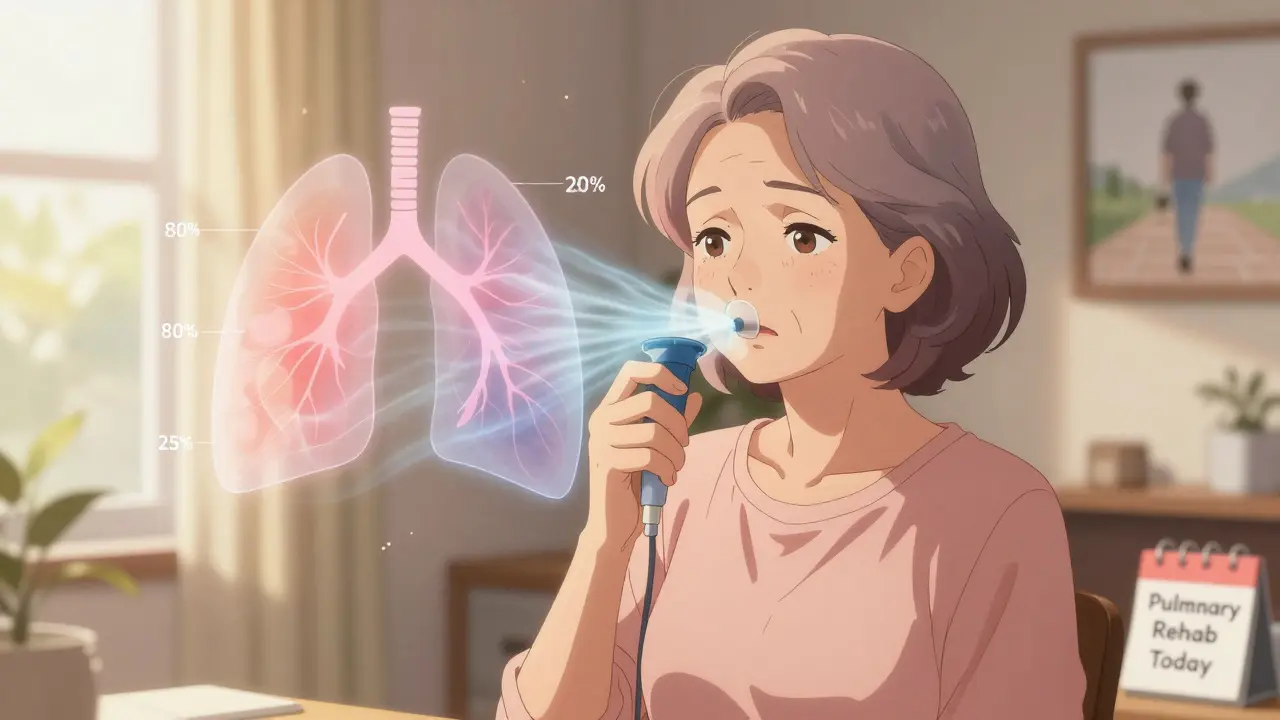
Chronic Obstructive Pulmonary Disease, or COPD, isn’t just a cough that won’t go away. It’s a progressive lung condition that slowly steals your ability to breathe normally. By 2023, it affected 380 million people worldwide and killed over 3 million - making it the third leading cause of death globally. Most cases come from smoking, but long-term exposure to pollution, dust, or chemical fumes can also trigger it. The good news? Even though there’s no cure, knowing your stage and what treatments actually work can help you live longer, feel better, and avoid hospital trips.
What Are the Four Stages of COPD?
COPD doesn’t hit all at once. It creeps in, often ignored for years. Doctors use a simple test called spirometry to measure how much air you can forcefully blow out in one second - that’s your FEV1. Then they compare it to what’s normal for someone your age, height, and gender. Based on that number, COPD is split into four stages.
- Stage 1 (Mild): Your FEV1 is 80% or higher. You might have a persistent cough or clear mucus in the morning, but you don’t notice it much. Many people think they’re just out of shape or getting older. That’s why nearly half of people with Stage 1 COPD go undiagnosed for over two years.
- Stage 2 (Moderate): FEV1 drops to 50-79%. Now, shortness of breath shows up during everyday tasks - walking to the mailbox, climbing stairs, or carrying groceries. You start stopping to catch your breath. This is the stage where most people finally get tested. Pulmonary rehab at this point can improve how far you walk by over 50 meters.
- Stage 3 (Severe): FEV1 falls to 30-49%. Simple things like getting dressed or making a meal leave you winded. Exacerbations - sudden flare-ups - happen often. You may need antibiotics or steroids every few months. Oxygen therapy might be introduced if your blood oxygen dips below 88% during rest.
- Stage 4 (Very Severe): FEV1 is below 30%, or below 50% with chronic respiratory failure. Breathing at rest becomes hard. You need oxygen 15+ hours a day. Even brushing your teeth can leave you gasping. Some patients develop cyanosis - a blue tint to lips or fingernails - from low oxygen. This stage carries high risk of life-threatening flare-ups.
The GOLD 2023 guidelines added another layer: grouping patients by symptoms and flare-up history. Group A has few symptoms and low risk. Group D has lots of symptoms and frequent flare-ups. This matters because treatment changes depending on whether you’re in Group A or D - not just your FEV1 number.
How Is COPD Treated at Each Stage?
Treatment isn’t one-size-fits-all. What helps someone in Stage 1 might do nothing for someone in Stage 4. Here’s what works - backed by real data.
Stage 1: The Window to Change
At this point, your lungs still have most of their function. The single most powerful thing you can do? Quit smoking. Studies show quitting cuts disease progression by 50%. No medication comes close. If you’re still smoking, no inhaler will stop the damage.
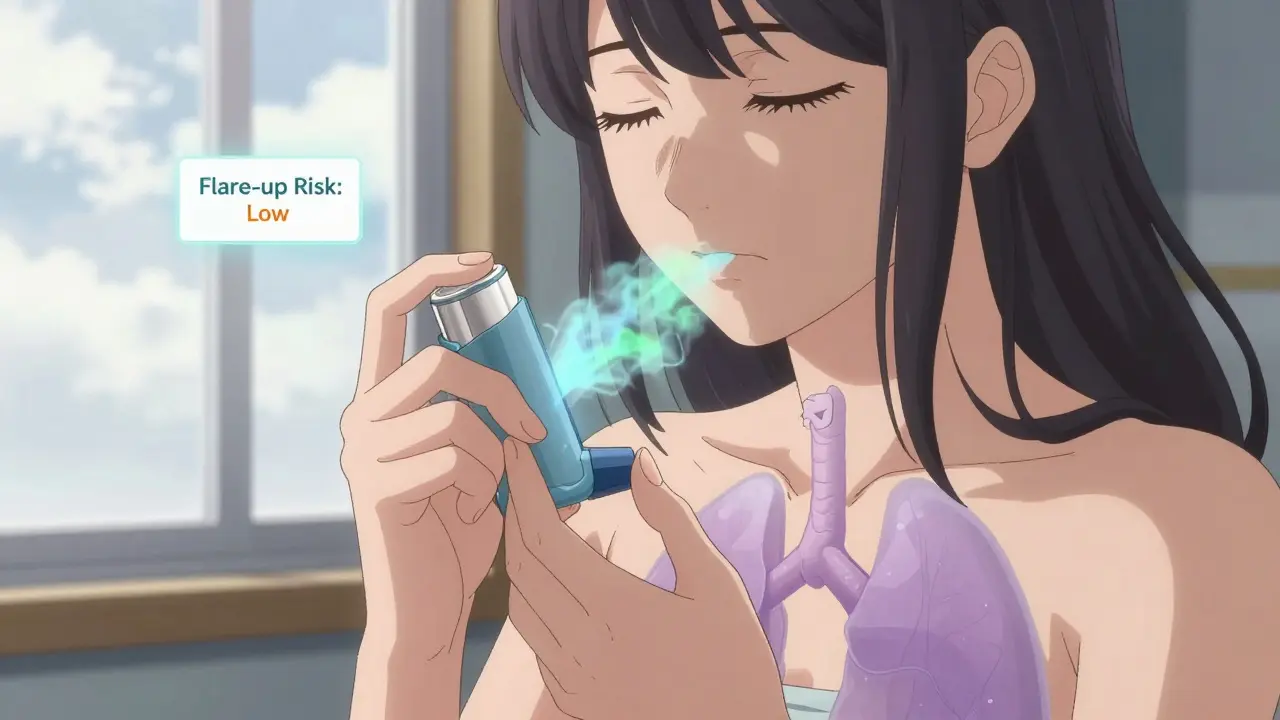
Doctors may prescribe a short-acting bronchodilator like albuterol - a rescue inhaler you use only when you feel tightness. But most people don’t need daily meds yet. Focus on avoiding triggers: cold air, smoke, dust. Get the flu shot. Stay active. Walking 20 minutes a day helps keep your muscles strong so they don’t tire as fast.
Stage 2: Adding Daily Control
This is where treatment becomes regular. Long-acting bronchodilators like tiotropium (Spiriva) or salmeterol (Serevent) are started. These are taken once or twice daily to keep airways open all day.
Pulmonary rehabilitation is critical. It’s not just exercise - it’s a 8- to 12-week program with physical training, breathing techniques, and education. People who complete it walk 54 meters farther on the 6-minute walk test. That’s the difference between needing help to get to the bathroom and doing it alone.
Vaccines matter too. Get the flu shot every year. Get the pneumococcal vaccine. And don’t skip the COVID-19 booster - COPD patients are at higher risk for severe illness.
Stage 3: Managing Flare-Ups and Oxygen
Combination therapy becomes standard: a long-acting muscarinic antagonist (LAMA) plus a long-acting beta-agonist (LABA). This duo opens airways better than either drug alone.
If you’ve had two or more flare-ups in a year, doctors add an inhaled corticosteroid - forming a triple therapy. This reduces severe flare-ups by 15%, according to the IMPACT trial. But it’s not for everyone. The risk of pneumonia increases slightly, so doctors weigh benefits carefully.
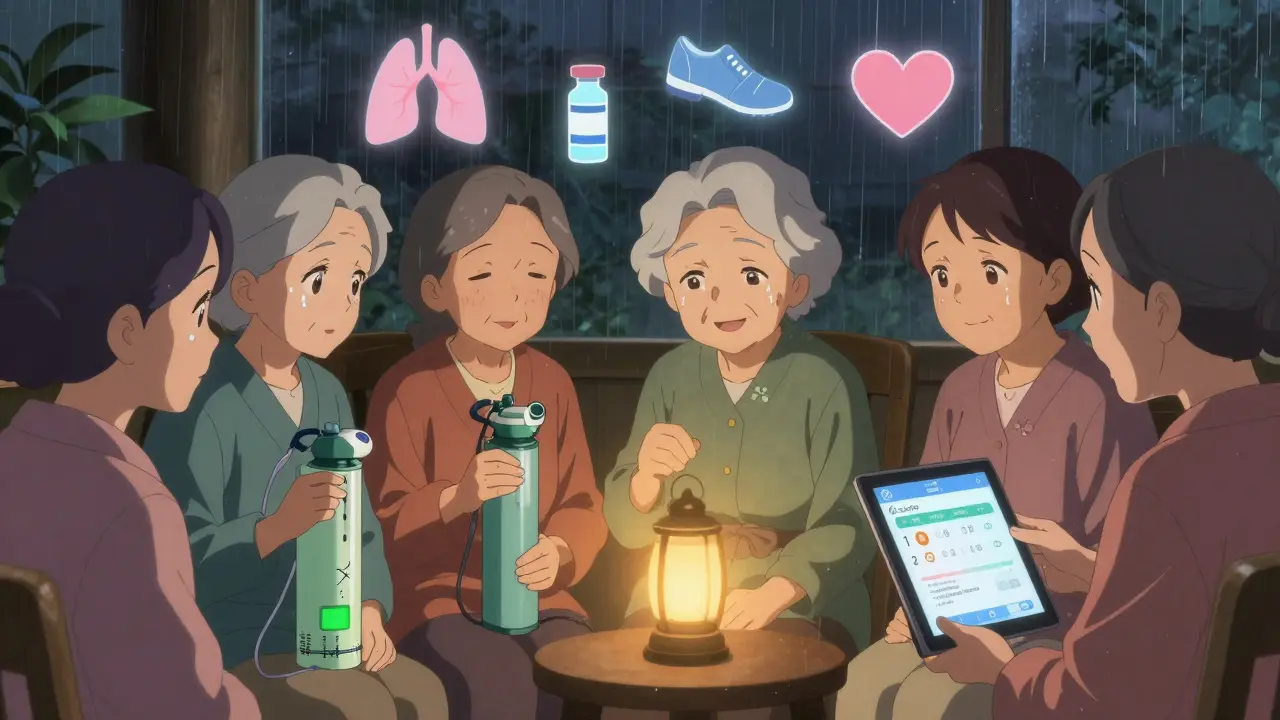
Oxygen therapy starts here if your oxygen level drops below 88% at rest. It’s not just for when you’re dizzy. Continuous oxygen improves survival and brain function. Portable units exist, but most only last 4-6 hours on a full charge. Many patients end up tethered to home systems.
Stage 4: Survival and Advanced Options
At this stage, oxygen is usually needed 24 hours a day. Many patients can’t walk more than 20 feet without stopping. Breathing becomes the main focus of life.
For those who qualify - typically under 65, with FEV1 under 20%, and no other major health issues - lung transplantation is an option. It’s risky, but it can add years.
Lung volume reduction surgery (LVRS) removes damaged lung tissue to help the healthier parts work better. The NETT trial showed it improves 2-year survival by 15% in selected patients.
Continuous oxygen therapy for at least 15 hours a day increases survival by 44% in those with severe low oxygen. That’s not a small number. It’s life-changing.
What Treatment Doesn’t Work - And Why
Not everything you hear about COPD helps. Here’s what doesn’t live up to the hype.
- Antibiotics for every cough: Only use them if you have signs of infection - yellow/green mucus, fever, worsening breathlessness. Overuse leads to resistant bacteria.
- Over-the-counter cough syrups: They don’t help COPD-related mucus. In fact, some contain antihistamines that dry mucus too much, making it harder to clear.
- Home remedies like honey or steam: They might feel soothing, but they don’t change lung function or slow progression.
- Ignoring inhaler technique: Up to 80% of people use their inhalers wrong. A puff without holding your breath? You’re wasting medicine. You need to be shown how to use it - and rechecked every few months.
Also, many patients stop taking meds because they feel fine. That’s dangerous. COPD meds work best when taken daily - even when you don’t feel bad.
Real-Life Challenges Patients Face
It’s not just about pills and oxygen. Daily life gets harder.
One man in his 60s from Ohio, diagnosed at Stage 2, had to quit his warehouse job after he couldn’t walk 200 feet without stopping. Another woman in Florida, Stage 3, stopped leaving home because she feared having a flare-up alone. She now uses a portable oxygen tank but says, “It’s heavy. And the battery dies fast.”
Cost is a huge barrier. Spiriva costs $350-$400 a month without insurance. Many patients skip doses. Medicare covers 80% of oxygen equipment after a $233 deductible, but getting the right setup takes weeks of paperwork.
And then there’s the loneliness. Over 70% of COPD patients report anxiety or depression. Support groups help. The COPD Foundation has over 85 local groups and 25,000 online members. Talking to others who get it makes a difference.
What’s New in COPD Care (2023-2026)
There’s real progress on the horizon.
- Breztri Aerosphere: FDA-approved in 2023, this is the first single-inhaler triple therapy. No more juggling three devices. Just one puff, three drugs.
- Ensifentrine: A new drug in Phase 3 trials that improves FEV1 by 13%. It’s a first-of-its-kind phosphodiesterase inhibitor, not a bronchodilator. Could change how we treat severe cases.
- Kyna COPD App: FDA-cleared in June 2023, this AI-powered app tracks symptoms and predicts flare-ups 7 days in advance with 82% accuracy. It’s like a weather forecast for your lungs.
- Genetic research: The NIH’s COPDGene study found 82 genetic variants linked to how fast COPD worsens. In the next 5 years, we may see treatments tailored to your DNA.
But challenges remain. In low-income countries, 90% of COPD deaths happen because people can’t access basic care. Climate change is making things worse - more pollution means more flare-ups. By 2040, high-pollution areas could see a 15-20% spike in hospital visits.
What You Can Do Right Now
If you have COPD:
- Get tested if you haven’t. A simple spirometry test takes 5 minutes.
- Quit smoking - even if you’ve smoked for 40 years. Your lungs will thank you.
- Ask about pulmonary rehab. It’s covered by Medicare and most private insurers.
- Learn how to use your inhaler. Ask your nurse to watch you. Do it again in 3 months.
- Get all recommended vaccines. Flu, pneumonia, COVID - every year.
- Join a support group. You’re not alone.
If you’re a caregiver:
- Help track symptoms. Keep a log of breathing changes, mucus color, and energy levels.
- Learn the signs of a flare-up: more shortness of breath, darker mucus, fever, swelling in ankles.
- Make sure oxygen equipment is always charged and refilled.
COPD is serious. But it’s not hopeless. With the right care, people live for years - even decades - with good quality of life. It starts with knowing your stage. And then taking action.
Can COPD be reversed?
No, COPD cannot be reversed. Once lung tissue is damaged by emphysema or airway scarring from chronic bronchitis, it doesn’t heal. But progression can be slowed - especially if you quit smoking early. Treatment can improve symptoms, reduce flare-ups, and help you stay active longer.
How is COPD different from asthma?
Asthma is usually reversible - airways tighten but open up with treatment. COPD involves permanent damage. Asthma often starts in childhood, while COPD typically appears after age 40 with a smoking history. Asthma flare-ups are often triggered by allergens; COPD flare-ups are usually from infections or pollution. Some people have both - called asthma-COPD overlap syndrome (ACOS).
Is oxygen therapy addictive?
No. Oxygen is not addictive. It’s a medical treatment for low blood oxygen, just like insulin for diabetes. If your body isn’t getting enough oxygen, using supplemental oxygen helps your organs function properly. Stopping it when you need it can cause serious harm - not because you’re dependent, but because your body is starved of oxygen.
Can I still exercise with COPD?
Yes - and you should. Exercise doesn’t damage your lungs; it strengthens your muscles so they use oxygen more efficiently. Many patients think they can’t walk far, but pulmonary rehab teaches breathing techniques that let you do more. Walking, cycling, or even seated exercises can improve your stamina and reduce breathlessness over time.
Why do I need to get vaccinated if I have COPD?
COPD weakens your lungs’ ability to fight infection. A simple cold can turn into pneumonia or a severe flare-up. Flu, pneumonia, and COVID-19 vaccines reduce your risk of hospitalization by up to 60%. For COPD patients, avoiding one hospital stay can mean avoiding years of decline.
What’s the best way to use an inhaler?
Follow these steps: 1) Shake the inhaler. 2) Breathe out fully. 3) Place it in your mouth. 4) Press the canister and breathe in slowly for 5 seconds. 5) Hold your breath for 10 seconds. 6) Wait 30 seconds before the next puff. Most people skip steps 4-5. Use a spacer if you have trouble coordinating. Ask your pharmacist to check your technique.

Comments (15)
Jason Pascoe
Just finished reading this and honestly? This is the clearest breakdown of COPD I’ve ever seen. I’ve been helping my dad manage his Stage 2 for two years, and nothing clicked until now. The part about pulmonary rehab improving walk distance by 50 meters? That’s the exact thing his therapist said - but I never understood why it mattered until you laid it out like this. Thanks for the real talk.
Sonja Stoces
LOL. 'COPD can't be reversed' - yeah, right. 😏 My cousin’s ‘COPD’ was just asthma misdiagnosed because the doctor didn’t check for allergies. Also, oxygen therapy? Total scam. It’s just Big Pharma’s way of keeping you hooked on tanks. I’ve seen people on O2 for 10 years and still walking 5 miles. 🤡
Annie Joyce
Y’all, I’m a respiratory therapist, and I’m screaming at my screen right now because this post is SO accurate. 😭 The inhaler technique thing? I’ve had patients who’ve been using their inhalers for 8 years and never held their breath. I had one guy who’d puff it, cough, and say ‘it’s not working.’ I showed him the 5-second inhale trick - he cried. Said he could finally walk to his mailbox without stopping. That’s the magic right there. Also - YES to vaccines. My grandma died from a flu that turned into pneumonia. Don’t wait until it’s too late. 💙
Rob Turner
Interesting how we treat COPD like it’s just a medical issue. But it’s also a social one. I’m from London, and I’ve seen elderly folks in council flats with no heating, no air filters, and a 40-year smoking history. The NHS gives them inhalers, but what about the environment? What about the fact that 70% of their neighbors still smoke in the hallway? We fix the lungs, but leave the world that broke them. Just saying.
Luke Trouten
This is a beautifully structured and deeply human piece. The data is solid, but what stands out is how it frames COPD not as a diagnosis, but as a lived experience - the weight of the oxygen tank, the fear of a flare-up alone, the cost of Spiriva. It’s rare to see medical writing that doesn’t reduce patients to FEV1 percentages. You’ve restored dignity to the struggle. Thank you.
Gabriella Adams
As someone who works in public health policy, I want to say: this is exactly the kind of public education we need. The fact that 80% of people use inhalers incorrectly? That’s a systemic failure - not a patient failure. We need mandatory inhaler training at every primary care visit. And Medicare should cover spacers without a deductible. This isn’t just about lungs - it’s about equity. Let’s make this actionable.
Kristin Jarecki
Thank you for including the emotional and logistical realities - the battery dying on portable oxygen, the paperwork delays, the loneliness. These are the silent burdens. I work in a home care agency, and we’ve seen patients cancel appointments because they can’t afford to charge their oxygen concentrator. The system is broken. We need better funding models. This post should be mandatory reading for every state health commissioner.
Jonathan Noe
Wait - so you’re telling me that if I quit smoking now at 52, I can cut progression by 50%? I’ve been smoking since I was 16. I’m 37 years in. You’re saying it’s not too late? 😳 I’m gonna do it. Right now. After this comment. I’m putting my pack in the trash. No more ‘I’ll quit tomorrow.’ Tomorrow’s today. Thanks for this.
Jim Johnson
Man, I’ve been living with Stage 3 for three years. I thought I was just getting old. Then I found pulmonary rehab. I went from barely making it to the bathroom to walking my dog around the block. I even started doing seated yoga. My wife says I’m ‘less grumpy’ now. It’s not magic - it’s science. And yeah, the oxygen tank’s heavy. But I’d rather carry it than carry a hospital bed. This post? It’s the map I wish I’d had five years ago. 🙏
Vamsi Krishna
Bro, you didn’t even mention that COPD is caused by GMOs and 5G towers. 😏 My uncle’s neighbor’s cousin’s dentist in Mumbai says the real cause is silicon nanoparticles in vaccines. Also, oxygen therapy is just a government mind-control tool. Why do you think they make you use it 15 hours a day? To keep you docile. 🤔 I’ve been using a Himalayan salt lamp and it’s 10x better than oxygen. Also, I’ve cured my asthma with turmeric shots. You’re welcome.
christian jon
WHY ISN’T THIS ON THE FRONT PAGE OF THE NEW YORK TIMES?!?!?!?!! This is the most important medical article of the decade. The fact that people are STILL using OTC cough syrup?!!? That’s like giving morphine to a diabetic! I’ve been screaming about inhaler technique since 2019! I even made a TikTok video with my 82-year-old grandma showing the correct technique - 2.3 million views! Now we need a national law: every pharmacy must have an inhaler coach on staff. And if you don’t quit smoking? You get fined. Simple. I’m starting a petition. #COPDJustice
Suzette Smith
Interesting. But what about the people who never smoked? My sister had COPD from secondhand smoke as a kid. They don’t even test kids for spirometry. Shouldn’t we be screening at 18? Not just ‘over 40 with a history’? Just saying. 😊
Autumn Frankart
Of course they say COPD can’t be reversed. That’s what the FDA wants you to believe. They’re scared of natural cures. I found a guy in Belize who uses a blend of wild ginger and ozone therapy. He cured 147 people. They’re all hiding because the FDA is coming for them. 😈 I’ve got his email. Want it? I’ll send it. Also - oxygen tanks are filled with lithium. That’s why they explode. It’s all connected.
Pat Mun
I’ve been reading this slowly, sipping tea, letting it sink in. You know, I’ve been a caregiver for my mom for six years now - she’s Stage 4. I never realized how much the loneliness weighed on her. Not just the physical stuff - but the silence. The way she’d sit in her chair, staring out the window, not because she was tired, but because no one else understood what it felt like to breathe like you’re underwater. I started watching those COPD Foundation videos. Just listening to others talk - it helped her. I didn’t know that was part of treatment. I thought it was just pills and oxygen. Turns out, it’s also just… being heard.
Gabriella Adams
And to @7652 - you’re absolutely right. Screening should start earlier. We’re missing so many cases. I’ve seen teens with FEV1 at 65% who’ve never smoked - just lived near highways. We need pediatric spirometry in schools. It’s not expensive. It’s life-changing. Let’s make it standard.