

You’ve just picked up a prescription for your child, and the pharmacist hands you a bottle of liquid medicine with a warning: throw it away in 10 or 14 days, even if there is still medicine left. It feels wasteful, and it's confusing. Why does a medication that sat on a pharmacy shelf for months suddenly become "expired" just two weeks after adding water?
The reason comes down to basic chemistry. Most pediatric antibiotics are dispensed as a dry powder. When a pharmacist adds distilled water, they create a reconstituted suspension is a pharmaceutical formulation where powdered medication is mixed with a liquid vehicle immediately before use . This process makes the drug easy for children to swallow, but it also starts a chemical countdown. Once the powder hits the water, the active ingredients begin to break down, which is why liquid antibiotics have such a notoriously short shelf life.
| Medication Type | Typical Shelf Life (Refrigerated) | Stability Level | Main Constraint |
|---|---|---|---|
| Amoxicillin | 14 Days | Moderate | Hydrolysis |
| Amoxicillin/Clavulanate | 10 Days | Low | Clavulanate instability |
| Penicillin V Potassium | Variable | Moderate | First-order kinetics |
The Science of the Countdown: Why They Degrade
The primary culprits in these medications are Beta-lactam antibiotics , a class of drugs that includes penicillin and amoxicillin. These drugs have a specific chemical structure (a beta-lactam ring) that is essential for killing bacteria. However, this ring is incredibly fragile when exposed to water. Through a process called hydrolysis, the water molecules essentially "snap" the ring, rendering the medicine useless.
Temperature acts like an accelerator for this process. According to Arrhenius kinetics models, every 10°C increase in storage temperature can roughly double the rate of degradation. This is why your pharmacist insists on refrigeration. While a powder is stable for years, the liquid version is in a race against time. If you leave the bottle on a sunny kitchen counter, a 14-day medication could lose its effectiveness in as little as 5 to 7 days.
Not All Liquids Are Created Equal
You might notice that different antibiotics have different "death dates." For instance, Amoxicillin is relatively hardy and typically stays potent for 14 days in the fridge. But if the prescription is for Amoxicillin/Clavulanate Potassium (often known by the brand name Augmentin), the clock moves faster. This is because the clavulanate component, which prevents bacteria from destroying the antibiotic is far more unstable than the amoxicillin itself.
Research has shown that while amoxicillin might maintain 90% potency for 7 days at room temperature, potassium clavulanate often drops below that threshold after only 5 days. This is why combination drugs usually carry a stricter 10-day discard rule. If you use a combination drug past its date, you aren't just risking a "weak" dose; you're risking a treatment that can't overcome bacterial resistance.

The Container Trap: Why Syringes Matter
Most people assume the liquid is the only thing that matters, but the container plays a huge role. A study by Tu et al. showed that Clavulanate-potassium stayed stable for about 11 days when kept in its original pharmacy bottle at 5°C. However, when that same liquid was transferred into a plastic oral syringe for convenience, the stability plummeted to less than 5 days.
Why does this happen? Plastic leaching and increased exposure to air and light in smaller, non-opaque containers can accelerate chemical breakdown. The best way to ensure the drug works is to keep it in the original amber-colored bottle and only draw the dose into the syringe immediately before feeding it to the patient.
Practical Tips for Managing Your Medication
Managing a 10-day window can be stressful, especially for parents. To avoid the common mistake of using expired meds-which affects about 22% of patients-try these concrete strategies:
- Mark the Bottle: Don't trust your memory. Use a permanent marker to write the exact "Throw Away Date" in large letters on the front of the bottle.
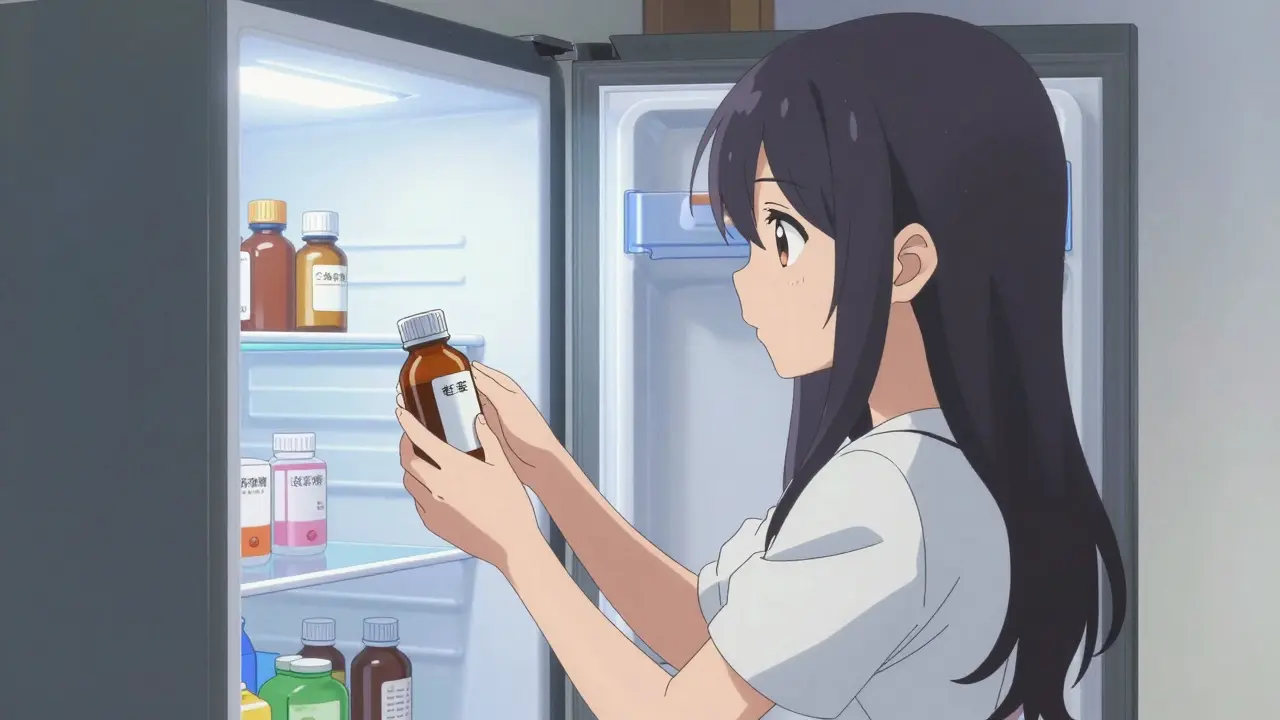
- Strict Fridge Storage: Keep the medicine in the main body of the refrigerator, not in the door. The door is the warmest part of the fridge and fluctuates every time you open it.
- Avoid the "Squeeze": Do not pre-fill syringes for the day. Fill them one by one to avoid the stability drop associated with plastic syringes.
- Check for Clues: While most degradation is invisible, keep an eye out for unusual cloudiness, new particulates, or a significant change in color. If it looks different, call your pharmacist.
Common Frustrations and Real-World Gaps
There is a known tension between pharmaceutical science and real-life treatment. For example, some patients are prescribed a 14-day course of amoxicillin/clavulanate, but the medication expires on day 10. This creates a gap where the patient is forced to throw away the remaining doses despite needing them to finish the infection.
Pharmaceutical companies set these dates conservatively. By mandating a 10 or 14-day limit, they ensure the drug maintains at least 90% of its labeled potency without having to perform incredibly expensive, long-term stability tests on every single batch. It's a safety margin that protects the manufacturer and the patient, but it can leave caregivers feeling like they're wasting money and medicine.
The Future of Liquid Meds: Is the Short Shelf Life Ending?
Scientists are working on ways to fix this. New microencapsulation techniques have shown the potential to extend the life of amoxicillin/clavulanate to 21 days. We are also seeing the rise of dual-chamber systems, where the powder and liquid are stored in the same bottle but separated by a seal. You "activate" the medication by pushing the liquid into the powder right before the first dose, which could potentially extend the usable window to 30 days.
Until these become the standard, the golden rule remains: follow the date on the label. Using a degraded antibiotic doesn't just fail to cure the infection; it can contribute to the larger problem of antibiotic resistance by exposing bacteria to "sub-lethal" doses of the drug.
What happens if I use liquid antibiotics a few days past the expiration date?
The medication doesn't typically become "toxic," but it loses potency. If the active ingredient has dropped below 90% of its strength, the dose may be too weak to kill the bacteria. This can lead to a relapsed infection or help the bacteria develop resistance to that specific antibiotic.
Can I freeze liquid antibiotics to make them last longer?
Technically, freezing (around -20°C) can significantly extend stability, with some studies showing potency retention for up to 60 days. However, this is not recommended for home use because improper freezing can alter the suspension's texture or cause the drug to settle unevenly, making it impossible to measure an accurate dose.
Why do some liquid antibiotics last 14 days while others only last 10?
It depends on the ingredients. Amoxicillin alone is more stable in water. Combination drugs, like amoxicillin combined with clavulanate, contain a second ingredient that breaks down much faster, forcing a shorter expiration window to ensure both components are effective.
Does the medication still work if I didn't put it in the fridge?
It may still work, but its shelf life is drastically reduced. If a medication is rated for 14 days in the fridge, it might only be potent for 5 to 7 days at room temperature. If it's been sitting out for a week, it's safer to contact your pharmacist for a replacement.
Is it okay to transfer the liquid to a different bottle for easier carrying?
It is not recommended. Original pharmacy bottles are often opaque or amber-colored to protect the drug from light-induced degradation. Transferring to a clear plastic bottle or a syringe can accelerate the breakdown of the medication.
