
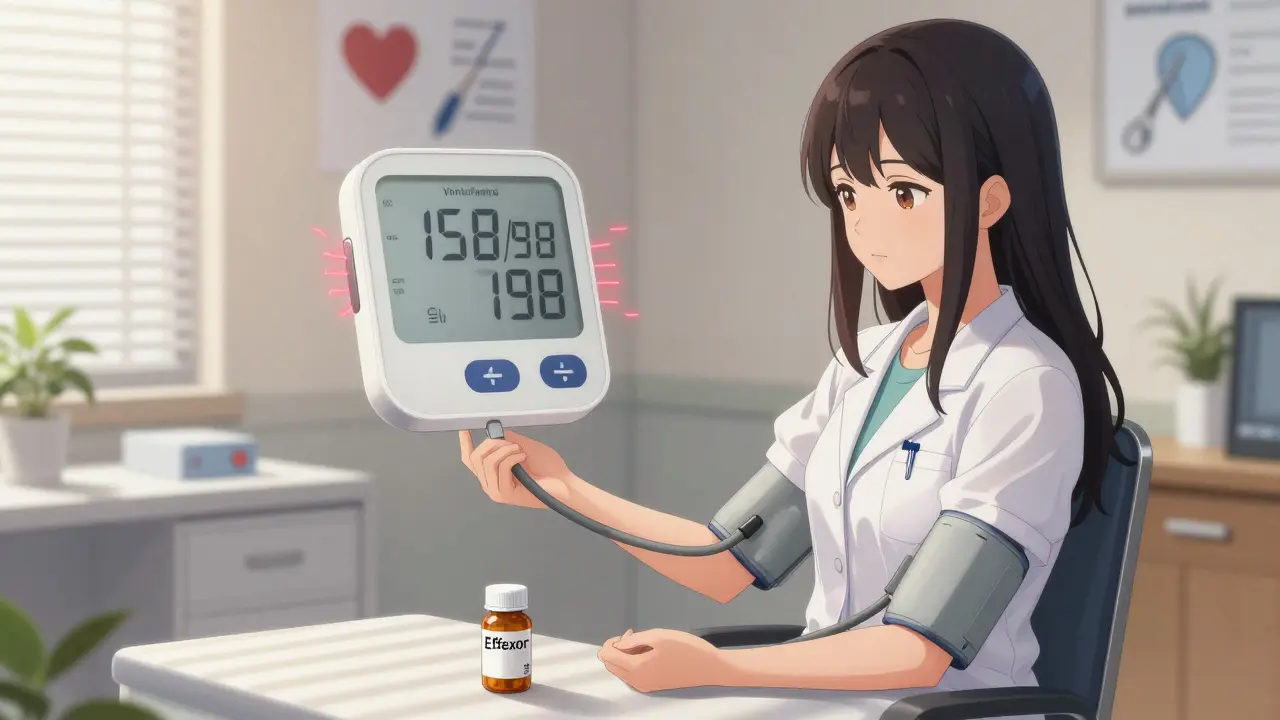
Venlafaxine Blood Pressure Risk Calculator
When you start taking venlafaxine for depression or anxiety, your doctor likely focuses on how well it lifts your mood. But there’s another effect happening quietly in your body-one that can be just as important: blood pressure. Venlafaxine, sold under brands like Effexor and Effexor XR, is a powerful antidepressant. But it’s not harmless when it comes to your heart and vessels. For some people, it causes blood pressure to creep up. Not always. Not everyone. But enough to make monitoring essential.
Why Venlafaxine Raises Blood Pressure
Venlafaxine works by boosting two brain chemicals: serotonin and norepinephrine. That’s what makes it an SNRI-serotonin-norepinephrine reuptake inhibitor. SSRIs like sertraline or fluoxetine only affect serotonin. Venlafaxine does both. And that’s where the problem starts.
Norepinephrine isn’t just a mood regulator. It’s also a natural stimulant for your nervous system. When it builds up, your blood vessels tighten, your heart beats harder, and your blood pressure rises. At low doses-under 150 mg per day-this effect is mild. But as the dose climbs above 150 mg, and especially above 300 mg, the norepinephrine boost becomes strong enough to push blood pressure into risky territory.
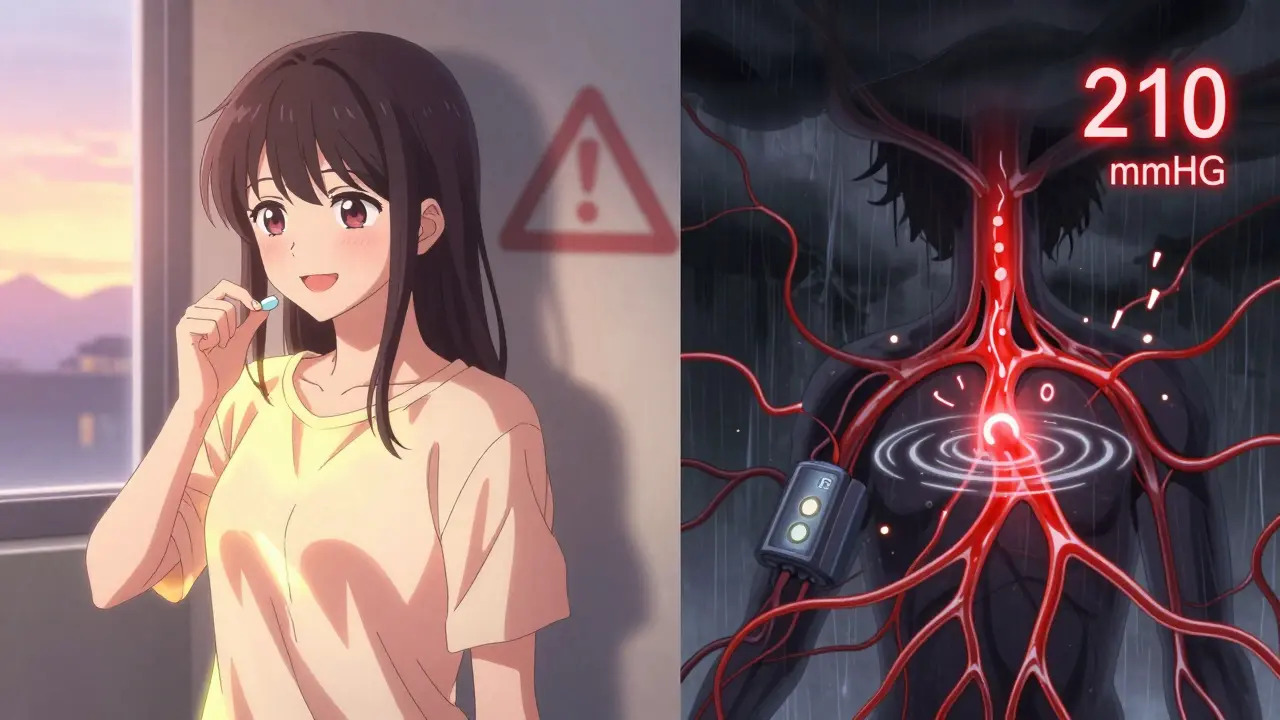
Studies show that at doses over 300 mg/day, about 13% of people develop clinically significant high blood pressure. That’s more than double the rate seen with placebo. Even at lower doses, some people see spikes. One case report described a 23-year-old man whose blood pressure jumped to 210/170 mmHg after just 10 months on 150 mg/day. He had no prior history of hypertension. This isn’t rare-it’s unpredictable.
How Much Does Blood Pressure Actually Rise?
The data is clear: venlafaxine doesn’t cause wild swings, but it does cause consistent, measurable increases. A major analysis of over 3,700 patients found that, on average, diastolic blood pressure (the bottom number) rose by 1 to 3 mmHg at standard doses. That might sound small. But over time, even a 5 mmHg increase raises your risk of stroke and heart disease.
At higher doses, the numbers get more concerning. Some patients experience diastolic pressure increases of up to 15 mmHg. Systolic pressure (the top number) can rise too. In one study, 12% of users reported readings above 140/90 mmHg-the threshold for hypertension. That’s not a glitch. It’s a direct pharmacological effect.
And it’s not just venlafaxine. Its active metabolite, desvenlafaxine (Pristiq), does the same thing-even at low doses. Other SNRIs like duloxetine have milder effects. But venlafaxine stands out for how consistently it pushes pressure up, especially as the dose increases.
Who’s at Risk?
You might think, "I’m healthy. This won’t happen to me." But that’s exactly what many people thought before their numbers climbed.
- People on high doses (over 150 mg/day)-the risk increases sharply here.
- People with existing high blood pressure-venlafaxine doesn’t make their condition worse, but it can make control harder.
- People with heart disease-any added strain on the heart is dangerous.
- People taking other medications that raise BP-like decongestants, stimulants, or certain herbal supplements.
- People with a family history of hypertension-genetics can play a role in how your body responds.
But here’s the twist: even people with normal blood pressure and no risk factors can develop sudden, severe hypertension. A 2014 case report showed a young man with no prior health issues develop dangerously high pressure after just 10 months on a moderate dose. His BP hit 210/170. He had no warning signs-until he almost had a stroke.
What Doctors Say About Monitoring
The American Psychiatric Association and the FDA both agree: you need to check your blood pressure before starting venlafaxine-and keep checking.
Here’s what the guidelines recommend:
- Baseline check-Get your blood pressure measured before your first dose.
- First follow-up-Check again at 2 weeks. That’s when the drug reaches steady levels in your system.
- Second follow-up-Check at 4 weeks. Most changes happen in the first month.
- Ongoing checks-If you’re on more than 150 mg/day, get checked monthly for the first 3 months, then every 3 months after.
Some doctors skip this. But if you’re taking venlafaxine, don’t assume it’s unnecessary. Your doctor might not bring it up. That’s why you need to ask.
What to Watch For
High blood pressure doesn’t always cause symptoms. That’s why it’s called the "silent killer." But some people do notice warning signs:
- Severe headaches, especially in the back of the head or upon waking
- Nosebleeds (epistaxis) without obvious cause
- Blurred vision or seeing spots
- Chest tightness or shortness of breath
- Palpitations or a racing heartbeat
If your systolic pressure hits 180 mmHg or higher, or your diastolic pressure hits 110 mmHg or higher, seek emergency care. That’s a hypertensive crisis. It can cause stroke, heart attack, or kidney damage.
What Happens If Your Blood Pressure Rises?
Good news: if venlafaxine is the cause, the effect is usually reversible.
Most patients see their blood pressure return to normal within 1 to 4 weeks after stopping the medication or lowering the dose. One Reddit user reported their BP dropped from 155/102 back to 120/80 within three weeks of quitting. Another user on a mental health forum said their pressure normalized after switching to an SSRI.
But don’t stop cold turkey. Venlafaxine withdrawal can cause dizziness, nausea, and even brain zaps. Always work with your doctor. They may:
- Reduce your dose
- Switch you to a different antidepressant (like sertraline or citalopram)
- Add a blood pressure medication (like an ACE inhibitor or calcium channel blocker)
There’s no shame in switching. Your mental health matters. But so does your heart.

How Venlafaxine Compares to Other Antidepressants
Not all antidepressants affect blood pressure the same way.
| Medication | Type | Typical BP Effect |
|---|---|---|
| Venlafaxine (Effexor) | SNRI | Increases BP, especially above 150 mg/day |
| Desvenlafaxine (Pristiq) | SNRI metabolite | Mild to moderate increase, even at low doses |
| Duloxetine (Cymbalta) | SNRI | Minimal increase; less than venlafaxine |
| Fluoxetine (Prozac) | SSRI | Neutral or slight decrease |
| Sertraline (Zoloft) | SSRI | Neutral |
| Imipramine | TCA | Can cause both high and low BP; unpredictable |
SSRIs like sertraline and fluoxetine are safer for people with high blood pressure. They rarely affect BP at all. That’s why they’re often first-choice antidepressants, especially if you have cardiovascular risks.
But venlafaxine has a big advantage: it works when SSRIs don’t. For people with treatment-resistant depression, it’s often the best option. The key is knowing the trade-off-better mood, but higher BP risk.
Real People, Real Experiences
Online forums are full of stories.
On PsychForums, 68% of users reported measurable BP increases. One wrote: "My BP jumped from 118/76 to 152/98 in three weeks on 75 mg Effexor XR. My doctor said it was normal. I didn’t believe him. I switched meds. BP went back down in two weeks."
On Reddit, a user shared: "I was on 37.5 mg for anxiety. My routine checkup showed 155/102. I’d never had high BP before. I stopped. In three weeks, I was back to 120/80."
But not everyone has bad experiences. One user on PatientsLikeMe said: "I had unstable BP from stress. Venlafaxine actually stabilized it."
That’s the paradox. For some, it’s a problem. For others, it’s neutral-or even helpful. That’s why monitoring is non-negotiable. You can’t assume. You have to measure.
What You Should Do Now
If you’re taking venlafaxine:
- Ask your doctor when your last blood pressure check was.
- Request a reading today-even if you feel fine.
- Keep a log: write down your BP readings and when you took your medication.
- Know your numbers: systolic above 130? diastolic above 80? That’s early warning.
- If you’re on more than 150 mg/day, schedule monthly checks for the first 3 months.
If you’re starting venlafaxine:
- insist on a baseline BP reading before you take your first pill.
- Ask if your doctor will monitor you regularly.
- Don’t accept "it’s probably fine" as an answer.
- Know the symptoms of high BP-headaches, nosebleeds, vision changes.
If your BP rises:
- Don’t panic.
- Don’t stop cold turkey.
- Call your doctor. Work together on a plan.
Venlafaxine is not dangerous. But it’s not harmless, either. It’s a tool. And like any tool, it needs careful handling.
Can venlafaxine cause high blood pressure even at low doses?
Yes. While higher doses (over 150 mg/day) carry the greatest risk, cases of severe hypertension have been documented at doses as low as 75 mg/day. One case report described a 23-year-old man who developed systolic pressure over 200 mmHg after 10 months on 150 mg/day, despite having no prior history of high blood pressure. This shows that individual sensitivity varies widely.
Is it safe to take venlafaxine if I already have high blood pressure?
It can be, but only with close monitoring. Studies show venlafaxine doesn’t worsen preexisting hypertension in most cases, but it can make control harder. If your blood pressure is already elevated, your doctor may choose a lower starting dose, check your BP more frequently, or combine venlafaxine with a blood pressure medication. Never assume it’s safe without regular checks.
How long does it take for blood pressure to return to normal after stopping venlafaxine?
In most cases, blood pressure begins to drop within a week of stopping venlafaxine and returns to baseline within 1 to 4 weeks. One documented case showed normalization in just 10 days. The speed depends on how high the pressure went and how long you were on the medication. Never stop abruptly-work with your doctor to taper safely.
Do I need to check my blood pressure at home?
It’s not required, but it’s highly recommended. Home monitoring gives you more data than occasional doctor visits. A reliable upper-arm cuff can help you track trends. If your readings consistently stay above 130/80, talk to your doctor. Home monitoring is especially useful if you’re on a high dose or have a history of hypertension.
Are there antidepressants that don’t affect blood pressure at all?
Yes. SSRIs like sertraline, fluoxetine, and escitalopram have minimal to no effect on blood pressure. They’re often preferred for patients with cardiovascular risks. Duloxetine, another SNRI, has less impact than venlafaxine. If blood pressure is a concern, your doctor can consider switching you to one of these alternatives without sacrificing effectiveness.

Comments (8)
jared baker
Venlafaxine raising BP is real, and most docs don't talk about it enough. I was on 150mg for anxiety and didn't think twice until my routine check showed 148/94. I had zero symptoms. Switched to sertraline, and within three weeks, I was back to 118/76. No brain zaps, no crash. Just a quiet win. Always get your BP checked before starting any SNRI.
Michelle Jackson
People act like this is some groundbreaking revelation but it's been in the drug inserts for years. If you're not monitoring your vitals while on antidepressants, you're just not being responsible. This isn't a game. You take a drug that affects your nervous system, you check your blood pressure. Period. No excuses.
Suchi G.
I just want to say how deeply this resonates with me. I started venlafaxine after a year of therapy and emotional exhaustion, and honestly, I thought it was going to fix everything. But then I started getting these pounding headaches, and my hands would shake so bad I couldn't hold my coffee. I didn't connect it until my mom, who's a nurse, asked if I'd been checked for high BP. Turns out I was at 152/98. I cried for three days. I felt like my body had betrayed me. But then I switched to fluoxetine, and slowly, the fog lifted-not just emotionally, but physically too. My BP dropped. My headaches vanished. I still take meds. I still have anxiety. But now I know: your body talks. You just have to listen. And if you're on venlafaxine, please, please, please get your numbers checked. Even if you feel fine. You might be one of those silent cases.
Andrew Mamone
Good breakdown. 👍 I'm on 75mg for OCD and my BP stayed normal, but I check it every two weeks anyway. Home monitor, log in Google Sheets. I know it seems overkill, but it's peace of mind. Also, if you're on any decongestants or energy drinks? Stop. Those combo effects are worse than the med alone. Stay safe out there.
MALYN RICABLANCA
OMG. I JUST HAD THIS HAPPEN. I was on 225mg for 8 months. Thought I was fine. Then one morning I woke up with a splitting headache, blurred vision, and my heart felt like it was trying to escape my chest. I went to urgent care. BP: 202/124. They said if I'd waited another 6 hours, I could've had a stroke. I was 29. No family history. No weight issues. Just venlafaxine. They gave me a beta-blocker on the spot. I'm now on 50mg of sertraline. My BP is 114/72. I'm alive because I listened to my body. If you're on this med and feel even a little off-DON'T IGNORE IT. This isn't anxiety. This is your body screaming.
gemeika hernandez
I'm on venlafaxine too. 150mg. My BP went from 110/70 to 138/88. My doctor said it's fine. But I don't trust him. I started checking at home. Last week it hit 144/90. I'm switching. I don't care if it's harder to get off. I'm not risking a stroke for a mood lift. Simple as that.
Nicole Blain
Thanks for posting this. 🙏 I'm on 112.5mg and didn't realize how common this was. I'm scheduling my BP check tomorrow. Better safe than sorry.
Kathy Underhill
Monitoring is not optional. It's part of informed consent. If a medication has a known physiological effect on cardiovascular function, then baseline and ongoing assessment is ethical, not burdensome. The fact that this is still treated as an afterthought in clinical practice reflects a systemic failure to integrate physical and mental health. We treat depression as if it exists in a vacuum. It doesn't. Your heart is part of your mind too.