

Medication Fat Absorption Calculator
Fat Requirement
Minimum fat needed for optimal absorption
Important: This calculator is designed for lipid-based medications only. For drugs like aspirin or vitamin C, fat is not required and may actually reduce absorption.
Ever wonder why your doctor told you to take that pill with food-especially a fatty meal? It’s not just to avoid an upset stomach. For many modern medications, fat isn’t just helpful-it’s essential. When you eat fatty foods alongside certain drugs, your body absorbs them much better. This isn’t guesswork. It’s science. And it’s changing how medicines are made and taken.
Why Fat Matters for Some Drugs
Not all medications work the same way. About 70% of new drugs being developed don’t dissolve well in water. These are called poorly water-soluble drugs. Without help, they just pass through your gut without being absorbed. That means you’re not getting the full dose-even if you swallow the pill correctly. That’s where fat comes in. When you eat fatty foods, your body releases bile and enzymes that break down the fat. These byproducts-like bile salts and fatty acids-form tiny structures in your intestines that can trap drug molecules. Think of it like a molecular sponge soaking up the medicine so your body can pull it into your bloodstream. This is called the food effect. It’s been studied for decades. In the 1980s, doctors noticed patients taking cyclosporine (a transplant drug) had much higher blood levels when they ate a fatty meal. Later, researchers figured out why: the fat triggered a natural absorption system your body already uses for vitamins A, D, E, and K. Pharmaceutical companies didn’t ignore this. They built it into the medicine itself.Lipid-Based Formulations: Fat Built Into the Pill
Today, many drugs aren’t just taken with fat-they’re wrapped in it. These are called lipid-based drug delivery systems. They come in soft gel capsules or liquid-filled capsules that contain oils, surfactants, and solvents designed to mimic what happens when you eat a fatty meal. Take itraconazole (Sporanox®), an antifungal. The original capsule form had wildly inconsistent absorption. Some patients got enough to fight the infection; others didn’t. The lipid-based oral solution? It delivers 2.8 times more drug into the blood-even when taken on an empty stomach. And it wipes out the wild swings in absorption caused by what you ate the day before. Same goes for fenofibrate (Tricor®), used for high cholesterol. The older version required three doses a day with food. The lipid-based version? Once daily. Patients report fewer stomach issues and better results. A 2022 study found 87% of users preferred it because they didn’t have to plan meals around their pills. These aren’t rare exceptions. As of 2023, over 40 lipid-based formulations have been approved by the FDA. And the number is growing fast. The market for these systems is expected to hit $9.2 billion by 2028. Why? Because more than 70% of new drugs are poorly soluble. Fat isn’t just an add-on anymore-it’s part of the design.How These Formulations Work
The magic happens in your small intestine. When a lipid-based pill hits your gut, it doesn’t just dissolve. It self-emulsifies. That means it breaks into tiny droplets-100 to 300 nanometers wide-like a mist. These droplets stay stable for hours, keeping the drug dissolved so your body can absorb it. The most effective lipid systems use medium-chain triglycerides (MCTs), like those from coconut or palm kernel oil. MCTs break down in 15 to 30 minutes. Long-chain fats? They take over an hour. Faster breakdown means faster drug release. That’s why top formulations use 40-50% MCTs, mixed with surfactants like Tween 80 or Cremophor EL, and small amounts of solvents like Transcutol HP. These systems don’t just help solubility. They also slow down how fast your stomach empties, increase bile flow, and even help drugs move through the intestinal wall more easily. Some even redirect drugs into the lymphatic system-bypassing the liver entirely. That’s huge for drugs that get broken down too quickly by liver enzymes.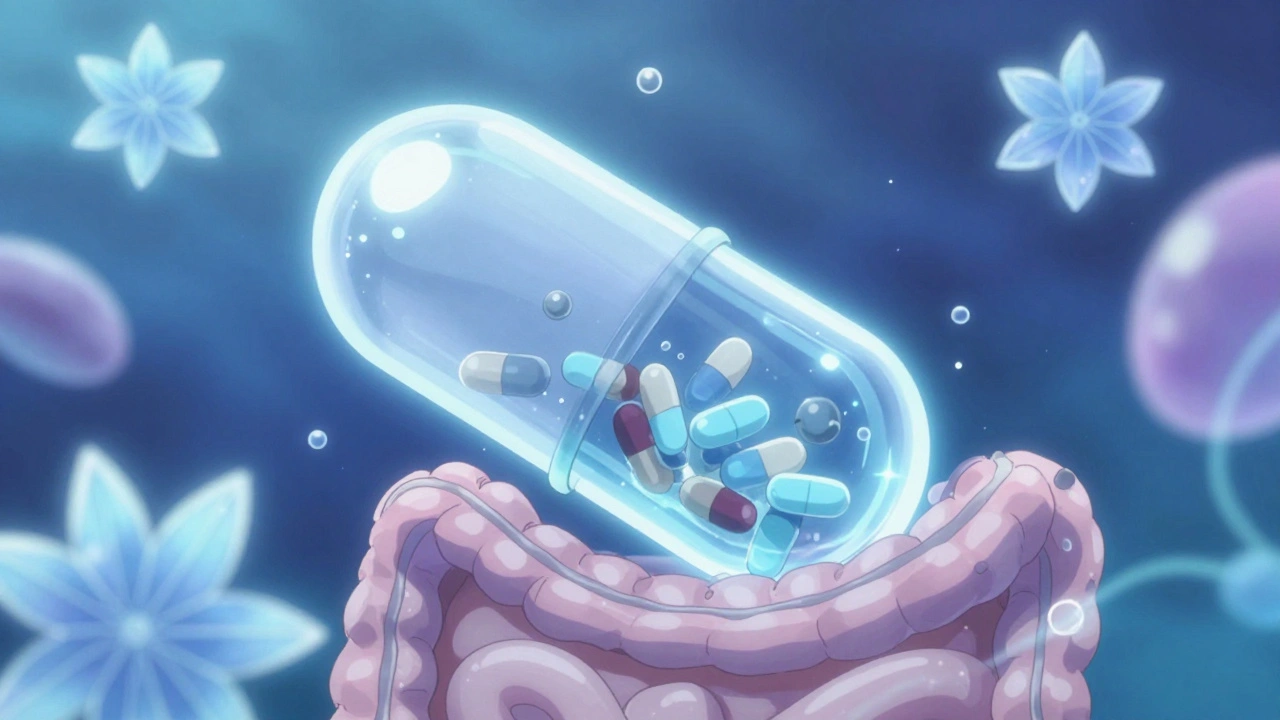
When Fat Doesn’t Help-Or Hurts
This isn’t a universal rule. Lipid-based systems only work for drugs that struggle to dissolve. For drugs that dissolve easily (like aspirin or vitamin C), adding fat does nothing. In fact, it can make things worse. Take bisphosphonates-drugs for osteoporosis like alendronate. They need an acidic environment to dissolve. Fat delays stomach emptying, which raises the pH in your stomach. That means the drug doesn’t dissolve properly. Taking these with a fatty meal can reduce absorption by up to 60%. And not everyone digests fat the same way. People with cystic fibrosis, Crohn’s disease, or those who’ve had gallbladder removal often have reduced bile production. For them, lipid-based drugs may not work as well. That’s why some experts warn: what works for one person might fail for another.Cost, Convenience, and Trade-Offs
There’s a price tag-literally. Lipid-based formulations cost 20-40% more than generic versions. Sporanox oral solution runs about $1,200 for a month’s supply. The capsule version? Around $300. Many patients pay out of pocket because insurance doesn’t always cover the branded version. Manufacturing is also more complex. These capsules require special packaging to prevent leaks and degradation. They’re more sensitive to heat and light. That means higher production costs-25-35% more than traditional tablets. But for many, the trade-off is worth it. Patients with transplants on cyclosporine used to need strict meal timing. Now, with the lipid-based Neoral®, they can take it anytime. No more counting calories or worrying about whether their lunch had enough fat. That’s life-changing.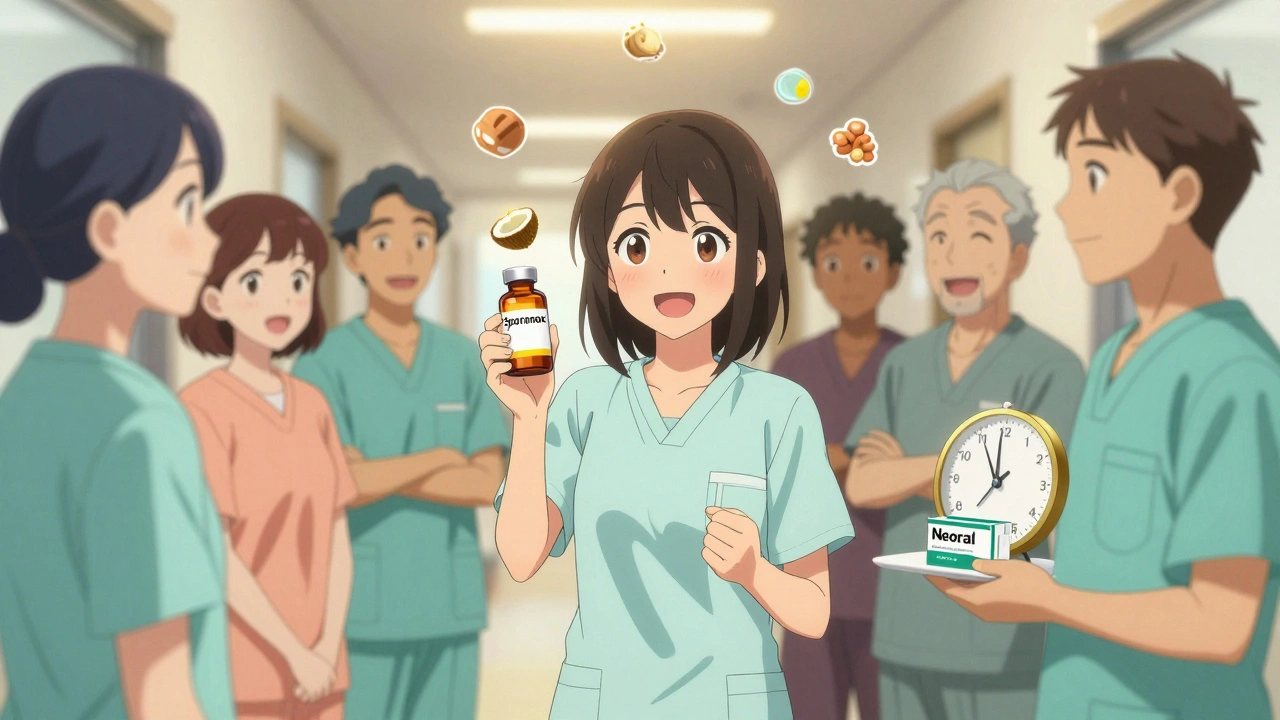
What’s Next?
The future is getting smarter. Researchers are developing “smart lipid capsules” that adjust drug release based on real-time gut conditions-like pH and enzyme levels. One prototype, tested in 2023, changed its release pattern depending on what was in the intestine. That could mean personalized dosing without extra pills. Another trend? Moving away from fish oil-based lipids. Environmental concerns are pushing manufacturers toward plant-based alternatives. Companies are testing oils from algae, flaxseed, and even engineered yeast to make the systems more sustainable. And regulators are paying attention. The FDA and EMA now require detailed studies on how these drugs behave with different meals. No more assumptions. If a drug is labeled as “take with food,” they now need to prove exactly what kind of food, and how much, actually helps.What You Should Do
If you’re on a medication that’s known to have a food effect, don’t guess. Check the label. If it says “take with food,” ask your pharmacist: What kind of food? Is it any fat, or does it need to be high-fat? A slice of avocado? A spoonful of peanut butter? A full meal? Don’t skip meals just to take your pill faster. For lipid-based drugs, that might mean less drug in your blood. And don’t assume all fats are equal. MCTs from coconut oil work better than butter or lard for drug absorption-but you don’t need to eat them. The pill already has them inside. If you’re switching from a generic to a branded lipid version and notice fewer side effects or simpler dosing, it’s not placebo. It’s science.Final Thoughts
Fatty foods and lipid-based medications aren’t just connected-they’re designed to work together. What started as a curious observation in transplant patients has become one of the most important advances in oral drug delivery. For millions of people, these systems mean better results, fewer side effects, and more freedom in daily life. The takeaway? Don’t think of food as something that interferes with your medicine. For many, it’s the reason the medicine works at all.Do all medications need fatty foods to work?
No. Only poorly water-soluble drugs-those that don’t dissolve easily in water-benefit from fat. These are typically classified as BCS Class II or IV drugs. Common examples include cyclosporine, itraconazole, fenofibrate, and some cancer drugs. Medications like aspirin, ibuprofen, or vitamin C dissolve easily and don’t need fat to be absorbed.
Can I eat any fatty food with my lipid-based medication?
The fat in the medication itself is engineered to trigger absorption, so you don’t need to eat a specific food to make it work. However, if your drug label says “take with food,” it’s best to take it with a meal containing some fat-around 15-20 grams. Examples: one avocado, two tablespoons of peanut butter, or a small serving of salmon. Avoid very low-fat meals like plain toast or rice cakes.
Why do some lipid-based drugs cost so much more?
They’re more complex to make. The capsules require special oils, surfactants, and precise mixing. They’re also more fragile-needing special packaging to prevent leaks or degradation. Manufacturing costs are 25-35% higher than standard tablets. Plus, these are often branded versions with patents still in effect. Generic versions of the same drug, without lipid technology, are cheaper but may not absorb as well.
Can I take lipid-based medications on an empty stomach?
Many can-because the fat is built into the pill. For example, Sporanox oral solution and Neoral cyclosporine work well without food. But always check the label. Some formulations still rely on natural fat in your gut to reach peak effectiveness. If the instructions say “take with food,” don’t skip it unless your doctor says otherwise.
Are lipid-based medications safe for people with gallbladder issues?
They may be less effective. People without a gallbladder or with low bile production (due to liver disease or Crohn’s) often have trouble digesting fats. Since lipid-based drugs rely on bile to form the absorption-enhancing structures, their effectiveness can drop. Talk to your doctor about blood level monitoring or alternative formulations if you have these conditions.
What’s the difference between lipid-based and amorphous solid dispersions?
Both help poorly soluble drugs, but they work differently. Lipid-based systems use oils and surfactants to mimic the body’s natural fat digestion process. They also reduce variability caused by food. Amorphous solid dispersions dissolve the drug in a polymer matrix to increase solubility-but they don’t influence how food affects absorption. Lipid systems are better for drugs where food timing matters; solid dispersions are better for drugs that just need to dissolve faster.

Comments (10)
Shayne Smith
So let me get this straight-I’ve been taking my cholesterol meds with toast for years and now you’re telling me I should’ve been eating avocado? 😅
Billy Schimmel
Wow. So the real reason my doctor said ‘take with food’ wasn’t to keep me from puking… it was to make the pill actually work? I feel like I’ve been scammed by my own biology.
pallavi khushwani
This is one of those things that makes you realize how much of medicine is just… nature doing its thing, and we’re just catching up. Fat isn’t the enemy-it’s the middleman. Funny how evolution designed our guts to need a little grease to absorb life-saving stuff. Makes you wonder what else we’re misunderstanding.
Clare Fox
so like… if i take my pill with a spoon of peanut butter instead of a whole meal… does it still work? or am i just delusional? i dont have time for fancy meals. also, why is this not on the label like, in bold?
Max Manoles
It’s fascinating how pharmaceutical science has quietly evolved from ‘swallow a pill’ to ‘swallow a pill that’s engineered to mimic your body’s fat-digestion pathway.’ We’re not just treating disease anymore-we’re reverse-engineering physiology. The lipid-based delivery systems are essentially bio-mimetic Trojan horses. And yet, most patients still think it’s just ‘take with food’ because the doctor said so. The gap between clinical innovation and patient understanding is widening.
Ashish Vazirani
India has been eating ghee with medicine for centuries-our grandmas knew this before Big Pharma did! Now they want to patent coconut oil and sell it for $1,200? Classic Western exploitation. We’ve been using Ayurvedic fats to enhance absorption since the Vedas. Why didn’t they study *our* medicine first?!
Arjun Deva
Wait… so this whole ‘fat helps absorption’ thing… is it just a cover-up? Are they making drugs weaker on purpose so they can sell you the ‘enhanced’ version for 4x the price? I’ve seen the patents-this isn’t science. It’s a money racket. They don’t want you healthy-they want you buying new bottles every month.
Katie O'Connell
One must consider the epistemological implications of lipid-based delivery systems within the framework of pharmacokinetic determinism. The very notion that a pharmaceutical agent’s bioavailability is contingent upon dietary macronutrient composition suggests a profound ontological dependency on gastroenterological physiology-a dependency heretofore undertheorized in clinical pharmacology. The FDA’s recent regulatory stipulations, while commendable, remain insufficiently granular in their operationalization.
Mansi Bansal
While I appreciate the scientific rigor of this exposition, I must express my profound concern regarding the sociocultural implications of this trend. The commodification of dietary fat as a pharmaceutical adjuvant risks reinforcing neoliberal dietary hierarchies, wherein access to ‘optimal’ lipid formulations becomes a marker of socioeconomic privilege. Furthermore, the environmental cost of sourcing medium-chain triglycerides from palm kernel oil-despite the purported ‘plant-based’ rebranding-remains a critical ethical oversight. We must not mistake innovation for responsibility.
Akash Takyar
Great article! Really informative. I’ve been on cyclosporine for 12 years-used to stress over every meal. Now with Neoral, I just take it with whatever I’m eating. No more counting grams of fat. Life-changing. Thank you for explaining the science behind it. To everyone else: don’t guess. Ask your pharmacist what ‘with food’ really means. It’s not just advice-it’s medicine.