
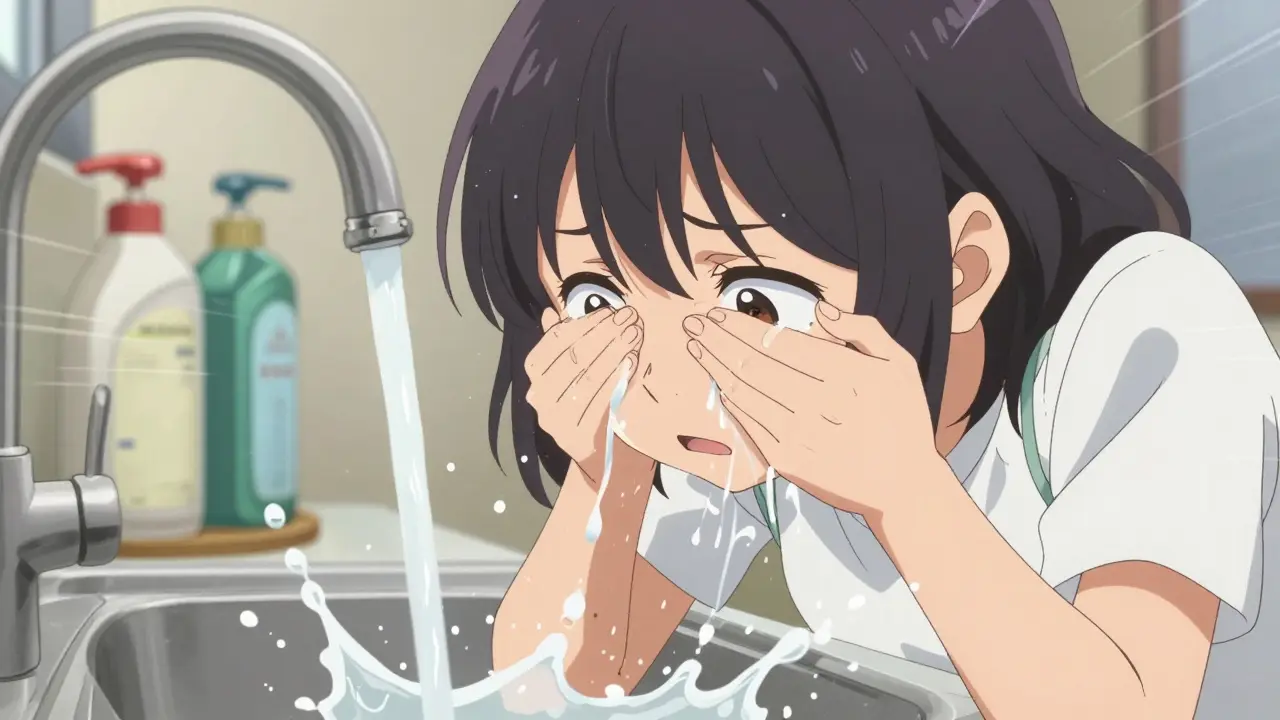
When a chemical splash hits your eye, you don’t have seconds to waste. It’s not like a cut or a burn on your skin. Your eye is made of delicate tissues that can be destroyed in under a minute. Alkali chemicals like drain cleaner, ammonia, or cement dust can eat through the cornea before you even blink. Acid burns, like from battery fluid or vinegar, are dangerous too-but alkali burns are worse. They don’t just sit on the surface. They slip inside, keep going, and can blind you for life if you don’t act fast.
Why Timing Is Everything
The clock starts the moment the chemical touches your eye. Research shows that starting irrigation within 10 seconds cuts the risk of permanent vision loss by 76%. That’s not a guess. That’s from a 2017 meta-analysis in the British Journal of Ophthalmology. Every second you wait, the chemical keeps burning deeper. After 60 seconds, the damage becomes irreversible in many cases. And here’s the scary part: most people don’t act fast enough. A 2022 study of workplace injuries found that the average delay before starting irrigation was over two minutes. By then, it’s often too late to save full vision.
Why do people wait? They panic. They rub their eyes. They think rinsing with a little water is enough. They look for saline instead of just turning on the tap. All of these mistakes make things worse. Rubbing spreads the chemical. Waiting for the right solution wastes time. And stopping too soon? That’s the #1 reason people end up with permanent damage.
What You Must Do Right Now
If you or someone else gets a chemical splash in the eye, here’s exactly what to do:
- Don’t rub. Even if it feels like you need to, don’t. Rubbing grinds the chemical into the eye and makes the burn deeper.
- Start flushing immediately. Don’t look for a bottle, don’t call for help first-just turn on the water. Use the nearest sink, shower, hose, or even a garden spigot. Tap water is fine. You don’t need sterile saline. Dr. Reay Brown from Bascom Palmer Eye Institute confirmed in JAMA Ophthalmology that tap water works just as well as saline for the first step.
- Hold the eye open. Use your fingers to gently pull the upper and lower eyelids apart. You need the water to reach under both lids. If the person is in pain and can’t keep their eye open, help them. Don’t let them close it.
- Flush for at least 20 minutes. This is non-negotiable. Healthdirect Australia, Better Health Channel, and the American Red Cross all agree: 15 to 20 minutes of continuous irrigation is the minimum. Some experts say 10 minutes is enough, but 20 is safer. The CDC says to keep going until the eye’s pH returns to normal (between 7.0 and 7.4), which may take longer. Don’t stop because it hurts. Don’t stop because you think it’s clean. Keep going.
- Position the head right. Tilt the head back and turn it toward the injured side. This keeps the chemical from running into the other eye. Most guides don’t mention this, but it’s critical. If you don’t, you risk a second injury.
- Remove contact lenses if you can. If the person wears contacts, try to take them out during flushing-unless the eye is already badly damaged. If it’s too painful or the surface is torn, leave them in. Water will wash under them anyway. The goal is to flush, not to remove lenses perfectly.
What Not to Do
People make the same mistakes over and over. Here’s what you must avoid:
- Don’t use eye drops or ointments. They don’t flush anything out. They just trap the chemical against the eye.
- Don’t wait for an ambulance. Emergency services can take 10-20 minutes to arrive. By then, the damage is done. Start flushing now.
- Don’t use a small stream of water. You need a strong, steady flow. A dripping faucet won’t cut it. Use the shower head, hold the faucet under running water, or use a hose. The goal is to flood the eye, not drip on it.
- Don’t cover the eye. Covering it with a bandage or cloth can trap heat and chemicals. Keep it open and exposed to water.
- Don’t assume it’s fine after a few minutes. Even if the pain fades, the chemical may still be working. You need the full 20 minutes.
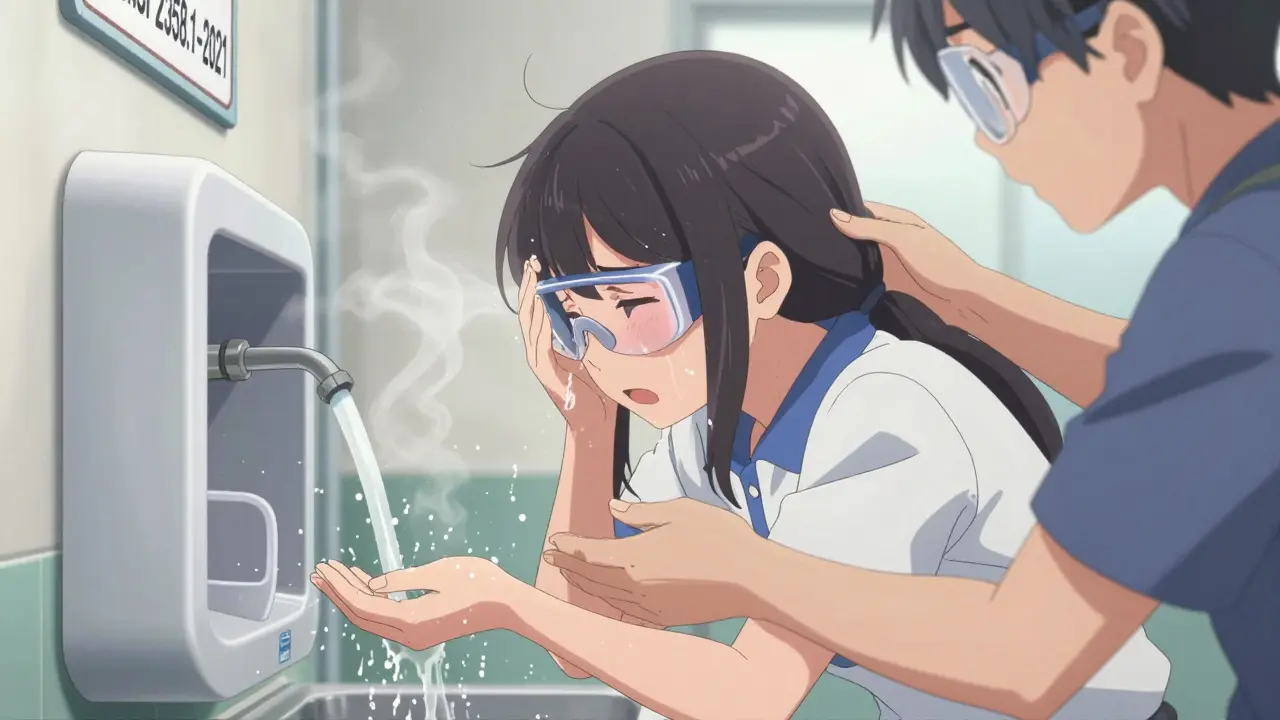
Workplace vs. Home: What’s Different?
At work, you should have an ANSI Z358.1-2021 compliant eyewash station. These are required by OSHA in any place where chemicals are used. They must deliver tepid water (60-100°F) at 0.4 gallons per minute, and they must activate in under one second. The water temperature matters. Too cold, and people stop flushing because it’s painful. Too hot, and you burn the eye. The 2021 update fixed this by requiring temperature control.
At home, you don’t have those stations. But you still need to act fast. Keep a jug of water near the garage, workshop, or cleaning supplies. Some people keep a small bottle of saline in their first aid kit-but again, tap water is just as effective for initial flushing. The key isn’t the source-it’s the speed and duration.
And here’s something most people don’t know: 22.8% of workplaces with chemical hazards don’t even have an eyewash station within 10 seconds’ reach. That’s an OSHA audit finding from 2023. If you work with chemicals, check where the eyewash is. Practice getting to it. If it’s blocked, broken, or frozen, report it. Your vision depends on it.
What Happens After Flushing?
Even after 20 minutes of flushing, you still need to go to the ER. The irrigation stops the burning-but it doesn’t fix the damage. You might feel better, but the eye could still be swelling, tearing, or developing a corneal ulcer. Doctors will check the pH, look for burns under the eyelid, and test for vision loss. In severe cases, you might need a corneal transplant. About 18.7% of people with serious chemical injuries need one within five years, according to 2023 Medicare data. Each transplant costs over $27,700.
There’s new hope, though. In 2022, the FDA approved a new solution called Diphoterine. It doesn’t just wash away chemicals-it binds to them and neutralizes them on contact. It cuts irrigation time by 40%. But it’s not available in homes yet. It’s mostly used in hospitals and industrial settings. For now, water is still your best friend.
Why Most People Fail
Why do so many people get it wrong? Because they’ve never practiced it. A 2022 study found that people who had hands-on training were 3.2 times more likely to do the right thing than those who only read a pamphlet. Most first aid courses focus on CPR and choking. Eye injuries get skipped. And smartphone apps? A 2023 study found that 63.2% of them give wrong or conflicting advice. One app says flush for 5 minutes. Another says use milk. Another says don’t touch the eye at all.
And then there’s the myth that you need special tools. You don’t. You need water, time, and courage. You need to ignore the pain and keep going. It’s not comfortable. It’s not quick. But it’s the only thing that saves sight.
What You Can Do Today
You don’t need to wait for an accident to prepare. Here’s what to do now:
- Know where your eyewash is. At work, home, gym-wherever chemicals are present.
- Practice the steps. Go to your sink. Turn on the water. Hold your eye open for 20 seconds. Do it now. Make it a habit.
- Teach your family. Show your kids, partner, or roommates how to flush an eye. Don’t assume they know.
- Keep water handy. In your garage, workshop, or cleaning closet, keep a jug of clean water. Just in case.
- Check your workplace. Is the eyewash station working? Is it clear? Is it warm enough? If not, report it.
Chemical eye injuries are preventable. They’re not accidents waiting to happen-they’re failures of preparation. You can’t control if a bottle spills. But you can control how fast you respond. And that’s the difference between seeing your child’s face tomorrow… and never seeing it again.
What should I do if a chemical gets in my eye?
Immediately flush your eye with cool tap water for at least 20 minutes. Hold your eyelids open with your fingers, tilt your head back, and turn toward the injured side to prevent the chemical from spreading to your other eye. Do not rub your eye or wait for help-start flushing right away. Even if the pain lessens, keep going for the full 20 minutes.
Is saline better than tap water for flushing the eye?
No. Tap water works just as well as saline for initial irrigation. A 2020 study in JAMA Ophthalmology found no advantage to using sterile saline in the first minutes after exposure. The most important factor is speed and volume-not the type of liquid. Use whatever water is fastest and most available.
How long should I flush my eye after a chemical splash?
Flush for at least 20 minutes. Some guidelines say 15 minutes, but 20 is safer. The CDC recommends continuing until the eye’s pH returns to normal (7.0-7.4), which may take longer. Never stop just because it feels better. The chemical can still be active under your eyelids.
Should I remove my contact lenses if I get a chemical splash?
Try to remove them if you can, but only if it’s not too painful or the eye isn’t severely damaged. If the surface is burned or swollen, leave them in. Water will still flush underneath. The priority is continuous irrigation-not perfect lens removal.
Are alkali burns worse than acid burns?
Yes. Alkali chemicals-like drain cleaner, ammonia, or cement dust-penetrate deeper into eye tissues than acids. They can destroy the cornea and lens from the inside out. Acid burns are serious too, but they tend to stay on the surface and form a protective layer. Alkali burns are more likely to cause permanent vision loss.
Can I use an eyewash station at home?
Standard ANSI-compliant eyewash stations are designed for workplaces, not homes. But you don’t need one. A sink, shower, or even a hose with running water works just as well for immediate first aid. The key is speed and duration-not the equipment.
What are the most common mistakes people make after a chemical eye injury?
The top mistakes are: rubbing the eye (68% of cases), stopping irrigation too soon (57%), using too little water (83%), waiting to call for help, and using eye drops or ointments. These actions trap chemicals, spread them, or delay treatment-making the injury worse.
How can I prevent chemical eye injuries?
Wear safety goggles when handling chemicals, whether at work or home. Store cleaners and solvents out of reach of children. Know where your eyewash is and practice getting to it. Train yourself and others on proper first aid. Most injuries happen because people aren’t prepared-not because accidents are unavoidable.

Comments (15)
Rhiannon Bosse
I swear, if I see one more person rub their eye after a chemical splash, I'm gonna scream. I work in a lab and saw a guy do this last year-he thought blinking would 'fix' it. Bro, your cornea is not a touchscreen. Tap water for 20 minutes. Not 5. Not 10. TWENTY. And no, your fancy saline spray isn't magic. It's just expensive water.
Timothy Davis
The 76% reduction stat is from a 2017 meta-analysis, sure-but did they control for chemical concentration? Most studies use 1% NaOH solutions. Real-world drain cleaner is 20-30%. Also, the CDC’s pH normalization claim? Unverified in vivo. You can’t just assume tap water neutralizes alkali. It dilutes. Big difference. And don’t get me started on the '20 minutes' dogma-some industrial spills need 45. This post is dangerously oversimplified.
Lexi Karuzis
Wait… so you’re telling me the government doesn’t require every home to have a Diphoterine kit?? And yet they mandate smoke detectors?? This is a MASSIVE cover-up. Who profits from people going blind? Pharma? The water industry? The OSHA lobby? I’ve been researching this for 3 years. They don’t want you to know that saline is just a placebo. Tap water is the real weapon. And they know it. They’re letting you go blind so you’ll buy more eye drops. I’m not paranoid. I’m PREPARED.
Brittany Fiddes
Honestly, this is the most British thing I’ve ever read. 'Just turn on the tap.' Oh, lovely. In the UK, our water is hard enough to strip paint off your kettle. You think that’s going to help a chemical burn? In America you’ve got chlorine and fluoride. In Germany, they use mineral-rich water. In Japan, they have specialized eyewash stations. You Americans think running water is a universal solution. It’s not. It’s a colonial mindset wrapped in a first-aid pamphlet.
Colin Pierce
I’ve trained 300+ warehouse workers on this. The biggest mistake? Stopping at 10 minutes because 'it feels better.' I always say: if your eye’s still open, keep flushing. I had a guy last month who flushed for 27 minutes because he was scared to stop. He’s got 20/20 vision now. No transplant. No drama. Just water. And courage. Seriously, just do it. No excuses.
Amber Daugs
I’m sorry, but if you’re using tap water because you’re too lazy to buy saline, you’re not being practical-you’re being negligent. Your 'just turn on the sink' advice is irresponsible. What if your water has lead? Arsenic? Your neighbor’s dog peed in the gutter outside? You’re risking secondary poisoning. And why isn’t anyone talking about the fact that 80% of home water systems aren’t even tested for contaminants? This isn’t first aid-it’s Russian roulette.
Ambrose Curtis
I work in a chemical plant and we use Diphoterine daily. It’s legit. But here’s the thing-most people don’t know how to use it. They spray it like perfume. You need to hold the nozzle 2 inches from the eye and let it flow. And yes, tap water works. But if you’ve got Diphoterine? Use it. Then flush with water. And no, rubbing your eye won’t make you feel better-it’ll make you blind. I’ve seen it. Don’t be that guy.
Linda O'neil
You can do this. I know it sounds scary. I was scared too. But when my kid spilled bleach in his eye, I didn’t panic-I just turned on the shower, held his eyelids open, and counted to 20 minutes. It felt like forever. But he’s fine. No scars. No surgery. Just water. And you can do it too. You’re stronger than you think. Just keep going. I believe in you.
jonathan soba
Interesting. The 2023 OSHA audit found 22.8% of workplaces without eyewash stations within 10 seconds. But what about the 14.3% that had them but were frozen in winter? Or the 31% that were blocked by boxes? The real problem isn’t awareness-it’s infrastructure neglect. And yet, no one holds employers accountable. We just tell people to 'flush with water.' Convenient. Especially when liability is involved.
Chris Urdilas
I used to think this was overkill. Then I saw a guy flush for 5 minutes, say 'good enough,' and walk away. Two weeks later, he lost his eye. I don’t care if you're busy. I don’t care if it hurts. If your eye’s on fire, you don’t get to pick when to stop. 20 minutes. Not 15. Not 18. TWENTY. And if you’re reading this and you’ve ever stopped early? You’re lucky. Don’t make that mistake again.
James Dwyer
This is the kind of info that saves lives. I printed it out and put it on my fridge next to the fire extinguisher. My wife doesn’t even know how to change a tire, but now she knows how to flush an eye. That’s power. Thank you for not sugarcoating it.
doug b
Look. I’m not a doctor. I’m a mechanic. But I’ve seen oil and brake fluid in eyes. I’ve seen guys rub. I’ve seen guys wait. I’ve seen guys die. Just turn on the water. Hold it open. Don’t stop. That’s it. No fancy gear. No apps. No milk. Just water. And guts. You got this.
SRI GUNTORO
In India, we use rosewater for eye burns. It’s cooling. Natural. And it’s been used for centuries. Why are Western guidelines ignoring traditional remedies? Rosewater has anti-inflammatory properties. Why is tap water the only option promoted? Is this cultural bias? Or corporate control? I am not convinced.
Kevin Kennett
I’m a single dad. I taught my 8-year-old how to flush an eye last week. We practiced in the shower. She held my eyelid open while I pretended to get splashed. We laughed. We cried. We did it again. That’s the point. This isn’t just medical advice-it’s love. You’re not just saving an eye. You’re saving someone’s future. So don’t just read this. Do it. Teach someone. Now.
Jess Bevis
Tap water. 20 minutes. No rub. No wait. Done.