
Every year, millions of men get a PSA test without ever being told what it really means. The test sounds simple: a blood draw, a number, and a decision. But that number - whether it’s 4.1 or 6.8 - doesn’t tell you if you have cancer. It doesn’t even tell you if you’ll ever need treatment. And that’s the problem.
What PSA Screening Actually Measures
The PSA test measures prostate-specific antigen, a protein made by the prostate gland. High levels can mean cancer - but they can also mean a swollen prostate from aging, a recent bike ride, a urinary infection, or even a digital rectal exam done the day before. About 75% of men with PSA levels between 4.0 and 10.0 ng/mL don’t have cancer. Yet they still get biopsies. And biopsies carry risks: bleeding, infection, hospital visits, and weeks of anxiety.
Worse, the test misses some dangerous cancers. Around 15% of men with aggressive, life-threatening prostate cancer have PSA levels below 4.0. That means a normal result can give false reassurance. The test isn’t broken - it’s just not precise enough to be used alone.
The Big Debate: Does PSA Screening Save Lives?
Two massive studies, one in Europe and one in the U.S., gave conflicting answers. The European Randomized Study of Screening for Prostate Cancer (ERSPC) found that PSA screening reduced prostate cancer deaths by about 21% over 10 years. But the U.S.-based PLCO trial found no real benefit. Why the difference? The U.S. study had so many men in the "no screening" group who still got tested anyway that the results got blurred.
Here’s what we know for sure: for every 1,000 men screened annually for 10 years, about 1 or 2 prostate cancer deaths are prevented. That sounds good - until you look at the cost. The same group of men will see 100 to 120 false positives, leading to unnecessary biopsies. And 80 to 100 will be diagnosed with cancers that would never have caused symptoms or shortened their lives.
These are called overdiagnosed cancers. They’re real tumors, but slow-growing, harmless. Yet once found, most men feel pressured to treat them - with surgery, radiation, or hormone therapy. Each of those treatments carries real risks: incontinence, impotence, bowel problems. For many men, the cure is worse than the disease.
Shared Decision-Making Isn’t Just a Buzzword - It’s the Only Ethical Way Forward
That’s why major medical groups - the American Cancer Society, the U.S. Preventive Services Task Force, the American Urological Association - now all say the same thing: don’t screen men without talking to them first.
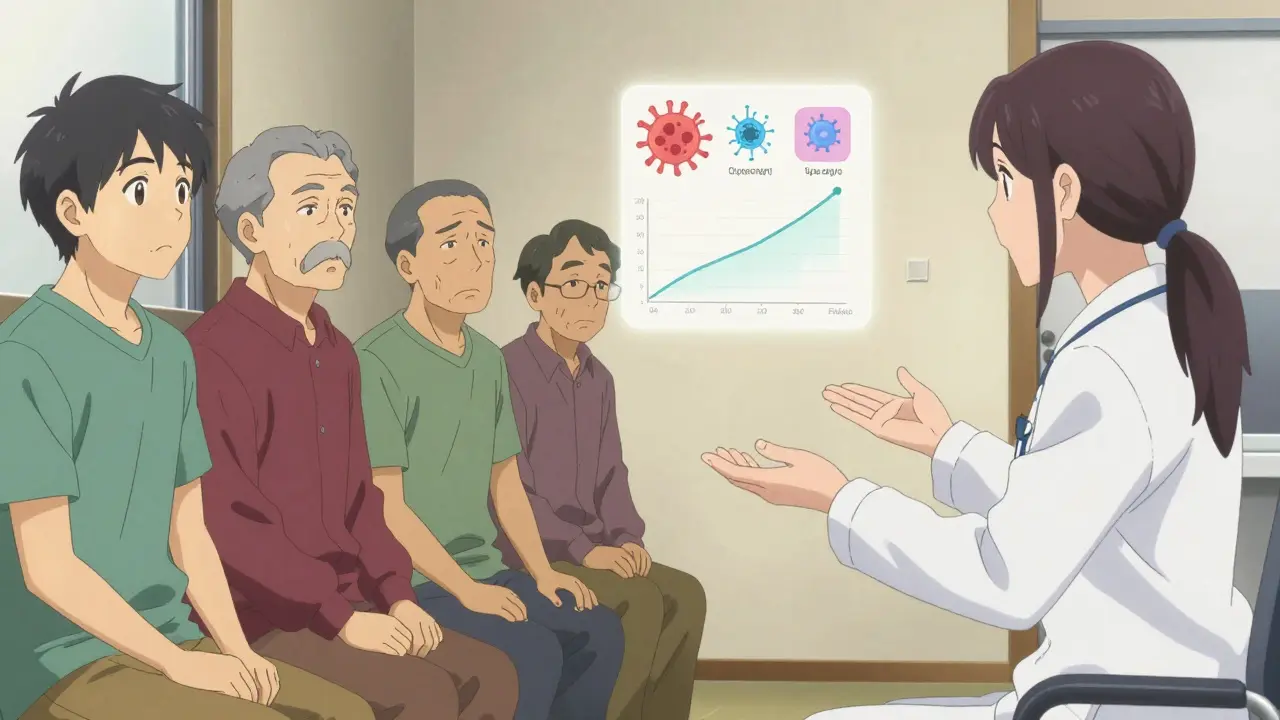
Shared decision-making means a doctor doesn’t just hand you a test form. It means sitting down, explaining the numbers, showing the trade-offs. It means saying: "Here’s what could happen if you get tested. Here’s what could happen if you don’t. What matters most to you?"
It’s not about pushing men toward or away from testing. It’s about helping them understand what they’re signing up for. A 62-year-old man in Australia might care more about avoiding incontinence than living an extra year. A 58-year-old with a strong family history might want every possible advantage. Neither choice is wrong - but both need to be informed.

What Happens When Doctors Skip the Conversation
A 2022 study found that primary care doctors spend an average of just 3.7 minutes discussing PSA screening during a checkup. That’s less time than it takes to refill a prescription. Meanwhile, the American College of Physicians recommends 15 to 20 minutes.
And it shows. A 2017 national survey found that only 60% of men who got a PSA test were told about the possible harms. On Reddit, men report being told, "It’s just a blood test. Everyone gets it." No mention of overdiagnosis. No mention of biopsy risks. No mention that many cancers found this way never need treatment.
One man, diagnosed after a PSA of 4.7, had his prostate removed. He spent the next year dealing with urinary leakage and erectile dysfunction. His cancer? Low-risk. It would have never spread. He could have lived his life with active surveillance - regular checkups, no surgery. But no one told him that was an option.
What’s Replacing PSA? Not Much - Yet
There are newer tools. Multiparametric MRI can scan the prostate before a biopsy, reducing unnecessary procedures by 27%. The 4Kscore test combines four biomarkers to better predict aggressive cancer - it’s 95% accurate at ruling out high-risk disease. Genomic tests like Oncotype DX can tell if a diagnosed cancer is slow or fast-growing.
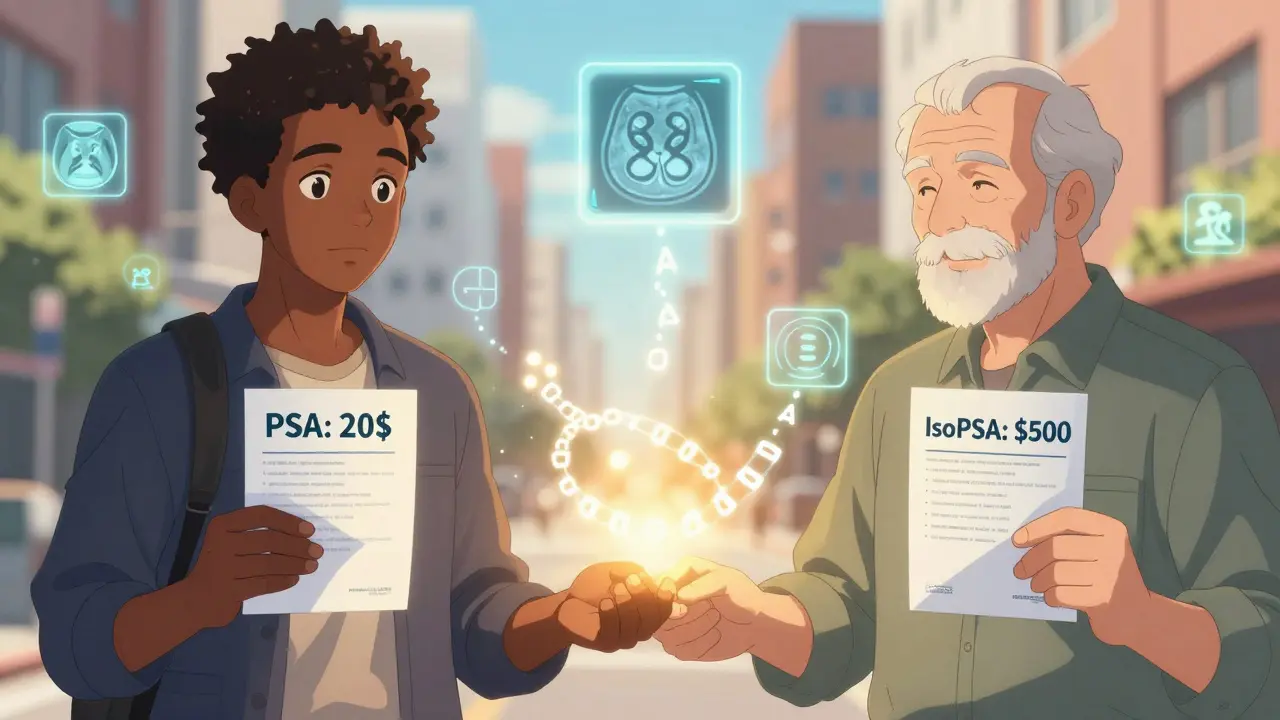
But these cost hundreds or even thousands of dollars. PSA? It’s $20 to $50. Most insurance covers it. Most clinics have it on hand. So even as better tools arrive, PSA remains the default - because it’s cheap and easy.
Some new tests are promising. IsoPSA, approved by the FDA in 2021, claims to be 92% specific for aggressive cancer - far better than traditional PSA’s 25%. AI models trained on routine blood work can now predict prostate cancer risk with 85% accuracy. But these aren’t in every doctor’s office yet.
Who’s at Highest Risk - And Who’s Being Left Behind
African American men are 70% more likely to get prostate cancer and more than twice as likely to die from it. Yet they’re 23% less likely to have a shared decision-making conversation before screening. Why? Systemic gaps in care. Language barriers. Lack of trust. Time constraints. The same system that over-treats white men often under-screens Black men.
Men with a family history of prostate cancer, especially if a close relative was diagnosed before 65, also need earlier and more thoughtful screening. But again - if the doctor doesn’t ask about family history, they won’t know.
What Should You Do?
Here’s the bottom line:
- If you’re under 50 and have no family history or symptoms, you probably don’t need a PSA test.
- If you’re 55 to 69, talk to your doctor. Not just about the test - about what happens next. Ask: "What if my PSA is high? What if it’s normal? What are my options if cancer is found?"
- If you’re over 70, screening is unlikely to help. The risks outweigh the benefits. Unless you’re in excellent health and have a 15+ year life expectancy, most experts say skip it.
- Ask for a decision aid. The Mayo Clinic, the American Cancer Society, and the Ottawa Personal Decision Guide offer free tools with visual charts showing the real odds - deaths prevented, biopsies triggered, lives changed.
Don’t let a number on a lab report make your decision for you. Prostate cancer isn’t a yes-or-no problem. It’s a trade-off. And you deserve to know what you’re trading.
What’s Changing Now?
The U.S. Preventive Services Task Force is now pushing for risk-based screening - using baseline PSA at age 45 to guide future testing. If your PSA is under 1.0 at 45, you might only need testing every 5-10 years. If it’s above 2.0, you might need closer monitoring.
The National Cancer Institute’s P4 study is testing whether early PSA levels can predict lifetime risk. The BARCODE1 trial is looking at genetic markers to find who benefits most from screening.
But until those tools are widely available, shared decision-making is the only thing standing between a man and a treatment he doesn’t need - or a cancer he doesn’t catch.
Final Thought: It’s Not About the Test. It’s About the Conversation.
PSA screening isn’t good or bad. It’s complicated. And the only way to navigate that complexity is with clear, honest, patient-centered talk. No pressure. No assumptions. Just facts - and space for you to decide what matters most.
Should I get a PSA test if I’m 58 and healthy?
If you’re 55 to 69 and in good health, you should talk to your doctor about PSA screening - but don’t get it unless you understand the risks and benefits. For every 1,000 men screened, 1-2 deaths from prostate cancer are prevented, but 80-100 will be diagnosed with cancers that would never have caused harm. Ask your doctor: "What happens if my PSA is high? What are my options if cancer is found?" Only make a decision after this conversation.
What if my PSA is 5.2 - does that mean I have cancer?
No. A PSA of 5.2 doesn’t mean you have cancer. About 75% of men with PSA levels between 4.0 and 10.0 don’t have cancer. High PSA can be caused by an enlarged prostate, infection, recent exercise, or even a bike ride. Your doctor should check for these causes before jumping to a biopsy. Ask about PSA density, velocity, or an MRI before deciding on a biopsy.
Is active surveillance a real option if I’m diagnosed?
Yes - and it’s the right choice for many men. Studies like the ProtecT trial show that men with low-risk prostate cancer who choose active surveillance (regular PSA tests, MRIs, and biopsies) have the same 10-year survival rate as those who get surgery or radiation - 99%. Many men avoid side effects like incontinence and impotence by choosing to monitor instead of treat immediately.
Why do some doctors still push PSA testing?
Some doctors still recommend PSA testing because they believe it saves lives - and in some cases, it does. But many also order it out of habit, fear of missing something, or because patients ask for it. Others don’t know the latest guidelines or don’t have time to explain the trade-offs. That’s why shared decision-making tools and training are critical - to ensure men aren’t screened without understanding the consequences.
Are there better tests coming?
Yes. Tests like IsoPSA, 4Kscore, and AI models analyzing blood patterns are more accurate at spotting aggressive cancer. Multiparametric MRI can help avoid unnecessary biopsies. But these are expensive and not yet widely used. PSA remains the most common test because it’s cheap and available. Until better tools are routine, shared decision-making is still your best protection.

Comments (13)
Tamar Dunlop
The complexity of prostate cancer screening is not merely a medical issue-it is a profound ethical imperative. To reduce a man’s autonomy to a single blood value is to disregard the very essence of patient dignity. The data presented here is not just statistics; it is the lived reality of men who have been misled by the illusion of certainty. Shared decision-making is not a bureaucratic checkbox-it is the moral foundation of modern medicine.
David Chase
THIS IS WHY AMERICA IS LOSING THE WAR ON CANCER!!! 🤬
Doctors are too scared to tell men the truth! PSA is FREE, it’s EASY, and it SAVES LIVES! Why are we letting bureaucrats and ‘active surveillance’ cowards kill men? I’m 61 and I got mine at 55-no cancer, but I know I’m safe! If you don’t test, you’re gambling with your life! #PSAisLife #NoMoreWimps
Emma Duquemin
Let me tell you what happened to my uncle-he was 63, healthy, PSA at 5.8, and they did a biopsy. Turns out? Benign prostatic hyperplasia. He spent three weeks in pain, couldn’t pee properly, and had to take antibiotics like candy. Then they told him, ‘Oh, it’s just an enlarged prostate.’ No one warned him. No one said, ‘Hey, this might be a wild goose chase.’
That’s the problem. We treat screening like a routine blood draw, like getting a flu shot. But this isn’t a flu shot. This is a doorway to a labyrinth of anxiety, needles, and surgeries that might not even be necessary.
I’m a nurse. I’ve seen men cry because they lost their ability to be intimate with their wives after surgery. I’ve seen men who didn’t need treatment, but felt like failures for not ‘doing everything.’
It’s not about fear. It’s about FEAR being weaponized by a system that profits from action, not observation. Active surveillance isn’t ‘doing nothing’-it’s the most courageous choice. And we need to stop making men feel guilty for choosing it.
Kevin Lopez
PSA sensitivity: 80%. Specificity: 25%. PPV: 25%. NPV: 90%. NNT: 500. NNH: 80. Overdiagnosis rate: 30-40%. Biopsy complication rate: 5-15%. Active surveillance 10-year survival: 99%. Cost per life-year saved: $120K. Conclusion: PSA is a flawed tool used by undertrained providers in a fee-for-service system. The data is clear. The guidelines are clear. The execution is garbage.
Samar Khan
So what? I’m 58 and I got tested. My PSA was 4.9. They did the biopsy. Turned out nothing. But now I know I’m fine. Why risk it? You don’t need to be a genius to know: better safe than sorry. 🤷♀️
Russell Thomas
Oh wow, so now we’re having a TED Talk about prostate cancer? Let me guess-the doctor didn’t say ‘have a nice day’ fast enough, so now it’s a moral crisis?
My dad got screened at 60. Found cancer. Treated it. Still alive at 78. Meanwhile, your ‘active surveillance’ guy is probably still scrolling Reddit wondering if his PSA is ‘too high.’
Wake up. Not every man wants to be a statistic. Some just want to live.
Joe Kwon
I appreciate the nuance here. As someone who works in clinical informatics, I’ve seen how PSA gets ordered reflexively-like a default checkbox. But the real shift isn’t in the test-it’s in the conversation. Tools like decision aids and structured patient education reduce anxiety and improve satisfaction, even when men choose to decline screening.
One study showed that when men were shown visual risk charts (like the ones from Ottawa), 40% chose to defer screening. Not because they were scared-but because they understood the trade-offs.
We need to stop treating this like a yes/no lab order and start treating it like a life decision. And yes, that takes time. But it’s worth it.
Nicole K.
This is just another liberal attempt to make men feel guilty for taking care of themselves. If you’re healthy, get the test. If you’re scared, get the test. If you’re old, get the test. Why would you not want to know? It’s a simple blood draw. Stop overcomplicating it. Men have died because they didn’t get tested. That’s on them.
Amy Cannon
It is, indeed, a matter of profound societal concern that the medical-industrial complex continues to prioritize procedural throughput over patient comprehension. The psychological burden of false positives, the iatrogenic trauma of unnecessary interventions, and the erosion of autonomy under the guise of preventive care-these are not mere inconveniences; they are systemic failures in the fiduciary relationship between physician and patient.
Moreover, the disparity in access to shared decision-making tools among racial and socioeconomic groups reveals a troubling pattern of inequity masked as clinical neutrality. African American men, who face disproportionately higher mortality rates, are simultaneously the least likely to receive informed counseling-a paradox that demands urgent, structural reform.
One cannot help but reflect upon the words of Dr. Atul Gawande: ‘The goal of medicine is not to extend life at all costs, but to enable people to live well.’ In this context, the PSA test is not a diagnostic instrument-it is a mirror reflecting our collective failure to honor the human dimension of health.
Himanshu Singh
My uncle had prostate cancer, he chose active surveilance, now he is 80 and hiking every weekend. No surgery, no side effects. PSA was 6.1, but he was fit and healthy. Don’t rush to cut things out. Wait, watch, talk to doc. 😊
Alex Ronald
For anyone wondering if active surveillance is real: yes. It’s not just a delay-it’s a validated strategy. The ProtecT trial showed no difference in survival between surgery, radiation, and monitoring after 10 years. The only difference? Quality of life. Men on surveillance reported better sexual function, urinary control, and less anxiety over time. The fear of ‘doing nothing’ is often worse than the cancer itself. Talk to a urologist who actually knows the data-not the one who just wants to schedule a biopsy.
Teresa Rodriguez leon
I got mine at 56. It was 5.3. Biopsy came back negative. But I still feel like I was manipulated into it. No one ever said, ‘This might not help you.’ I just assumed it was the right thing to do. Now I feel stupid.
Paige Shipe
You’re all missing the point. The problem isn’t PSA-it’s the lack of physician accountability. If a doctor orders a PSA without discussing risks, they should be required to document the patient’s informed refusal in writing. We don’t let surgeons operate without consent. Why is this different? The system rewards volume, not wisdom. And until we change the incentives, men will keep getting tested like it’s a routine vaccination. This isn’t prevention-it’s performance.