
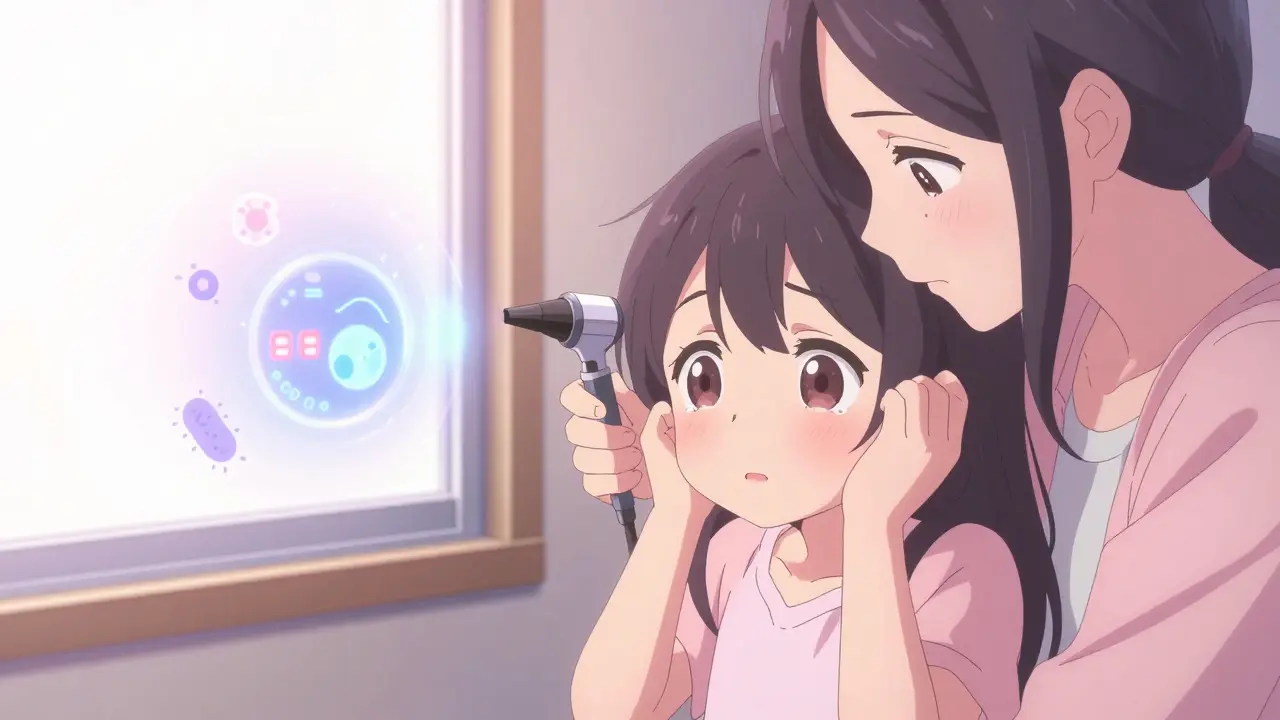
Most parents have been there: a fussy child, tugging at their ear, running a fever, and sleeping poorly. It’s often otitis media - a middle ear infection. It’s one of the most common reasons kids visit the doctor, and it’s just as common in adults after a cold or flu. But here’s the thing: antibiotics aren’t always the answer. In fact, for many cases, they’re not needed at all.
What Exactly Is Otitis Media?
Otitis media means inflammation or infection in the middle ear - the space right behind the eardrum. It’s not just an "earache." It’s when fluid builds up behind the eardrum because the Eustachian tube, which normally drains fluid from the ear, gets blocked. This usually happens after a cold, allergies, or a respiratory infection. The trapped fluid becomes a breeding ground for bacteria or viruses.Children are far more likely to get it than adults. Why? Their Eustachian tubes are shorter, more horizontal, and less developed. That makes it harder for fluid to drain. By age 3, over 80% of kids have had at least one middle ear infection. Peak times? Between 3 months and 3 years old.
There are two main types:
- Acute otitis media (AOM): Sudden onset, painful, often with fever. The eardrum looks red and bulging.
- Otitis media with effusion (OME): Fluid is still there after the infection clears, but no active infection. No pain, no fever. This can last weeks or even months.
OME doesn’t need antibiotics. It usually goes away on its own. But AOM? That’s where the confusion starts.
What Causes It?
Bacteria are the usual suspects: Streptococcus pneumoniae, Haemophilus influenzae (non-typeable), and Moraxella catarrhalis. Viruses like RSV, rhinovirus, and influenza can also trigger it. The infection often starts in the nose or throat, then spreads to the ear.Some kids are at higher risk:
- Exposure to cigarette smoke - increases risk by about 50%
- Bottle-feeding while lying down (vs. breastfeeding upright)
- Attending daycare - kids there have 2 to 3 times more ear infections
- Living in areas with heavy air pollution
- Not being up to date on vaccines, especially PCV13 (pneumococcal conjugate vaccine)
That last point matters. Since PCV13 became routine, vaccine-type pneumococcal ear infections have dropped by 34%. It’s one of the most effective ways to prevent AOM.
How Do Doctors Diagnose It?
It’s not just about the ear tugging. Many parents think that’s a sure sign. But kids tug at their ears for all kinds of reasons - teething, tiredness, even just curiosity.A doctor uses a tool called a pneumatic otoscope. It looks inside the ear and gently puffs air to see if the eardrum moves. If it’s stiff and bulging? That’s a classic sign of AOM. If it’s red but moves fine? Probably not an infection.
In some cases, a hearing test might show a mild conductive hearing loss - 15 to 40 decibels. That’s like trying to hear someone whispering across the room. It’s temporary and goes away when the infection clears.
Some clinics now use smartphone otoscopes like CellScope Oto. Parents can take a picture of the eardrum and send it to the doctor. Studies show it’s about 85% accurate. It’s not perfect, but it helps avoid unnecessary trips.
Do Antibiotics Always Help?
No. And this is the biggest misconception.Eighty percent of uncomplicated ear infections in kids go away on their own within 3 days. Pain and fever drop naturally. Antibiotics don’t speed this up much - they just reduce the chance of complications.
That’s why guidelines from the American Academy of Pediatrics (AAP) and American Academy of Family Physicians (AAFP) now recommend watchful waiting for many cases.
Here’s when antibiotics are recommended:
- Children under 6 months with confirmed AOM
- Children 6 to 23 months with severe symptoms (fever over 39°C or ear pain lasting more than 48 hours)
- Children 2 years and older with severe pain or high fever
- Any child with a ruptured eardrum and pus draining out
For most healthy kids over 2 with mild symptoms? Wait 48 to 72 hours. Use pain relief. See if it gets better.

Which Antibiotics Are Used?
If antibiotics are needed, amoxicillin is the first choice. Dose? 80-90 mg per kg of body weight, split into two doses a day. It’s cheap, effective, and most bacteria still respond to it.But resistance is rising. In the U.S., 30-50% of Streptococcus pneumoniae strains are now resistant to low-dose penicillin. That’s why high-dose amoxicillin is used - it overpowers the resistant bugs.
For kids allergic to penicillin:
- Ceftriaxone - a single shot
- Cefdinir - oral, once a day
- Azithromycin - 3 to 5 days of treatment
Amoxicillin-clavulanate (Augmentin) is used if the first treatment fails or if the child has had repeated infections. But it’s not a first-line choice - it’s stronger, with more side effects.
Duration? It depends on age and severity:
- Under 2 years: 10 days
- 2-5 years with severe symptoms: 7 days
- 6 years and older with mild symptoms: 5-7 days
Don’t stop just because they feel better. Finish the full course - even if the pain is gone.
What About Side Effects?
Antibiotics aren’t harmless. About 10-25% of kids get diarrhea. Up to 10% get a rash. Some get vomiting or yeast infections.One mom on Reddit shared: "My 18-month-old had a mild ear infection. We waited 48 hours. No antibiotics. The fever broke, the crying stopped. We avoided a week of diarrhea."
Another parent in Ohio said: "We waited 72 hours. Then her fever hit 104°F. We ended up in the ER with a ruptured eardrum. I wish we’d started antibiotics sooner."
That’s the tension: balancing risks. Antibiotics have side effects. But so does a high fever or a ruptured eardrum. The key is knowing which symptoms need action.
How to Manage Pain
Pain control is the #1 priority - whether or not you use antibiotics.- Ibuprofen: 5-10 mg per kg every 6-8 hours
- Acetaminophen: 10-15 mg per kg every 4-6 hours
Both work well. Ibuprofen often lasts longer and reduces inflammation too.
Warm compresses on the ear help. Otic drops like Auralgan can numb the pain - but never use them if the eardrum is ruptured. You could damage the inner ear.
Many parents say pain relief made all the difference. "Ibuprofen every 6 hours turned my crying baby into a sleeping one," one parent wrote.
When to Worry
Watch for red flags:- Fever over 40°C (104°F)
- Pain that doesn’t improve with painkillers
- Drainage of pus from the ear
- Dizziness or loss of balance
- Facial weakness (one side of the face droops)
- Severe irritability or lethargy
These mean it’s time to see a doctor - or go to urgent care. A ruptured eardrum isn’t an emergency, but it does need checking. Most heal on their own, but infection can spread.
What About Recurrent Infections?
About 20% of kids get 3 or more ear infections in 6 months. That’s recurrent AOM.Some kids outgrow it. Others need more help. Options include:
- Ear tubes (tympanostomy tubes) - small tubes placed in the eardrum to let fluid drain
- Removing adenoids - if they’re blocking the Eustachian tube
- Switching daycare or reducing smoke exposure
- Ensuring full vaccine schedule (PCV13, flu shot)
Ear tubes are common. They’re not a big surgery. Most kids go home the same day. They fall out on their own in 6-12 months. Many parents report fewer infections and better sleep after tubes.
What’s New in Treatment?
The field is changing fast:- The new 15-valent pneumococcal vaccine (Vaxneuvance), approved in 2021, shows 85% effectiveness against severe pneumococcal disease - likely to cut ear infections further.
- Office-based tympanometry (a test that measures eardrum movement) is being used more. One 2023 study found it reduced unnecessary antibiotics by 22% in young kids.
- Researchers are testing point-of-care tests that identify bacteria in minutes. One expert predicts these will cut broad-spectrum antibiotic use by 30-40% within 5 years.
Probiotics? A 2022 Cochrane review looked at 13 studies with over 3,400 kids. No significant drop in ear infections. So skip the probiotics for this.
The Bigger Picture
Otitis media leads to 15.5 million doctor visits in the U.S. each year. Antibiotics are prescribed in about 15 million of those. That’s 15 million doses - and 15 million chances for side effects, resistance, and unnecessary cost.The CDC calls penicillin-resistant Streptococcus pneumoniae a "serious threat." Overuse of antibiotics is making it worse.
But here’s the good news: antibiotic prescribing for ear infections dropped from 68% in 2010 to 59% in 2016. More doctors are following guidelines. More parents are asking: "Do we really need this?"
The message isn’t "don’t use antibiotics." It’s "use them wisely."
Can otitis media go away without antibiotics?
Yes, in most cases. Up to 80% of uncomplicated acute otitis media cases resolve on their own within 3 days, especially in children over 2 years old with mild symptoms. Pain management and observation are often the best first steps. Antibiotics are reserved for severe cases, very young children, or if symptoms worsen.
Is amoxicillin the best antibiotic for ear infections?
For most cases, yes. High-dose amoxicillin (80-90 mg/kg/day) is the first-line treatment because it’s effective, affordable, and most bacteria remain sensitive to it. If a child is allergic to penicillin, alternatives like ceftriaxone (shot) or azithromycin are used. Amoxicillin-clavulanate (Augmentin) is typically only used if the first treatment fails.
Why do some kids get ear infections more than others?
Several factors increase risk: exposure to cigarette smoke, bottle-feeding while lying down, attending daycare, having siblings in daycare, not being fully vaccinated (especially with PCV13), and having a family history of ear infections. Children under 2 are most at risk due to immature Eustachian tube anatomy.
Can ear infections cause hearing loss?
Temporary hearing loss can happen during active infection due to fluid blocking sound. This usually causes a mild conductive hearing loss of 15-40 decibels - like hearing someone whisper. Once the infection clears, hearing returns. Persistent fluid (OME) lasting more than 3 months may affect speech development in young children and should be evaluated.
What’s the difference between otitis media and swimmer’s ear?
Otitis media is an infection behind the eardrum, usually from a cold or virus. Swimmer’s ear (otitis externa) is an infection of the ear canal itself, often from water trapped after swimming. Swimmer’s ear causes pain when you tug the earlobe, while otitis media causes pain deep inside, often with fever and irritability.
Should I give my child antibiotics if they have fluid behind the eardrum?
No. Fluid behind the eardrum (otitis media with effusion) is not an infection - it’s leftover fluid after an infection has cleared. Antibiotics won’t help it go away faster. It usually resolves on its own within 3 months. Only treat if there are signs of a new active infection.
How can I prevent ear infections in my child?
Vaccinate: PCV13 and annual flu shots reduce risk. Avoid smoke exposure. Breastfeed upright if possible. Limit daycare exposure if infections are frequent. Wash hands often. Avoid bottle-feeding while lying down. These steps can cut infection rates by up to half.

Comments (8)
phyllis bourassa
I swear, every time I don't give my kid antibiotics for an ear infection, some random person on the internet tells me I'm a bad parent. Like, I get it-you're scared. But my 3-year-old had AOM last winter, we waited 72 hours, gave him ibuprofen, and he slept through the night for the first time in days. No rupture. No fever spike. Just a happy kid who didn't have to take a week of antibiotics and then get diarrhea for a month. 🙃
Ferdinand Aton
Nah, this whole 'watchful waiting' thing is just Big Pharma's way of making parents feel guilty. Antibiotics work. Fast. My son got a ruptured eardrum because we waited. Now he's got a scar on his eardrum and I have PTSD from the screaming. Do the right thing. Give the drugs.
William Minks
I'm from rural Tennessee and let me tell you-my grandma used to put warm olive oil in my ear and pray over it. 🙏
Fast forward 40 years, I'm a pediatric nurse and guess what? The science still holds. Most ear infections heal on their own. Pain management > antibiotics. My kids? Never had tubes. Never had side effects. Just lots of ibuprofen and cuddles. 😊
Jeff Mirisola
I get why parents panic. You see your kid in pain, you want to fix it NOW. But here’s the thing: antibiotics don’t fix pain. Ibuprofen does. And waiting 48 hours doesn’t mean 'do nothing.' It means 'monitor, soothe, and act if it escalates.'
I’ve seen kids recover faster with rest, fluids, and patience than with a 10-day antibiotic course. Let’s stop treating every ear tug like a life-or-death emergency. 🤝
Susan Purney Mark
I used to be the mom who rushed to the pharmacy at the first sign of fussiness. Then my daughter got a rash from amoxicillin and ended up in the ER. That’s when I learned: not every fever needs a prescription.
Now I keep a thermometer, ibuprofen, and a warm compress in my diaper bag. We wait. We watch. We comfort. And 9 times out of 10, it clears up without a single pill. 🌿
Ian Kiplagat
UK GP here. We’ve been doing watchful waiting for over a decade. Antibiotic prescribing for AOM dropped 60% since 2010. Complications? Minimal. Parental satisfaction? Higher.
It’s not about avoiding meds. It’s about using them when they matter. 🇬🇧
Amina Aminkhuslen
You people are so damn naive. 'Wait and see'? That’s just a fancy way of saying 'hope your kid doesn’t go deaf.' My sister’s kid got meningitis from a 'mild' ear infection because they waited. Now he’s got hearing aids and a speech therapist. Don’t be a statistic. Give the damn antibiotics. 🤬
amber carrillo
The data supports conservative management for most cases. Pain control remains the priority. Antibiotics should be reserved for high-risk populations or worsening symptoms. Evidence-based practice reduces resistance and improves outcomes.