
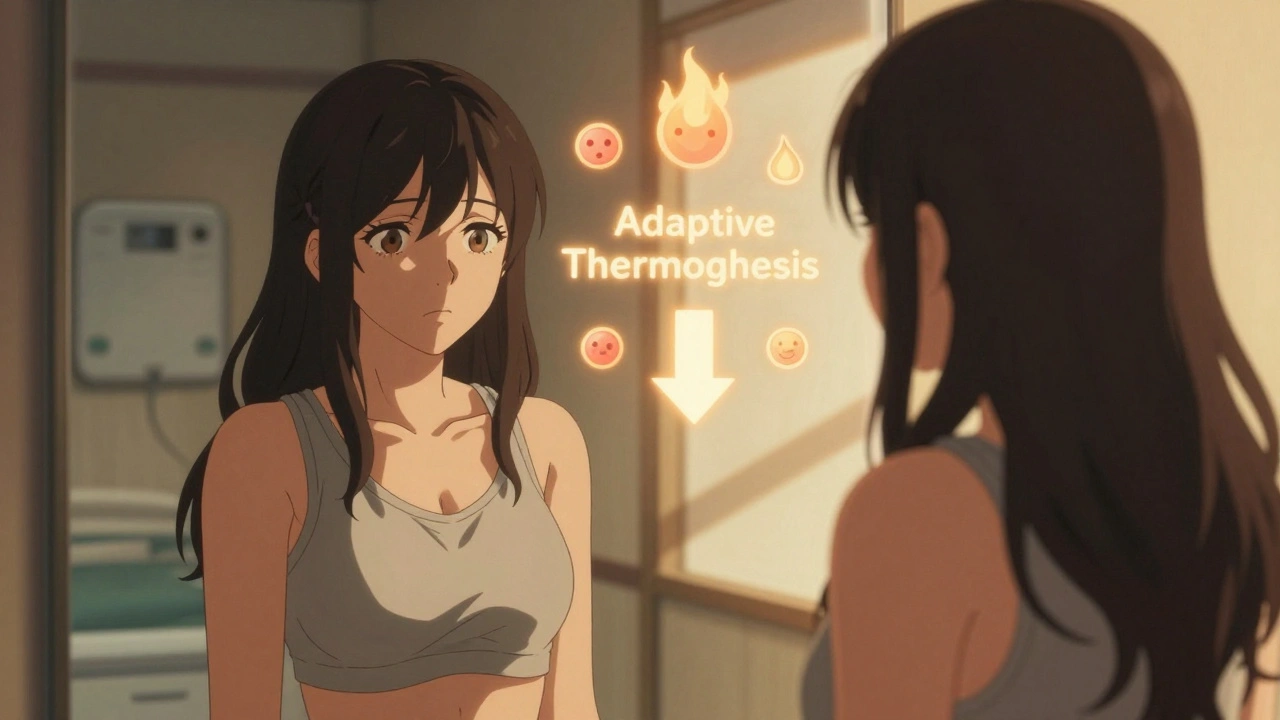
After losing 50 pounds, Sarah thought she’d finally beat her metabolism. She dropped from 210 to 160, hit her goal, and celebrated. But within six months, the weight crept back - not slowly, but steadily. She ate the same as when she was losing, maybe even less. Yet the scale wouldn’t budge. She wasn’t lazy. She wasn’t cheating. Her body had simply adaptive thermogenesis - a hidden, biological reset that lowered her calorie burn far beyond what her new weight should have allowed.
Why Your Metabolism Slows Down After Weight Loss
Your body doesn’t want you to lose weight. Not really. Evolution didn’t design us to thrive in calorie scarcity - it designed us to survive it. When you cut calories, your body doesn’t just burn fat. It starts conserving energy like a bank tightening its purse strings during a recession. That’s adaptive thermogenesis: your metabolism drops more than it should based on how much weight you lost. Let’s say you drop 20 pounds. Based on your new size, you should burn about 200 fewer calories a day. But adaptive thermogenesis can knock off another 100 to 300 calories on top of that. That’s like suddenly needing to eat 400 calories less just to stay the same weight. No wonder people regain. This isn’t just in people who lose weight on diets. It happens after bariatric surgery too - but less so. A 2016 study found that even though gastric bypass patients lost way more weight than those using bands, their metabolic slowdown was about the same. That means the surgery didn’t stop the adaptation - it just gave people a bigger buffer before the slowdown hit. The science is clear: this isn’t a myth. It’s measurable. In one study, people lost weight on a very low-calorie diet for 8 weeks, then maintained for 44 weeks. Their metabolism stayed depressed the whole time. Even after a year, they were burning hundreds of calories less than expected.What’s Actually Changing Inside Your Body
Your metabolism isn’t just a number on a calculator. It’s a complex system of hormones, nerves, and tissues working together. When you lose weight, your fat cells shrink - and they send out less leptin. Leptin tells your brain you have enough energy stored. Less leptin = your brain thinks you’re starving. That triggers a cascade:- Your thyroid slows down - less T3 hormone means your cells burn less fuel.
- Your sympathetic nervous system quiets down - less adrenaline and norepinephrine mean less heat production and movement.
- Your body reduces spontaneous movement - you fidget less, stand less, move more slowly without realizing it.
- Even your brown fat, the kind that burns calories to make heat, becomes less active.
Reverse Dieting: The Counterattack
Reverse dieting isn’t about getting fat. It’s about retraining your metabolism to burn more again - without gaining back everything you worked for. The idea is simple: after a long diet, slowly add calories back in - 50 to 100 per week - while keeping weight stable. You’re not trying to gain. You’re trying to reset. Here’s how it works in practice:- Start at your current maintenance calories (the amount you’re eating now without gaining or losing).
- Add 50 calories per week - mostly from carbs or fats, not protein.
- Weigh yourself every morning, same time, same conditions.
- If your weight stays stable for 2 weeks, add another 50.
- If you gain more than 0.5 pounds in a week, pause for another week before adding more.

What Doesn’t Work - And Why
A lot of people try reverse dieting wrong. They jump from 1,200 calories to 2,000 in two weeks. Boom - weight gain. Or they think they can eat whatever they want now. That’s not reverse dieting. That’s just bingeing. Here are the biggest mistakes:- Adding too fast: More than 150 extra calories per week almost always leads to fat gain. Your body needs time to adapt.
- Ignoring protein: You need 1.6 to 2.2 grams of protein per kilogram of body weight to protect muscle. Less protein = more muscle loss = slower metabolism.
- Skipping strength training: Lifting weights isn’t optional here. It’s essential. One study showed people who lifted 2-3 times a week during reverse dieting had 15% less metabolic slowdown than those who didn’t.
- Expecting miracles: Adaptive thermogenesis doesn’t vanish. It lessens. You won’t get back to your pre-diet burn rate - but you can get close enough to maintain without starving.
What Science Says About the Future
Researchers aren’t just watching this. They’re trying to fix it. A new drug in phase 2 trials targets brown fat to wake it up again. Early results show it cuts metabolic adaptation by 42%. That’s huge. But it’s still years away from the market. Meanwhile, a major NIH study is testing whether high-protein reverse dieting (40% protein) helps recover metabolism faster than standard diets. Early data says yes - people on high protein kept 18% more of their resting energy expenditure. Even your gut bacteria might play a role. A 2024 study found people with certain microbiome profiles had stronger adaptive thermogenesis. That means future tools might test your poop - not just your calories - to predict how your body will respond. And here’s the most important insight: adaptive thermogenesis isn’t your fault. It’s biology. You didn’t fail. Your body just did exactly what it was designed to do.
What You Can Do Today
You don’t need a lab test or a new drug. You need three things:- Start slow. Add 50 calories a week. Track your weight. Be patient.
- Move more - strategically. Lift weights 2-3 times a week. Walk daily. Don’t rely on cardio alone.
- Eat enough protein. Aim for 1.6-2.2g per kg of body weight. That’s about 120-160g for a 150-pound person.
Is Reverse Dieting Right for You?
It’s not for everyone. If you’ve only dieted for a few weeks, you probably don’t need it. If you’ve lost 10+ pounds over 6+ months and feel constantly tired, hungry, or cold - then yes. You’re likely in adaptive thermogenesis mode. It’s also not a free pass to eat junk. Reverse dieting is about rebuilding metabolic health, not undoing discipline. You’re not going back to your old eating habits. You’re upgrading them. Think of it like rebooting a computer. You’re not deleting your files. You’re clearing the cache so everything runs smoother.Does adaptive thermogenesis happen to everyone who loses weight?
Yes - but the degree varies. Everyone who loses weight experiences some level of metabolic slowdown beyond what their new body size predicts. Some people lose 50 extra calories a day. Others lose 300. Genetics, how much weight was lost, age, muscle retention, and hormone levels all play a role. Even lean individuals experience it - it’s not just about being overweight.
Can you reverse adaptive thermogenesis completely?
Not fully, but you can recover most of it. Research shows that after reverse dieting, resting metabolic rate improves significantly - often by 70-90% of the original loss. You likely won’t get back to your pre-diet burn rate, but you can get close enough to maintain your weight without extreme restriction. The goal isn’t perfection. It’s sustainability.
How long does reverse dieting take?
Typically 3 to 6 months. If you lost 50 pounds over a year, don’t expect to reverse diet in 30 days. The slower you go, the better the results. Rushing leads to regain. Most successful cases involve adding 50-100 calories per week, monitoring weight, and adjusting based on real data - not guesswork.
Do I need to track calories during reverse dieting?
Yes - at least at first. You need to know your starting point and how much you’re adding. After a few weeks, you can switch to intuitive eating if your weight stays stable. But without tracking, you won’t know if you’re adding too fast or too slow. Use an app like MyFitnessPal for the first 4-6 weeks to get accurate numbers.
Will reverse dieting make me gain weight?
If done correctly, no - or only minimally. The goal is to add calories without gaining fat. A small gain of 0.5-1 pound per month is normal as your body rebuilds muscle and glycogen stores. If you gain more than 1 pound per week, you’re adding too fast. Slow down. The scale isn’t the enemy - rapid gain is.
What if reverse dieting doesn’t work for me?
If you’ve followed the protocol for 6 months - slow calorie increases, strength training, high protein - and still can’t maintain weight, you may have a more complex metabolic issue. Talk to a registered dietitian or endocrinologist. You might benefit from hormone testing, gut microbiome analysis, or a metabolic rate test using indirect calorimetry. This isn’t failure - it’s data. Your body is telling you something.
If you’ve been stuck for months, wondering why you can’t lose - or keep off - weight, it’s not laziness. It’s biology. Adaptive thermogenesis is real. But so is your power to reset it. You don’t need another diet. You need a strategy that works with your body - not against it.

Comments (10)
Ella van Rij
Oh wow, another ‘metabolism is broken’ sob story. Let me grab my monocle and weep into my artisanal kale smoothie. Adaptive thermogenesis? How poetic. Next you’ll tell me my toaster is judging my toast choices. 🙄
ATUL BHARDWAJ
India also see this. Many people lose weight, then regain. Body is smart. Not lazy. Eat more slowly. Lift weights. Sleep well. That’s all.
Steve World Shopping
Adaptive thermogenesis is a classic example of homeostatic dysregulation mediated by leptin resistance and downregulated AMPK signaling in hypothalamic nuclei. Your brown adipose tissue isn’t ‘lazy’-it’s epigenetically silenced due to prolonged negative energy balance. Reverse dieting? It’s just re-sensitizing the leptin-melanocortin axis. Do you even track your RMR via DEXA or indirect calorimetry? Or are you just winging it with MyFitnessPal?
Rebecca M.
I did reverse dieting for 8 months. I gained 12 pounds. My jeans screamed. My therapist cried. My cat stopped cuddling. I’m not mad. I’m just… disappointed. 😭
Lynn Steiner
Ugh. I lost 40 lbs and now I’m colder than my ex’s heart. I’m always tired. My hair is falling out. My thyroid is probably crying in a corner. Why does my body hate me so much?? 💔 I just want to eat a bagel without feeling guilty.
Alicia Marks
You got this. Start slow. Add carbs. Lift heavy. You’re not broken-you’re rebuilding. One week at a time. 💪
Paul Keller
While I appreciate the anecdotal framework presented here, I must emphasize that the underlying physiological mechanisms of adaptive thermogenesis are not uniformly distributed across populations. The studies referenced, while methodologically sound, are largely derived from Western, educated, industrialized, rich, and democratic (WEIRD) cohorts. The applicability of reverse dieting protocols to individuals with different genetic, epigenetic, and cultural dietary histories remains underexplored. Furthermore, the assumption that caloric intake alone is the primary variable for metabolic recalibration ignores the profound impact of circadian alignment, sleep architecture, and micronutrient density. One cannot simply ‘reset’ a system that has been dysregulated by chronic stress, insulin resistance, and prolonged caloric restriction without addressing the root neuroendocrine dysfunctions. This is not a dieting problem-it’s a systemic adaptation to survival mode. Patience is not a strategy; it is a biological imperative.
Roger Leiton
Just tried reverse dieting last week-added 50 cals, now I’m eating a whole bag of chips and a tub of ice cream. My scale says ‘hi’ and my soul says ‘thank you.’ 🍦😂
Laura Baur
Let’s be brutally honest: most people who claim to have ‘adaptive thermogenesis’ are simply in denial about their inability to maintain discipline. You didn’t ‘reset’ your metabolism-you gave up. The fact that you’re even considering reverse dieting instead of just eating at maintenance proves you never truly understood energy balance. Protein? Strength training? Please. You think lifting weights is a magic bullet for metabolic resurrection? No. It’s just a Band-Aid on a hemorrhage. The real issue is your relationship with food, not your T3 levels. And if you’re still using MyFitnessPal after a year of dieting, you haven’t learned a single thing. This isn’t biology. It’s behavioral pathology disguised as science.
Jack Dao
Reverse dieting is just a fancy way of saying ‘I’m scared to eat normally again.’ You didn’t lose weight because you were disciplined-you lost it because you were starving. Now you want a trophy for not dying? Congrats. You survived. Now go eat a damn sandwich and stop treating your body like a lab rat. 😒