

When you’re traveling abroad and something goes wrong - a sudden allergic reaction, a fall, or a heart palpitation - the last thing you want is to struggle to explain what medications you’re taking. Emergency rooms don’t wait for translation apps to load. Paramedics don’t have time to guess if "heart pill" means aspirin, beta-blockers, or nitroglycerin. That’s why a multilingual medication list isn’t just helpful - it’s life-saving.
Imagine this: You’re in Tokyo, and your grandmother has a stroke. She’s confused, her speech is slurred, and she can’t say her name, let alone the names of her blood thinners. Without a clear list in Japanese, the ER team might miss her warfarin use entirely. A wrong dose of clot-busting drugs could kill her. But if she’s carrying a printed list with "ワルファリン 5mg 毎日1回" (warfarin 5mg once daily), the doctors act fast. No guesswork. No delay. That’s the power of a multilingual medication list.
What Belongs on Your Emergency Medication List
A good emergency list isn’t just a copy of your pharmacy receipt. It needs to be clear, complete, and easy for strangers to read - even if they don’t speak your language. Here’s what to include:
- Medication name - Use both brand and generic names. For example: "Lisinopril (Zestril)"
- Dosage - Always include the amount. "10 mg" not just "1 pill"
- Frequency - "Once daily," "Every 8 hours," "As needed for pain"
- Purpose - Why are you taking it? "For high blood pressure," "For diabetes," "For anxiety"
- Prescribing doctor - Name and clinic (if space allows)
- Start date - Helps doctors know if it’s new or long-term
- Herbal supplements and OTC drugs - Turmeric, ginkgo, ibuprofen, melatonin - these can interact dangerously with prescription meds
Don’t forget allergies. Write them clearly: "Allergic to penicillin - rash, swelling, trouble breathing." Include reactions, not just the drug name.
Which Languages Should You Use?
You don’t need to translate into every language on Earth. Focus on the ones you’ll actually need.
- Your home language - The version you understand best
- The language of your destination - If you’re going to Spain, use Spanish. If you’re traveling to Vietnam, use Vietnamese
- Your native language if you’re an immigrant - If you’re from Somalia but live in Australia, include Somali
- Any language spoken by family members who may accompany you - If your daughter speaks Mandarin, include it
According to the U.S. Census Bureau’s 2022 data, Spanish, Chinese, Tagalog, Vietnamese, and Arabic are the top five non-English languages spoken at home in the U.S. - and those are the languages most likely to be needed in emergency rooms worldwide. The Tennessee Pharmacists Association’s Universal Medication List (UML) covers exactly these: English, Spanish, Chinese, Vietnamese, Korean, Arabic, Russian, Somali, Nepali, and French. The NPS MedicineWise app adds Hindi, Persian, Punjabi, and Tamil - useful if you’re traveling to South Asia.
Where to Get Reliable Translated Lists
Don’t rely on Google Translate. Medical terms get butchered. "Take one tablet daily" becomes "Take one tablet one time daily" - and that’s not just awkward, it’s dangerous.
Use trusted sources:
- NPS MedicineWise (Australia) - Offers a free app (iOS and Android) with medication lists in 11 languages. You can type in your meds, set reminders, and print or email the list. It’s used by over 350,000 Australians monthly.
- Tennessee Pharmacists Association (TPA) UML - Available as a free PDF in 10 languages. Print it, fill it out, laminate it. Used in over 1,300 pharmacies across the U.S.
- MedlinePlus (U.S. National Library of Medicine) - Provides medication safety sheets in over 40 languages. Not interactive, but excellent for reference.
- British Red Cross Emergency Phrasebook - Not a medication list, but contains 150+ medical phrases in 36 languages. Use it alongside your list. Phrases like "I am taking..." and "I am allergic to..." can help you communicate when you’re too sick to speak clearly.
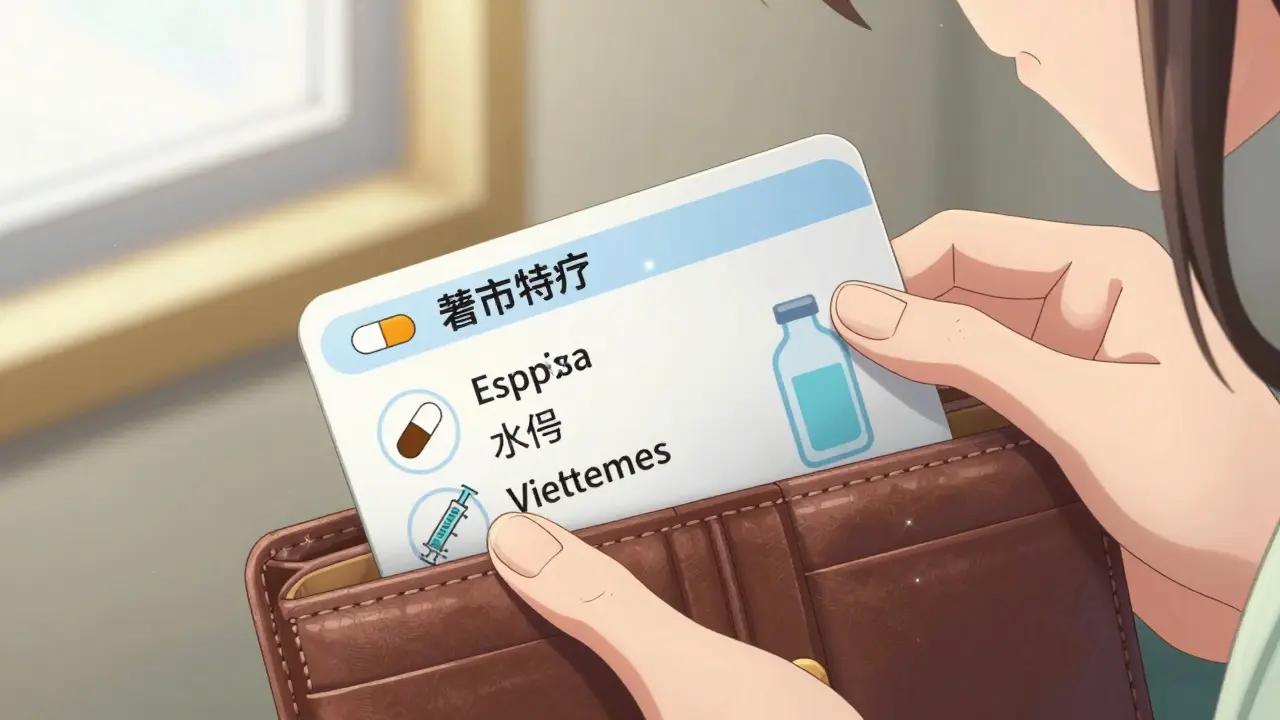
Pro tip: Download these resources before you travel. Save them to your phone, email them to yourself, and print a hard copy. Keep the printed version in your wallet. The digital version should be on a device you carry with you - not buried in a folder you’ll forget.
Digital vs. Paper: Which Works Better?
Both have strengths.
Digital lists (like the MedicineWise app) let you update meds in real time. If your doctor changes your dose next week, you tap a button and it updates everywhere. They can send alerts. They can share with family. But if your phone dies, or you lose it, you’re out of luck.
Paper lists don’t need batteries. They’re instantly visible to ER staff. They can be scanned or photographed. But they can get wet, torn, or lost. And if you don’t update them, they become dangerous - outdated info can lead to wrong treatment.
The best approach? Carry both. A laminated paper copy in your wallet. A digital copy on your phone with a screenshot saved to your home screen labeled "EMERGENCY MEDS."
How to Make Sure It Actually Works
Having the list isn’t enough. You need to make sure it’s usable.
- Use simple, clear terms - Avoid jargon. "Hypertension" becomes "high blood pressure." "Diabetes mellitus" becomes "diabetes."
- Check for dialects - Mandarin and Cantonese are different. Spanish from Mexico and Spain use different terms. Make sure your translation matches the region you’re visiting.
- Include traditional medicines - If you take ginger tea for nausea or turmeric for joint pain, write it down. Many ER staff don’t know these are medicines.
- Test it - Ask a friend who speaks the target language to read your list. Can they understand it? Can they explain it back?
- Update it every time you see a doctor - A 2022 study found 78% of medication errors happen during transitions of care. A list that’s six months old could be wrong.
Dr. Suzanne Rivera from Case Western Reserve University warns that translation alone isn’t enough. Cultural context matters. In some cultures, "taking medicine for the liver" means something very different than in the U.S. Make sure your purpose notes reflect how you understand your treatment - not just a literal translation.

What to Do in an Emergency
If you’re the patient:
- Hand your list to the first person who asks you questions - even if they’re not a doctor
- Point to the medication you’re having trouble with
- Use the British Red Cross phrases if you can’t speak: "I am allergic to..." or "I take this every day"
If you’re helping someone:
- Look for a folded paper in their wallet or phone case
- Check their watch or bracelet - some medical alert bracelets now include QR codes linking to digital lists
- Don’t assume they’re lying because they can’t explain it - they might be scared, in pain, or confused
Common Mistakes and How to Avoid Them
People make the same errors over and over:
- Only translating the brand name - "Lipitor" means nothing in Arabic. Write "atorvastatin" too.
- Leaving out supplements - 52% of LEP patients take herbal remedies, but 87% of lists don’t include them.
- Using slang - "My heart pill" isn’t helpful. Write "metoprolol 50mg daily for heart rhythm."
- Not updating - A 2021 study found 74% of pharmacies don’t remind patients to update their lists. You have to do it yourself.
- Using too many languages - A 20-page list in 12 languages is overwhelming. Stick to 3-4 essential ones.
One woman in Melbourne told me her son’s list had six languages. He got sick in Bali. The ER staff couldn’t find his meds. They had to call his aunt in Sydney to read the list aloud over Zoom. Simpler would have saved hours.
What’s New in 2026
Things are improving. In January 2024, the CDC added medication safety sheets in Amharic, Hmong, Karen, and Tibetan - targeting refugee populations. Google now shows translated medication info directly in search results for 100+ drugs across 30 languages. The American Pharmacists Association is finalizing national guidelines for 2025 that will require pharmacies to offer lists in languages matching local demographics.
But until those rules are everywhere, you can’t wait. The tools are here now. Use them.
Can I just use a translation app during an emergency?
No. Translation apps are too slow and unreliable in emergencies. They need internet, battery, and time to load. In a cardiac arrest or allergic reaction, every second counts. A printed, pre-translated list is instant. Use apps to create your list - not to use it during an emergency.
What if my language isn’t covered?
If your language isn’t available, create your own list using the standard format (medication, dosage, purpose, etc.) and hire a certified medical translator. Many universities or community health centers offer low-cost translation services. Avoid free online tools. A $20 professional translation could save your life. You can also use the British Red Cross Phrasebook to explain: "This is my medicine list. Please call my doctor."
Should I include over-the-counter drugs and supplements?
Yes. OTC meds like ibuprofen, antihistamines, or herbal supplements like St. John’s Wort can cause dangerous interactions with prescription drugs. In fact, 43% of medication errors in LEP patients involve unreported supplements. Write them all down.
How often should I update my list?
Update it every time you see a doctor, pharmacist, or change a dose. A 2022 study found 78% of medication errors happen during care transitions - like after a hospital stay or a new prescription. Don’t wait for your annual checkup.
Is there a mobile app I can use?
Yes. The NPS MedicineWise app (free on iOS and Android) is one of the best. It supports 11 languages, sends reminders, and lets you email or print your list. It’s used by over 350,000 Australians monthly. Other apps exist, but this one is backed by Australia’s national health authority and has been tested in real emergency scenarios.

Comments (14)
tynece roberts
i just printed mine in english, spanish, and vietnamese cause my mom’s from saigon and we travel there every year. i laminated it and stuck it in my wallet next to my insurance card. no more panic when she forgets her meds. also, i spelled "warfarin" wrong the first time and almost gave her the wrong dose. lol. never do that. check your spelling. 🤦♀️
Byron Boror
Why are we translating meds for foreigners? If you can’t speak English in an emergency, maybe you shouldn’t be traveling. This is just inviting chaos. We’ve got enough problems without making ERs into UN meetings.
Lorna Brown
This is actually one of the most thoughtful public health pieces I’ve read in years. It’s not just about language-it’s about dignity. When someone’s in cardiac arrest, they’re not a "foreigner" or a "non-English speaker." They’re a human being who deserves to be understood. The fact that we still treat medical communication as a privilege instead of a right says a lot about our system. Also, I’m adding Somali and Arabic to my list-my neighbor’s son is from Mogadishu and he saved my life last winter when I passed out. He knew exactly what my meds were because his mom had the same list. That’s community care right there.
Rex Regum
Oh wow. So now we’re translating everything into every language under the sun? Next thing you know, they’ll be printing "I AM ALLERGIC TO PENICILLIN" in Klingon. This isn’t a travel guide, it’s a surrender. We’re becoming a nation that apologizes for existing. If you can’t handle English, stay home. Or better yet-learn it. This is how cultures die. 🙄
Kelsey Vonk
Just made mine with English, Mandarin, and Spanish. I added little heart emojis next to the insulin and the blood pressure meds 😊. Also, I used the NPS app and it auto-updates when my pharmacy changes my dose. So cool. I feel like a superhero now. Also, I emailed it to my sister, mom, and my cat. (Okay, not the cat. But I could’ve.)
Jimmy V
10/10. I’m a paramedic. This list is gold. I’ve seen 3 deaths in 2 years because someone didn’t know what "heart pill" meant. One guy had 12 meds. None were labeled. He was clutching his chest, babbling in Tagalog. We had to call his cousin on FaceTime. Don’t wait. Print it. Laminate it. Carry it. And for god’s sake-include your turmeric. That stuff thins blood like a cheap wine. I’ve seen ERs shut down over it.
Richard Harris
brilliant idea. i just made mine in english and welsh-my nan’s from cardiff and she insists on speaking it even in hospital. i used the british red cross phrasebook too. added "i need a doctor" in 3 languages. also, i forgot to mention my vitamin d. whoops. will update tonight. 🙏
Kandace Bennett
Ugh. I’m so glad I’m not the only one who thought of this. I mean, really-how have we been this backward? I’ve got mine in English, French, Arabic, and Mandarin. I even got it professionally translated by a UN interpreter (yes, I know someone). I carry it in a gold-embossed wallet. You’re not really prepared unless you look like you’re about to save a president. 💅
Tim Schulz
Oh, so now we’re doing multicultural medicine bingo? "Here’s your warfarin in Vietnamese! And here’s your ibuprofen in Somali! And here’s your kombucha in Korean!" This isn’t healthcare. This is a Pinterest board for people who think "diversity" means printing 17 languages on a Post-It. Next up: ER staff required to learn sign language, Morse code, and dolphin communication. 🤡
Jinesh Jain
I live in Delhi and my mom takes ayurvedic herbs. I made a list in English and Hindi. I included "ashwagandha 500mg twice daily" and "turmeric paste with black pepper." The pharmacist at AIIMS said it was the clearest list he’d seen. No emojis. No drama. Just facts. Simple works.
douglas martinez
Thank you for this comprehensive and deeply considered guide. The inclusion of cultural context, the emphasis on updating protocols, and the clear delineation between digital and physical formats reflect an exceptional understanding of both clinical safety and human dignity. I strongly encourage all healthcare providers to adopt this model as a standard of care. This is precisely the kind of innovation that reduces disparities and saves lives.
Sabrina Sanches
YES! I just did mine! English and Spanish! I forgot my fish oil! I’m adding it now! I printed it on glitter paper! I’m so proud!! I love this!! 😍😍😍
Shruti Chaturvedi
My mother is from Kerala and she takes curry leaves and neem. I wrote it in English and Malayalam. The hospital in Kochi recognized it immediately. No need for fancy apps. Just clear words. And kindness. That’s what matters.
Katherine Rodriguez
Ugh this whole thing is so extra. I mean really. Who has time for this? My grandma just says "I take my pills" and the doctors figure it out. This is just woke nonsense. I’m not printing 5 languages. I’m not even printing one. If I die, I die. At least I didn’t waste my weekend on this.