
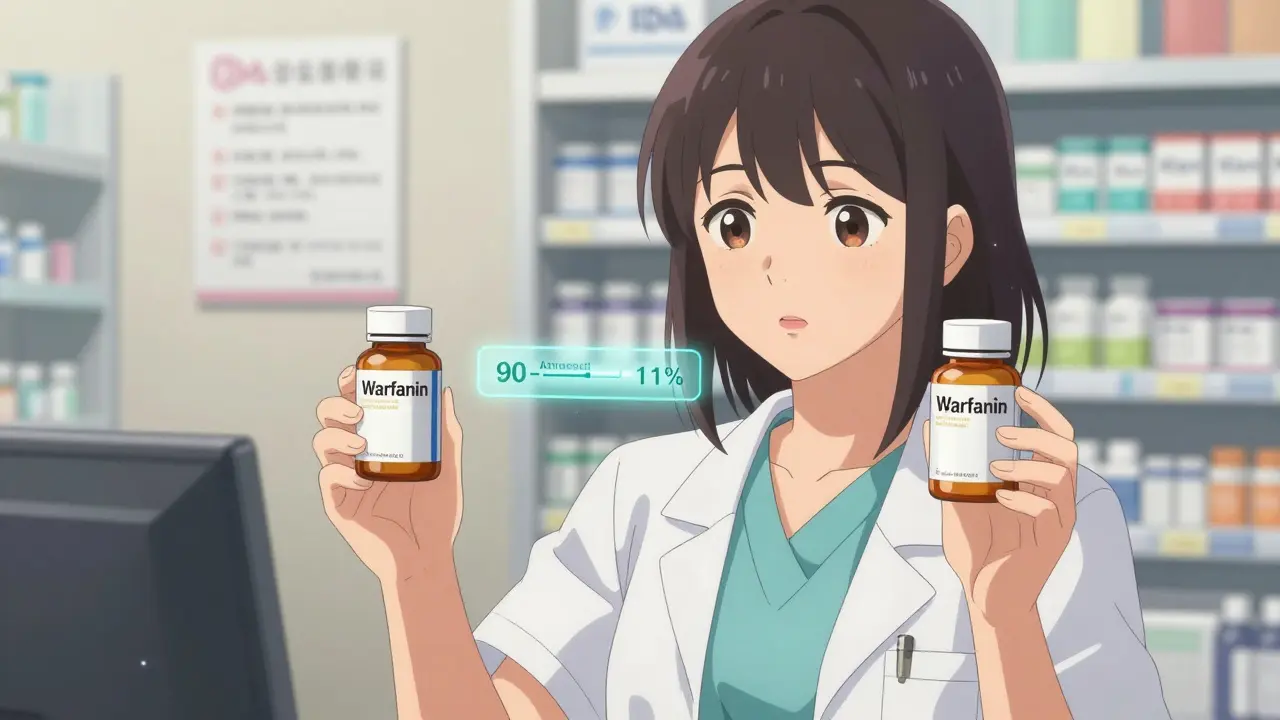
When you take a medication like warfarin, digoxin, or phenytoin, even a tiny change in your blood level can mean the difference between effective treatment and serious harm. These are NTI drugs - narrow therapeutic index drugs - and the FDA treats them differently than regular generics. The rules for proving they work the same as the brand-name version aren’t just stricter; they’re built for safety in ways most people don’t realize.
What Makes a Drug an NTI Drug?
An NTI drug has a very small window between the dose that works and the dose that causes harm. The FDA defines these drugs using a clear metric: if the ratio of the minimum toxic dose to the minimum effective dose is 3 or less, it’s an NTI drug. That means if your body needs 10 mg to get better, and 30 mg or less could hurt you, you’re dealing with an NTI drug.
This isn’t just theory. The FDA analyzed 13 drugs and found that 10 of them fit this 3-or-less threshold. Examples include carbamazepine for seizures, tacrolimus for organ transplants, lithium for bipolar disorder, and warfarin for blood clots. These aren’t obscure drugs - they’re used by hundreds of thousands of patients every day.
But here’s the catch: the FDA doesn’t publish a public list of all NTI drugs. Instead, they identify them case by case through product-specific guidance documents. If you’re a pharmacist or a patient, you won’t find a simple checklist. You have to look at the official guidance for each drug to know if it’s classified as NTI.
Why Standard Bioequivalence Rules Don’t Work for NTI Drugs
For most generic drugs, the FDA says they’re equivalent if their blood levels fall within 80% to 125% of the brand-name drug. That’s called average bioequivalence (ABE). It works fine for drugs where a 20% difference won’t hurt - like antibiotics or blood pressure pills.
But for NTI drugs, that 20% gap is dangerous. A 20% drop in warfarin could mean a blood clot. A 20% spike in digoxin could trigger a fatal heart rhythm. In 2010, the FDA’s advisory committee voted 11-2 that the standard 80-125% range was unsafe for these drugs. They recommended something tighter: 90% to 111%.
That’s not a small tweak. It’s a fundamental shift. The FDA didn’t just tighten the range - they built a whole new testing system around it.
The FDA’s Dual-Approval System for NTI Drugs
The current FDA standard for NTI drugs isn’t one test - it’s two. A generic version must pass both:
- Reference-Scaled Average Bioequivalence (RSABE): This looks at how much the drug’s levels vary from person to person. If the brand-name drug has low variability, the generic must match it closely. The upper limit of the confidence interval for the ratio of within-subject variability between the test and reference drug must be ≤ 2.5.
- Conventional Average Bioequivalence (ABE): Even if the RSABE passes, the generic must still fall within the 80-125% range. This acts as a safety net.
On top of that, the 90% confidence interval for the geometric mean ratio of the generic to brand must be entirely within 90.00% to 111.11%. That’s the tightest allowed range in U.S. drug regulation.
These aren’t just statistical tricks. They’re based on real-world data. The FDA used pharmacometric models to figure out what sample sizes and statistical power were needed to ensure 80% of studies would correctly identify true equivalence. The goal: no false positives. No generics approved that shouldn’t be.
Quality Control Is Even Tighter
Bioequivalence isn’t the only hurdle. The quality standards for NTI generics are stricter too.
For regular drugs, the active ingredient must be within 90-110% of the labeled amount. For NTI drugs, that range shrinks to 95-105%. That’s half the allowable variation. It means manufacturers have to control their production processes with far greater precision.
Why does this matter? Because even small batch-to-batch differences can add up. If a generic pill varies by 5% in potency and the patient’s metabolism shifts slightly, you could drift out of the safe range. That’s why the FDA demands tighter control - not just in the final product, but in every step of manufacturing.
How Are These Drugs Tested?
Standard bioequivalence studies use a two-period crossover design: patients take the brand, then the generic, or vice versa. But for NTI drugs, the FDA requires replicate designs. That means each patient takes the drug multiple times - often three or four doses - to measure how consistent the body’s response is.
This isn’t just more work. It’s more expensive. Replicate studies need more participants, more blood draws, and more complex analysis. That’s one reason why fewer companies make generic NTI drugs - the cost and complexity are high.
Studies on tacrolimus, for example, showed that even when two generic versions passed FDA standards individually, they didn’t always behave the same when swapped back and forth in patients. That’s why the FDA doesn’t assume all NTI generics are interchangeable with each other - only that each is equivalent to the original brand.
What About Other Countries?
The U.S. approach is unique. Health Canada and the European Medicines Agency (EMA) often just tighten the bioequivalence range to 90-111% and call it done. The FDA’s method is more sophisticated - it scales the limits based on how variable the brand-name drug is in real patients.
This means a drug with high variability might get slightly wider limits, while one with low variability gets tighter ones. It’s more precise, but also more complex. The FDA admits this makes global harmonization harder. Other agencies don’t use the same statistical models, so a generic approved in the U.S. might not automatically be accepted elsewhere.

Are NTI Generics Safe? The Evidence
There’s been a lot of debate, especially around antiepileptic drugs. Some doctors and patients worry that switching from brand to generic could trigger seizures. Studies show that, statistically, generic versions of carbamazepine and phenytoin are equivalent under FDA standards. Real-world data from large patient databases also support this.
But perception matters. Some states still require patient consent before substituting an NTI generic. Some pharmacists refuse to swap them without explicit approval. That’s not because the FDA’s standards are flawed - it’s because the fear is real, even if the risk is low.
The FDA’s position is clear: if a generic NTI drug meets their criteria, it’s therapeutically equivalent. They’ve approved hundreds of these generics. No widespread safety crisis has emerged. But they also acknowledge that education is needed - for prescribers, pharmacists, and patients.
What This Means for Patients
If you’re on an NTI drug, you’re not at higher risk just because you’re taking a generic. The FDA’s system is designed to catch any product that might cause harm. The tighter limits, replicate studies, and stricter quality controls all work together to protect you.
But if your doctor or pharmacist says you can’t switch, it’s not always about safety - it’s about policy. Some states have laws that block automatic substitution for NTI drugs, even if the FDA says it’s fine. Talk to your provider. Ask if your drug is classified as NTI. And don’t assume a generic is unsafe just because it’s cheaper.
The bottom line: NTI generics are held to the highest standard in U.S. drug regulation. The system isn’t perfect, but it’s built on data, not fear. And for patients who rely on these drugs, that’s the best kind of protection.
What drugs are considered NTI drugs by the FDA?
The FDA doesn’t publish a public list, but commonly recognized NTI drugs include warfarin, digoxin, phenytoin, carbamazepine, lithium, tacrolimus, cyclosporine, everolimus, and valproic acid. These are identified through product-specific guidance documents, not a centralized catalog. The classification is based on pharmacometric criteria, primarily a therapeutic index of 3 or less.
Why is the bioequivalence range for NTI drugs 90-111% instead of 80-125%?
A 20% difference in blood concentration can lead to serious side effects or treatment failure for NTI drugs. The 80-125% range used for most generics is too wide for these medications. The 90-111% range was recommended by the FDA’s advisory committee in 2010 after reviewing evidence that even small variations could be dangerous. This tighter limit ensures generic versions deliver nearly identical exposure to the brand-name drug.
Do NTI generics have to be tested differently than regular generics?
Yes. NTI drugs require replicate bioequivalence studies, meaning patients take the drug multiple times (often three or four doses) to measure within-subject variability. This allows regulators to use scaled bioequivalence methods that account for how much the brand-name drug’s levels fluctuate naturally. Standard two-period crossover studies aren’t sufficient.
Can I safely switch from a brand-name NTI drug to a generic?
According to the FDA, yes - if the generic has met their strict NTI bioequivalence standards. All approved NTI generics are considered therapeutically equivalent to their brand-name counterparts. However, some states require patient consent before substitution, and some clinicians remain cautious due to anecdotal reports. Always consult your doctor before switching, especially if you’ve had stability issues with your current medication.
Why don’t all generic manufacturers make NTI drugs?
The testing and manufacturing requirements are significantly more complex and expensive. Replicate studies require more participants, more blood samples, and advanced statistical analysis. Quality control must be within 95-105% instead of 90-110%. These barriers reduce the number of companies willing to enter the market, which can limit competition and keep prices higher than for standard generics.
What’s Next for NTI Drug Regulation?
The FDA continues to refine how it classifies NTI drugs. In 2022, they moved toward using the therapeutic index ≤ 3 as the primary quantitative criterion, making the process more objective. They’re also working on more transparent product-specific guidance documents that spell out exact requirements for each drug.
One challenge remains: global alignment. The U.S. uses a scaled approach. Europe and Canada use fixed limits. That means a generic approved in the U.S. might need new testing to be sold elsewhere. The FDA has said harmonizing these standards is a priority.
For now, the system works. Thousands of patients safely use generic NTI drugs every day. The FDA’s standards - though complex - are grounded in real data, not guesswork. And for drugs where the margin for error is razor-thin, that’s exactly what patients need.

Comments (12)
Susie Deer
Why are we even talking about this like it’s some big secret? The FDA’s rules are clear and they’re the gold standard. If you want safe meds, you don’t cut corners. End of story.
TooAfraid ToSay
Oh wow so the FDA is suddenly the moral compass of global pharma? Next they’ll tell us the moon landing was real and pizza is healthy. Wake up people - this is just corporate control dressed up as science.
Dylan Livingston
Let me get this straight - we’re celebrating a regulatory framework that requires *replicate studies*, *scaled bioequivalence*, and *95-105% potency control*… and somehow this is considered *basic*? How is this not a national triumph? Meanwhile, the rest of the world is still operating on 1980s assumptions while we’re doing pharmacometric ballet. Honestly, I’m embarrassed for anyone who thinks this is overkill. You wouldn’t let a 5% variance in your insulin pump - why treat your brain like it’s disposable?
And don’t even get me started on the fact that patients are still being told to ‘just switch’ without context. This isn’t about fear. It’s about informed consent. The FDA didn’t make this harder to scare people - they made it harder because they actually care if you live or die.
Also, can we please stop pretending that ‘generic’ means ‘identical’? It doesn’t. It means ‘meets the minimum bar.’ And for NTI drugs, that bar is set by people who’ve seen patients die because someone thought 125% was fine.
Andrew Freeman
fr tho why do we even need all this math? i mean if the pill looks the same and costs less why not just let people try it? my cousin took generic warfarin for 2 yrs and never had an issue
says haze
It’s fascinating how society conflates cost-efficiency with safety. The FDA’s NTI framework isn’t bureaucratic overreach - it’s the only rational response to a biological reality where a 10% fluctuation can induce seizures, embolisms, or organ rejection. What’s truly irrational is the cultural insistence that ‘all generics are equal’ - a myth perpetuated by those who don’t understand pharmacokinetics or have never held a loved one as they seize because someone thought ‘close enough’ was acceptable.
The 90-111% range isn’t arbitrary. It’s derived from population-level variance modeling, validated through thousands of data points. It’s not ‘tougher’ - it’s *accurate*. And yet, we still have pharmacists refusing substitutions based on anecdote, not evidence. That’s not caution. That’s ignorance masquerading as care.
And let’s not pretend the global community’s ‘simpler’ standards are better. Canada and the EMA use fixed ranges because they lack the infrastructure to model within-subject variability. That’s not innovation - it’s statistical laziness. The U.S. system is complex because biology is complex. Stop demanding simplicity where precision is non-negotiable.
Henry Sy
Y’all act like the FDA’s got some magic wand here. Real talk - if you’re on lithium or tacrolimus and you switch generics, your bloodwork goes haywire. I’ve seen it. Docs don’t wanna deal with the fallout so they just say ‘stick with brand.’ That’s not fearmongering - that’s survival. The FDA says it’s safe? Cool. But the clinic floor doesn’t care about confidence intervals - it cares about who’s in the ER this weekend.
And yeah, the cost? Of course it’s higher. That’s why only 3 companies make generic tacrolimus. And yeah, that’s why prices stay high. The FDA didn’t fix the market - they just made sure the ones who *do* make it don’t kill people.
Anna Hunger
Thank you for this meticulously detailed and scientifically accurate breakdown. The FDA’s approach to NTI drugs represents one of the most robust patient-safety frameworks in modern pharmacology. It is imperative that prescribers, pharmacists, and patients alike understand that bioequivalence for these agents is not a matter of regulatory preference - it is a matter of physiological necessity. The data is unequivocal, the standards are evidence-based, and the consequences of deviation are catastrophic. Continued education and transparency are essential to bridge the gap between regulatory science and public perception.
Allison Deming
It’s appalling how many people treat life-saving medications like they’re interchangeable consumer goods. You wouldn’t swap out the brake pads on your car with ‘close enough’ parts - why do you think your brain or heart deserves less? The FDA’s standards for NTI drugs are not ‘overregulation’ - they’re the bare minimum required to prevent preventable deaths. And yet, we still have state laws that require consent for substitution, not because the science is in doubt, but because public fear has been weaponized by those who profit from confusion. The real crisis isn’t the generics - it’s the misinformation.
And for those who say ‘my cousin took it fine’ - that’s not data. That’s anecdote. One person surviving a change doesn’t invalidate the statistical reality that hundreds have died because of it. The FDA doesn’t regulate for the lucky. It regulates for the vulnerable.
Alvin Bregman
im not saying the fda is wrong but why cant we just make a list? like a simple pdf? why make everyone dig through guidances like its a treasure hunt? i just wanna know if my med is ntis or not without a phd in stats
Sarah -Jane Vincent
EVERYTHING about this is a setup. The FDA doesn’t want you to know - but the same companies that make the brand-name drugs also control the testing labs. They design the studies. They pick the models. They decide what’s ‘safe.’ And now they’re using ‘complex math’ to justify why you can’t get a cheap generic. This isn’t safety - it’s a monopoly disguised as science. They want you to pay $500 for your warfarin so they can keep their profits. Don’t be fooled.
Jason Yan
I’ve been on tacrolimus for 12 years. Switched from brand to generic twice. Had my levels checked every time. Never had a spike or dip. The system works - not because it’s perfect, but because it’s *rigorous*. The FDA didn’t make this hard to be annoying. They made it hard because people’s lives are on the line. And yeah, it costs more. But so does an ICU stay. So does a transplant rejection. So does a seizure you can’t stop. This isn’t bureaucracy - it’s responsibility. And honestly? I’m glad someone’s doing it right.
Also, to the guy who said ‘my cousin’s fine’ - that’s great. But your cousin isn’t me. And I’m not gambling with my immune system because someone thinks ‘close enough’ is a good policy.
shiv singh
Who gave the FDA the right to decide what’s safe? You think they care about patients? They care about lawsuits. They care about liability. They make these rules so when someone dies, they can say ‘we followed protocol.’ This isn’t science - it’s legal armor wrapped in jargon. And the fact that you people cheer this? That’s the real tragedy.