
MAOI-Ephedrine Interaction Checker
WARNING: This Interaction Can Be Fatal
Combining ephedrine with MAO inhibitors can cause blood pressure to spike above 200 mmHg within minutes. This is a medical emergency that has caused deaths.
Do not take any stimulants (including cold medicine) if you are taking or have recently taken an MAOI.
Check Your Risk
Results will appear here after clicking "Check Risk"
Combining ephedrine with MAO inhibitors isn't just risky-it's potentially deadly. This isn't a theoretical warning. People have died from it. And it still happens today, even though these drugs aren't used as often as they once were.
Ephedrine shows up in many places you wouldn't expect. It's in some over-the-counter cold medicines, weight loss supplements, and even energy boosters. MAO inhibitors, on the other hand, are antidepressants. They're not first-line treatment anymore, but they still work for people who haven't responded to anything else. When these two meet in the body, they trigger a chain reaction that can send blood pressure skyrocketing in minutes.
What Happens When Ephedrine Meets an MAOI?
Your body naturally breaks down chemicals like norepinephrine using an enzyme called monoamine oxidase. MAOIs block this enzyme. That's how they help with depression-they let serotonin, dopamine, and norepinephrine stick around longer in the brain.
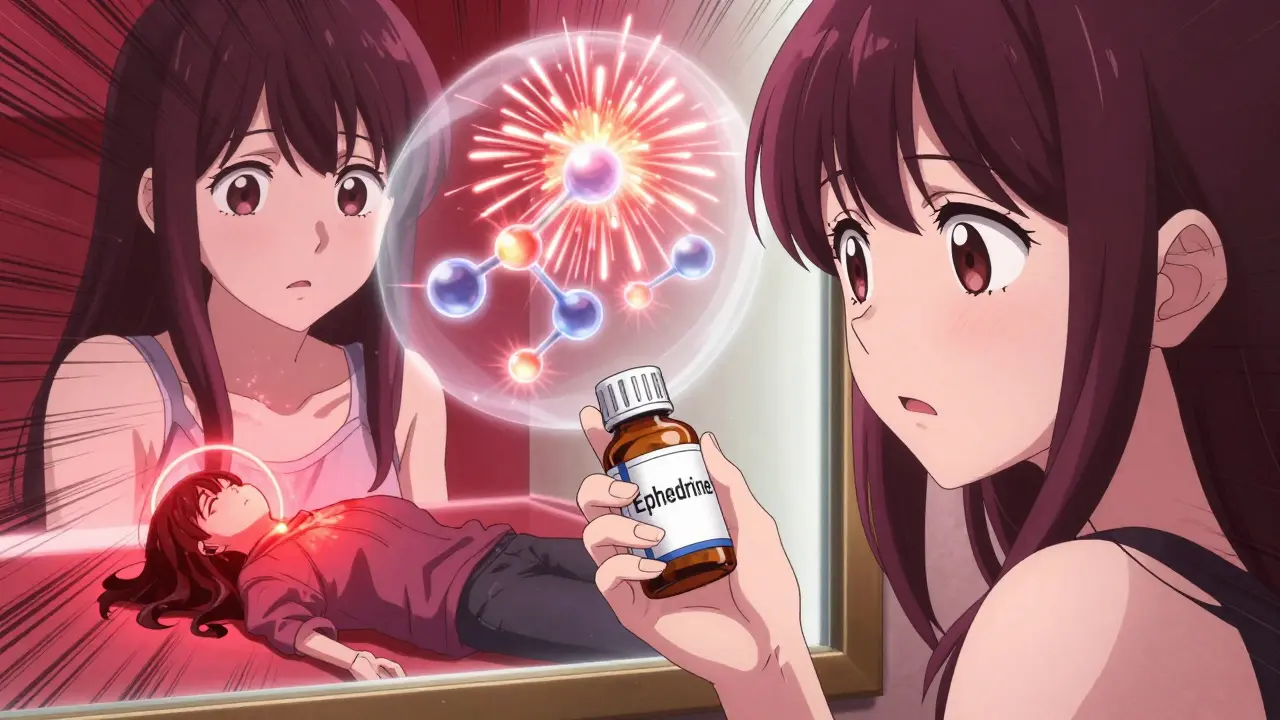
Ephedrine does something different but just as dangerous. It forces nerve endings to dump more norepinephrine into your system. Normally, your body would clear the excess. But with an MAOI in the mix, there's no cleanup crew. The result? A flood of norepinephrine that your blood vessels can't handle.
The numbers are terrifying. Systolic blood pressure can jump past 200 mmHg within 30 to 120 minutes after taking ephedrine while on an MAOI. That's higher than what you'd see in a heart attack or stroke. And it doesn't take much. A single 25 mg dose of ephedrine-common in OTC cold pills-is enough to trigger a crisis.
The Symptoms: When Your Body Starts Screaming
Most people don't realize what's happening until it's too late. The symptoms come fast:
- Severe headache, often starting at the back of the head and spreading forward
- Chest pain that feels like pressure or squeezing
- Heart racing or pounding so hard you can feel it in your throat
- Nausea, vomiting, sweating
- Dilated pupils, sensitivity to light
- Blurred vision or seeing spots
- Stiff neck, confusion, loss of consciousness
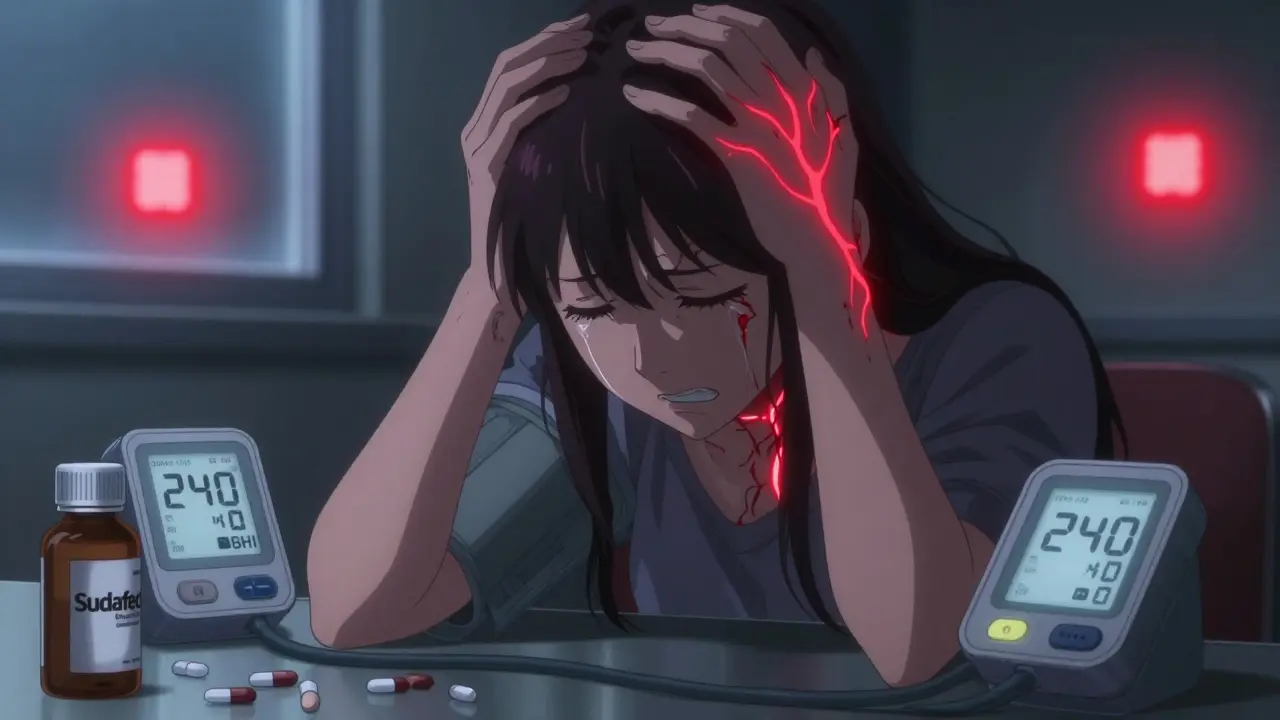
One 32-year-old man in a 2018 case report took a standard dose of ephedrine for a cold while on phenelzine (Nardil). His blood pressure hit 240 mmHg. He suffered a brain hemorrhage. He survived, but barely. His story isn't unique.
Reddit threads from users on MAOIs are full of similar accounts. One person wrote: "I took a Sudafed for my sinus infection. Within 20 minutes, I felt like my head was going to explode. I thought I was having a stroke. I called 911." Another said, "My vision went white. I couldn't speak. I thought I was dying."
Why This Interaction Is Still a Problem in 2026
You might think MAOIs are rare. They are-but not gone. Around 500,000 Americans are still prescribed them today, mostly for treatment-resistant depression or atypical depression. And many of them don't know what's dangerous.
Doctors outside psychiatry often don't know about the interaction. A 2021 study in JAMA Internal Medicine found that 22% of people on MAOIs got at least one contraindicated drug within 30 days of being prescribed. Often, it was a simple cold medicine from a primary care doctor or urgent care clinic.
Even worse, the risk doesn't go away when you stop the MAOI. Monoamine oxidase enzymes take 2 to 3 weeks to regenerate. That means if you quit your MAOI on Monday, you're still at risk if you take ephedrine on Friday-or even two weeks later.
What Drugs Are Actually Dangerous?
It's not just ephedrine. Any stimulant that releases norepinephrine is dangerous. That includes:
- Pseudoephedrine (Sudafed)
- Phenylephrine (found in many "Sudafed-free" cold pills)
- Phenylpropanolamine (banned in the U.S. but still in some foreign products)
- Epinephrine (in EpiPens-yes, even emergency epinephrine can be risky)
- Some herbal stimulants like bitter orange or guarana
Even foods can be a problem. Aged cheese, cured meats, tap beer, and fermented soy products contain tyramine-a compound that also triggers norepinephrine release. But the real danger is when food and drugs combine. One person on a Reddit thread said, "I had a glass of red wine and a sandwich with salami. I took a decongestant two hours later. I ended up in the ER."
What to Do If You're on an MAOI
There's only one safe rule: Never take ephedrine or any stimulant while on an MAOI. Not even once. Not even if you think "it's just a little."
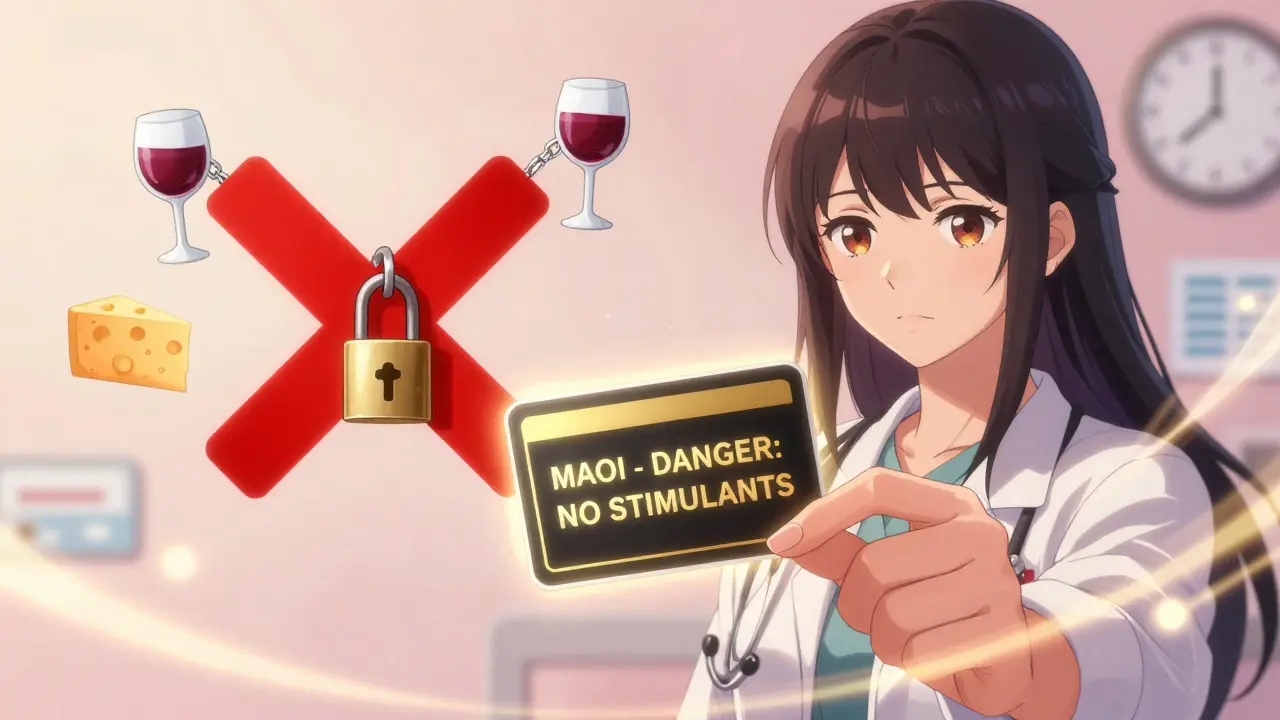
If you're prescribed an MAOI, get a written list from your doctor. Keep it in your wallet. Some people carry an "MAOI alert card"-like a medical ID bracelet but smaller. A 2022 Mayo Clinic survey found 87% of people who used one avoided accidental exposure.
Before taking any new medication-even a cough syrup or allergy pill-check with your pharmacist. Don't assume it's safe because it's "over-the-counter." Many OTC drugs are just as dangerous as prescription ones in this context.
What If You Accidentally Take Them Together?
If you or someone else takes ephedrine while on an MAOI and starts having symptoms, call 911 immediately. Don't wait. Don't try to "wait it out."
Emergency treatment is specific. The drug of choice is phentolamine, given intravenously. It works fast to reverse the blood pressure spike. Sublingual nifedipine (a common blood pressure pill) is not safe-it can drop pressure too fast, causing a stroke.
Even after treatment, the patient needs monitoring. Blood pressure can rebound. The body takes time to clear the excess chemicals. Hospitalization is often required.
Is There Any Hope for Safer Options?
Yes-but not much. In 2023, the FDA approved a new MAOI called befloxatone. It's reversible, breaks down in 6 hours, and requires 10 times more tyramine to trigger a crisis. Early studies show a 90% lower risk. But it's still brand new. Only a handful of clinics are using it.
Meanwhile, research is underway to test wearable blood pressure monitors that can alert patients to early signs of a crisis. The goal? Catch it before it becomes life-threatening.
But right now, the safest approach hasn't changed: avoid the combination entirely. No exceptions. No "maybe it's okay this time."
Why MAOIs Are Still Used at All
It's brutal, but true: for some people with severe, treatment-resistant depression, MAOIs are the only thing that works. They're more effective than SSRIs or SNRIs for certain types of depression-especially when fatigue, oversleeping, and weight gain are part of the picture.
That's why they haven't been pulled from the market. But their use is now tightly controlled. In 2022, the FDA required every MAOI prescription to come with a patient medication guide that spells out the risks in plain language. Pharmacies now flag these prescriptions in their systems. And many clinics require patients to sign a form acknowledging they understand the dangers.
Still, mistakes happen. People forget. New doctors don't know. And cold medicine labels don't always say "avoid if taking antidepressants."
Can I take ephedrine if I stopped my MAOI a week ago?
No. Even if you stopped your MAOI a week ago, you're still at high risk. Monoamine oxidase enzymes take 2 to 3 weeks to fully regenerate after an irreversible MAOI like phenelzine or tranylcypromine. Taking ephedrine too soon can still trigger a hypertensive crisis. Wait at least 14 days, and if you're unsure, check with your doctor.
Are all MAOIs equally dangerous with ephedrine?
Most are. Irreversible MAOIs like phenelzine (Nardil), tranylcypromine (Parnate), and isocarboxazid (Marplan) are the most dangerous because they permanently disable the enzyme for weeks. Selegiline (Emsam) at low doses (6 mg/day patch) carries less risk because it mainly targets MAO-B, but even then, ephedrine is still not recommended. Moclobemide is reversible and safer, but still not risk-free. Bottom line: no MAOI is completely safe with ephedrine.
What about pseudoephedrine? Is that safer than ephedrine?
No. Pseudoephedrine works the same way as ephedrine-it releases norepinephrine. It's just slightly less potent. But in combination with an MAOI, even a 30 mg dose of pseudoephedrine can cause a hypertensive crisis. The FDA and medical guidelines treat them as equally dangerous.
Can I use ephedrine if I'm not on an MAOI but take another antidepressant?
SSRIs and SNRIs don't carry the same risk as MAOIs. But combining ephedrine with any antidepressant can still raise blood pressure. It's not as dangerous as with MAOIs, but it's still not recommended. Always check with your doctor before mixing stimulants with any psychiatric medication.
What should I do if I accidentally take ephedrine while on an MAOI?
Call 911 immediately. Do not drive yourself. Do not wait to see if symptoms get worse. Symptoms can progress from headache to stroke or death within an hour. Emergency responders will administer phentolamine, which is the only safe treatment. Do not take any other blood pressure medication on your own.

Comments (8)
Arshdeep Singh
Let me break this down for you real simple: ephedrine + MAOI = biological suicide pact. No gray area. No "maybe it'll be fine." You think you're just popping a Sudafed for a stuffy nose? Nah. You're basically pouring gasoline on a lit match and calling it "self-care." I've seen this play out in ERs - the headache, the chest tightness, the pupils like dinner plates. It's not a theory. It's a death sentence with a 30-minute countdown. Stop treating OTC meds like candy.
Maddi Barnes
YOOOOO I just realized I took pseudoephedrine last week and I'm on selegiline 😭😭😭 I'm literally sweating just thinking about it. Like, I didn't know! The label just said "for congestion" and I thought "eh, it's just a decongestant." But now I'm Googling "what does a hypertensive crisis feel like" and I'm crying into my chamomile tea. Can someone tell me if I'm gonna die? I'm 31 and I just got my life together. I don't wanna go out like this. Also, I love you guys for making this post. This is why Reddit is still the last honest place on the internet. 🙏💖
Tommy Chapman
These MAOI users are just asking for trouble. You take a drug that's basically banned in most civilized countries, then you wonder why you're getting sick? I mean, come on. If you're gonna take a 1950s antidepressant, you better live like a monk. No caffeine, no cheese, no cold medicine, no life. Honestly, if you're on an MAOI, you shouldn't be allowed to own a car. Or a phone. Or breathe near someone who sneezes. America's healthcare system is a joke. We let people walk around with these time bombs in their system and then act surprised when they blow up. Wake up. This isn't a tragedy - it's negligence.
Freddy King
From a pharmacokinetic standpoint, the real issue is the non-selective, irreversible inhibition of MAO-A, which leads to unregulated norepinephrine spillover. Ephedrine acts as a TAAR1 agonist and VMAT2 substrate, forcing vesicular release. When MAO-A is downregulated, the catabolic clearance pathway is obliterated. The result? Exponential accumulation of synaptic NE → α1-adrenergic overstimulation → systemic vasoconstriction → systolic BP >200 mmHg. The clinical cascade is textbook neuropharmacology. What's wild is that primary care docs still prescribe Sudafed without checking med lists. The system is broken. We need automated EHR flags. Like, NOW.
Laura B
Thank you for writing this. I’ve been on phenelzine for 4 years and I still get nervous every time I have to take a new medication. I carry my MAOI card everywhere. My pharmacist knows me by name. I’ve had to explain this to my dentist, my physical therapist, even my yoga instructor. It’s exhausting. But I’m alive. And I’m happy. And I know I’m not alone. If you’re on an MAOI, please - get the card. Talk to your pharmacist. Don’t be ashamed. This isn’t about being "too careful." It’s about being smart. You’re not weird for being cautious. You’re a survivor.
Jayanta Boruah
It is imperative to elucidate that the pharmacodynamic interaction between monoamine oxidase inhibitors and sympathomimetic amines constitutes a life-threatening medical emergency. The pathophysiological mechanism involves the accumulation of endogenous norepinephrine due to the inhibition of enzymatic degradation, coupled with the exogenous stimulation of adrenergic receptors by ephedrine. The resultant hypertensive crisis may precipitate intracranial hemorrhage, myocardial infarction, or multiorgan failure. Clinical data from the FDA’s Adverse Event Reporting System corroborate this. It is therefore not merely advisable - it is a bioethical imperative - to avoid all such combinations. No exceptions. No compromises. This is not a suggestion. It is a biological law.
Taylor Mead
Hey, I just wanted to say - this post saved my life. I was about to grab a "Sudafed-free" cold pill because I thought "oh, it doesn't have pseudoephedrine, so it's safe." Then I saw this. I checked the ingredients - phenylephrine. Oh. Oh no. I called my psych right away. She told me to wait 3 weeks. I'm gonna wait 4. I'm not risking it. You're not a bad person for not knowing this. You're just human. But now you know. And that's what matters. Thank you for being the person who took the time to write this. Seriously. You did good.
Amrit N
just took a nyquil and im on parnate… oh god oh god oh god… i think im gonna be ok but i dont know… i dont even know what im doing… help? 🤯