
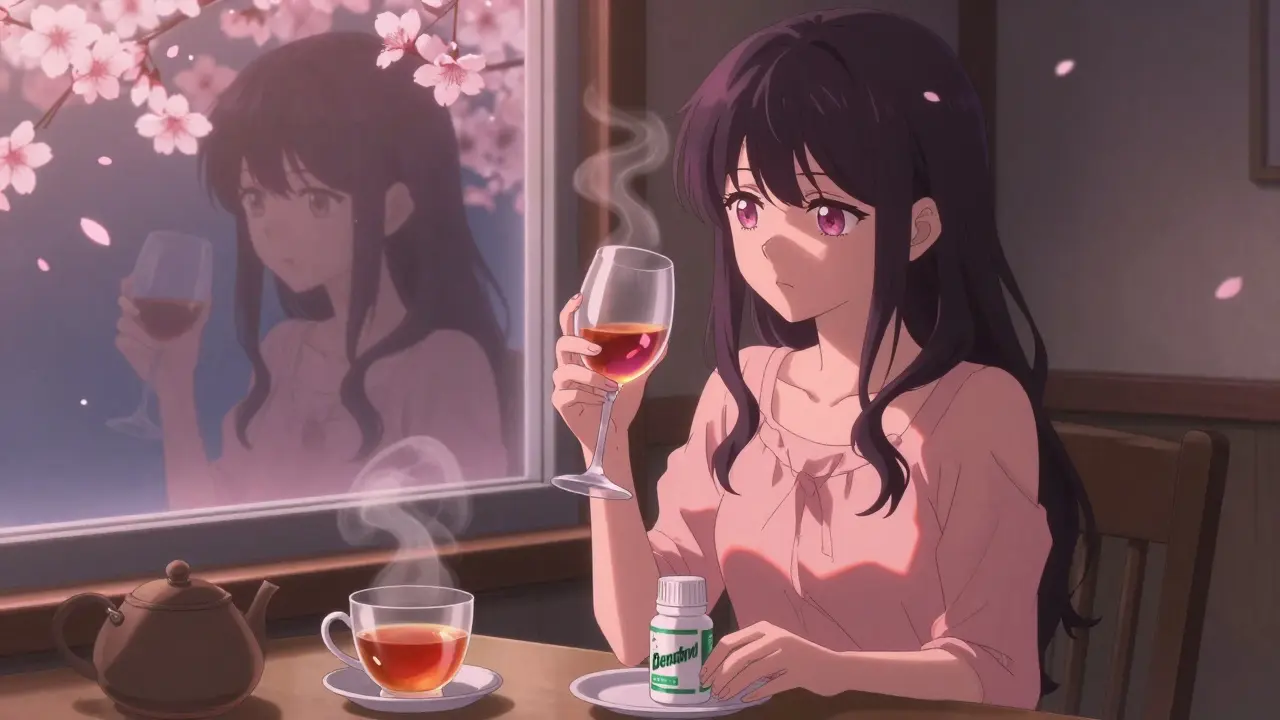
It’s easy to think that taking an antihistamine for allergies and having a drink at dinner is harmless. After all, you’re not drunk, you’re just sneezing. But when alcohol meets antihistamines, especially first-generation ones like Benadryl, the result isn’t just a sleepy night-it’s a dangerous drop in alertness that can turn ordinary moments into life-threatening ones.
Why Drowsiness Gets Worse Than You Think
Both alcohol and antihistamines slow down your brain. Alcohol boosts GABA, a chemical that calms nerve activity, and blocks NMDA receptors that keep you alert. First-generation antihistamines like diphenhydramine do something similar-they block histamine in your brain, which normally keeps you awake. When you mix them, these effects don’t just add up. They multiply.Studies show that combining alcohol with diphenhydramine can make you 300% more drowsy than if you took either one alone. That’s not a guess. It’s from the National Institute on Alcohol Abuse and Alcoholism. Your reaction time slows. Your coordination slips. You might not even realize how impaired you are until you try to stand up or drive.
Not All Antihistamines Are the Same
There’s a big difference between old-school antihistamines and the newer ones. First-generation drugs like diphenhydramine (Benadryl), chlorpheniramine, and promethazine cross into your brain easily. About half of people who take them feel sleepy-even without alcohol.Second-generation antihistamines like loratadine (Claritin), cetirizine (Zyrtec), and fexofenadine (Allegra) were made to avoid the brain. They’re called “non-drowsy” for a reason. But here’s the catch: they’re not alcohol-proof.
Take Zyrtec. Alone, it causes drowsiness in 15-20% of users. With one or two drinks? That jumps to 40-45%. Claritin goes from 6-14% drowsiness alone to 30-35% with alcohol. Even if you think you’re safe because you’re using the “non-drowsy” kind, alcohol still pulls the trigger.
What Happens in Your Body
Your liver doesn’t just process alcohol and antihistamines separately. It tries to handle them at the same time. Alcohol blocks the enzymes-CYP3A4 and CYP2D6-that break down antihistamines. That means the antihistamine stays in your system longer. Blood levels can stay 25-40% higher than normal.This isn’t just about feeling tired. It’s about toxicity. Higher drug levels mean more sedation, slower breathing, and a greater chance of passing out. In older adults, the risk is even worse. People over 65 experience 2.3 times more CNS depression from this combo than younger people. That’s why falls, fractures, and confusion spike after mixing the two.
The Driving Risk Is Real-and Overlooked
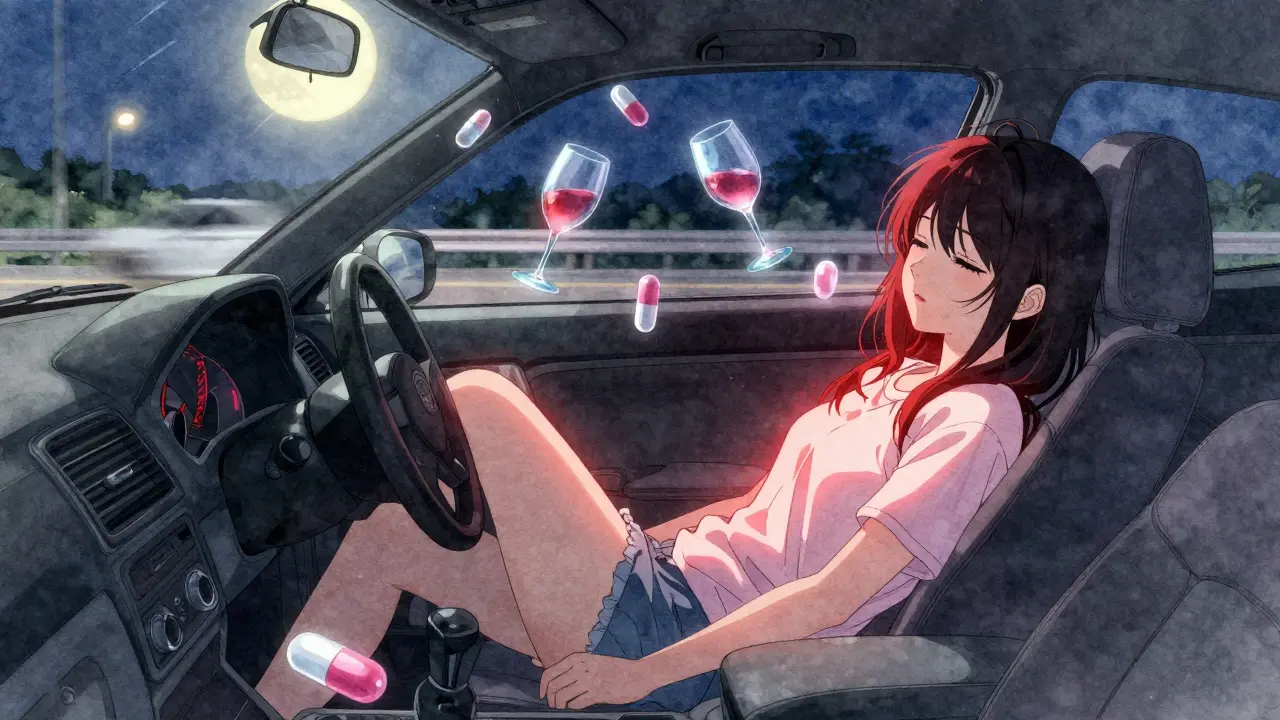
You might think, “I’m not drunk, so I’m fine to drive.” But that’s exactly what people think before they crash. The CDC found that 28% of traffic deaths in 2021 involved drivers with both alcohol and sedating medications in their systems. That’s not just alcohol. It’s alcohol plus antihistamines.One study showed that taking 50mg of diphenhydramine (two Benadryl pills) with 3-4 drinks created impairment equal to a blood alcohol level of 0.12-0.15%. That’s well above the 0.08% legal limit in every U.S. state. And this isn’t rare. Reddit users reported 32% of those who mixed Benadryl and alcohol fell asleep while driving. BuzzRx found 28% of users said they “passed out unexpectedly.”
It’s Not Just Allergy Pills
Benadryl isn’t just in allergy bottles. It’s in sleep aids, cold medicines, motion sickness pills, and even some pain relievers. There are 72 different over-the-counter products that contain diphenhydramine. You could be taking it without knowing.And here’s the problem: OTC labels say “may cause drowsiness.” They don’t say “don’t drink.” The FDA requires black box warnings on prescription antihistamines, but not on the ones you buy at the pharmacy. You’re left guessing.
Real Stories, Real Consequences
A 68-year-old woman in Melbourne took Zyrtec for her seasonal allergies and had a glass of wine with dinner. She woke up the next morning confused, with no memory of falling down the stairs the night before. Her doctor told her it was likely the combo.On Drugs.com, 41% of negative reviews for Claritin mentioned “unexpected drowsiness after drinking.” For Zyrtec, it was 37%. Older adults were far more likely to report memory lapses or disorientation. One 72-year-old wrote: “I thought I was just tired. Turns out, I was almost poisoned.”
What Should You Do Instead?
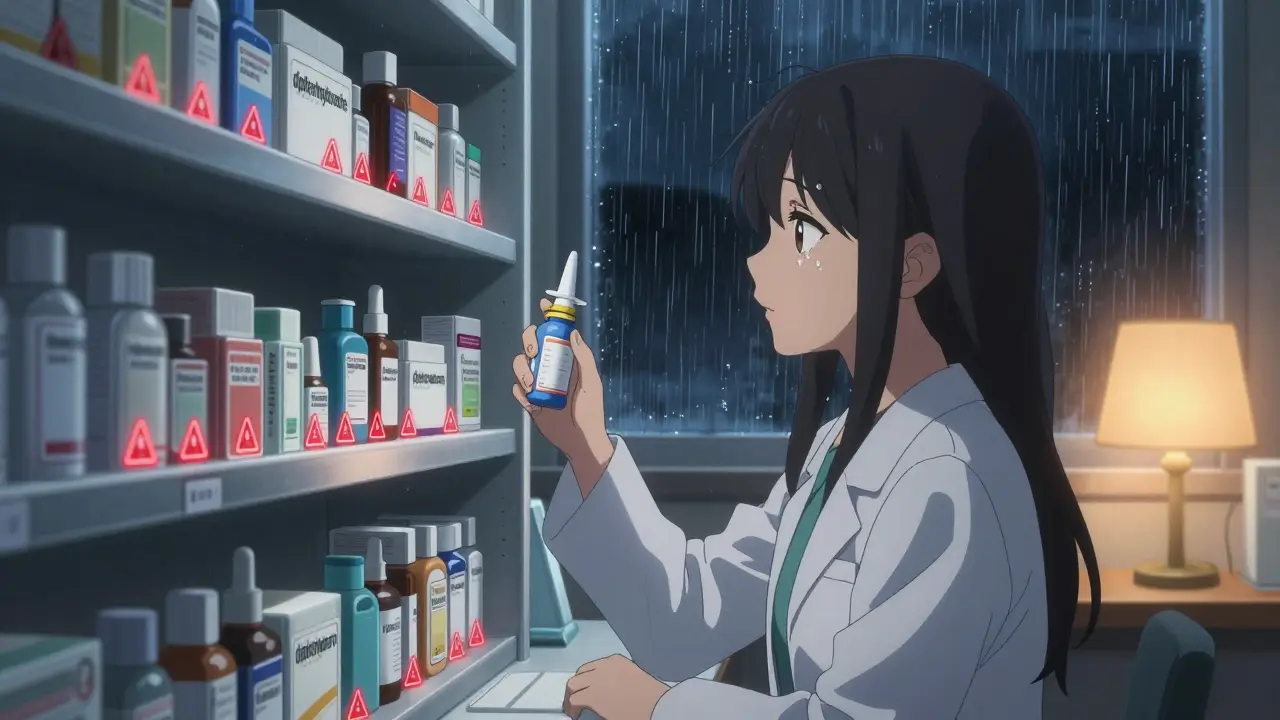
If you need to manage allergies and you drink alcohol, here’s what works:- Use nasal sprays like Flonase or Nasacort. They don’t enter your bloodstream much, so they won’t interact with alcohol.
- Try leukotriene inhibitors like Singulair. No known interaction with alcohol.
- If you must use an oral antihistamine, wait at least 12-16 hours after a first-generation one (like Benadryl) before drinking. For Claritin or Zyrtec, wait 8-12 hours.
- Don’t assume “non-drowsy” means “safe with alcohol.” It doesn’t.
And if you’re having a serious allergic reaction-swelling, trouble breathing-take your antihistamine, even if you’ve been drinking. Then get help immediately. The risk of anaphylaxis is far greater than the risk of drowsiness.
Why This Is Getting Worse
Since 2018, emergency visits for antihistamine-alcohol mix-ups have jumped 37%. The biggest increases? Adults 50-64 (up 52%) and women (up 48%). Why? More people are using OTC meds daily, and more women are managing chronic allergies with daily pills. Climate change is also making allergy seasons longer, so people are taking meds more often-and sometimes with wine, beer, or cocktails.And yet, a 2023 Consumer Reports survey found 63% of antihistamine users regularly drink within 12 hours of taking their meds. Only 28% knew this was risky.
The Bottom Line
There’s no such thing as a completely safe antihistamine with alcohol. Even the “non-drowsy” ones aren’t risk-free. The combination doesn’t just make you sleepy-it can make you dangerously unaware of your own impairment. Whether you’re driving, operating machinery, or just walking down the stairs, your body isn’t working right.If you take antihistamines regularly, treat alcohol like a potential trigger. Read labels. Know what’s in your medicine. Talk to your pharmacist. And if you’re unsure-skip the drink. Your brain will thank you.

Comments (11)
Tiffany Channell
People still don’t get it. You think you’re just having a glass of wine with your Zyrtec? You’re not. You’re playing Russian roulette with your frontal lobe. The data is right there. 45% drowsiness spike. No one wakes up thinking, 'I should’ve skipped the Chardonnay.' They wake up in the ER with a broken collarbone and no memory of how they got there.
veronica guillen giles
Oh sweetie, you’re not special. You think your ‘non-drowsy’ Claritin makes you invincible? Honey, the label says ‘may cause drowsiness’-not ‘may cause you to forget you have a car parked outside.’ I’ve seen it. My cousin drove into a mailbox after his Benadryl and whiskey. He thought he was fine. He wasn’t even close.
Ian Ring
Interesting read-thank you for the thorough breakdown. I’ve been using Flonase for years now, and honestly, it’s been a game-changer. No drowsiness, no interaction with my evening gin and tonic. The science here is solid, and I appreciate how you highlighted the enzyme inhibition by alcohol. It’s not just about feeling tired-it’s about pharmacokinetic sabotage.
Shanahan Crowell
STOP. Just stop. If you’re mixing meds and alcohol, you’re not ‘relaxing,’ you’re gambling with your life. And don’t say ‘I’ve done it for years and I’m fine’-that’s how people become statistics. You’re not a superhero. You’re a human with a liver that’s trying its best. Be kind to it. Skip the drink. Your future self will high-five you.
Angela Fisher
They’re hiding this on purpose. Big Pharma doesn’t want you to know that your allergy pills are quietly killing you with alcohol. The FDA doesn’t require black box warnings on OTC meds because they’re paid off. Look at the timeline-since 2018, ER visits jumped 37%. Coincidence? No. They’re letting people die so they can sell more pills. And now they’re pushing ‘non-drowsy’ ones like they’re safe? It’s a trap. I read the ingredient list on every bottle now. Diphenhydramine is everywhere. Even in some ‘all-natural’ sleep sprays. They’re lying. You’re being poisoned slowly.
Neela Sharma
Our bodies are not machines to be hacked with pills and wine. They are rivers-flowing, breathing, remembering. When we pour alcohol into the stream of antihistamines, we don’t just muddy the water-we drown the current. The silence after the fall, the forgotten stairs, the empty bed beside you in the morning-that’s not fatigue. That’s the soul whispering, ‘I tried to warn you.’
Shruti Badhwar
The data presented is compelling and aligns with clinical observations in primary care. The synergistic CNS depression observed with first-generation antihistamines and ethanol is well-documented in pharmacokinetic literature. Moreover, the delayed metabolism due to CYP450 inhibition significantly increases the half-life of diphenhydramine. This is not anecdotal-it is evidence-based medicine. Patients must be educated proactively, not reactively.
Brittany Wallace
I’m from the Midwest, and we all grew up thinking Benadryl was the cure-all for everything-from hives to insomnia to ‘just needing to chill.’ But now I see how dangerous that mindset is. My grandma took it with her nightly whiskey and didn’t realize why she kept falling. It broke my heart. We need more awareness-not fear, but compassion. Talk to your elders. Show them this. Maybe it saves someone’s life.
Michael Burgess
Just had to share this with my roommate who swears ‘Zyrtec + 1 beer = fine.’ I showed him the 40-45% drowsiness stat. He paused. Then said, ‘Wait… so I’m basically driving drunk every Friday?’ Exactly. 😔 I used to do it too. Thought I was ‘just sleepy.’ Turns out, I was just slow. And dangerous. Now I use nasal sprays. No regrets. My brain feels clearer. My sleep is better. My car? Still intact. 🙌
Liam Tanner
One sentence: If you’re taking anything that says ‘may cause drowsiness’ and you’re drinking, you’re not being cool-you’re being careless.
Sarah Little
Given the pharmacodynamic synergy between GABAergic potentiation and NMDA antagonism, coupled with CYP3A4/CYP2D6 competitive inhibition, the resultant CNS depression exhibits a non-linear, dose-dependent pharmacokinetic profile that significantly elevates the risk of respiratory compromise, particularly in elderly populations with reduced hepatic clearance. The CDC’s 28% mortality correlation is not merely associative-it is mechanistically validated. Regulatory oversight remains inadequate, and public health messaging is catastrophically under-resourced.