

When someone starts forgetting where they put their keys-or worse, forgets your name-it’s easy to brush it off as aging. But when those lapses become constant, when familiar streets turn confusing, and when the person you love no longer recognizes you, that’s not just forgetfulness. That’s Alzheimer’s disease. It doesn’t just steal memories; it reshapes identity, relationships, and daily life-for the person living with it and for everyone around them.
What Alzheimer’s Actually Does to the Brain
Alzheimer’s isn’t just about forgetting names. It’s a slow, silent war inside the brain. Two toxic proteins-amyloid-beta and tau-build up over years, forming plaques and tangles that choke off communication between brain cells. The hippocampus, the part responsible for forming new memories, is hit first. That’s why people with early-stage Alzheimer’s forget what they had for breakfast but can still recall their wedding day.
By the time symptoms show up, the damage has been building for 10 to 20 years. Brain scans show shrinkage in key areas, especially where memory and thinking live. Neurons die. Connections break. The brain literally gets smaller. This isn’t normal aging. Normal aging might mean slower recall. Alzheimer’s means the system collapses.
Current treatments like donepezil or memantine can help manage symptoms for a while, but they don’t stop the damage. In 2023, the FDA approved lecanemab, the first drug shown to slow cognitive decline by clearing amyloid plaques. It’s not a cure, but it’s a turning point. Still, it’s only for early-stage patients, requires regular brain scans, and carries risks like brain swelling. For most families, the focus remains on managing the day-to-day-not waiting for a miracle drug.
The Three Real Stages of Alzheimer’s
Doctors often break Alzheimer’s into three broad stages: early, middle, and late. But it’s not a straight line. Some people skip ahead fast. Others linger in middle stage for years. Each stage brings new challenges.
Early stage: This is when things start to feel "off." People forget recent conversations, repeat questions, misplace things like glasses or wallets, and struggle to find the right word. They might get lost driving to a familiar store. But they can still cook, pay bills, and drive. Many are diagnosed here-often because a family member notices the pattern. At this point, the person knows something’s wrong. They’re scared. They try to hide it. Support means patience, reminders, and giving them space to stay independent as long as possible.
Middle stage: This is the longest-and toughest-phase. Memory loss deepens. They forget personal history: their address, their children’s names. They may wander, get confused about time or seasons, and accuse loved ones of stealing. Sleep breaks down. Agitation spikes. Bathing or changing clothes becomes a battle. One caregiver I spoke to said her mother would hide medication in her sock drawer and then scream that someone was poisoning her. This stage is where most caregivers burn out. The emotional toll is crushing. The person isn’t being difficult-they’re lost. And they can’t explain why.
Late stage: The brain is severely damaged. Speech fades. They stop recognizing faces. Movement becomes limited. They may stop eating or swallowing safely. Incontinence is common. They need help with every single thing: eating, dressing, turning in bed. Some become mute. Others respond only to touch or music. This stage isn’t about cognition anymore. It’s about comfort. Pain management. Keeping them clean. Holding their hand.
Memory Decline: How It Progresses
Memory loss in Alzheimer’s follows a pattern. Short-term memory goes first. Long-term memory holds on longer. That’s why someone might not remember you visited yesterday-but still sing along to a song from their 20s.
Early on, they forget new facts. You tell them you’re going to the grocery store. Five minutes later, they ask again. They can’t learn new routines. A calendar or reminder app helps, but only so much. Later, they forget how to use familiar tools-like a phone or remote. They might stare at a spoon like it’s an alien object.
In late stage, even long-term memories fade. They might not remember their own children. But here’s the quiet truth: emotion lingers. They may not know your name, but they’ll smile when you hold their hand. They’ll calm down when you hum a lullaby. That’s why nonverbal connection becomes everything.
It’s also important to know: not all memory loss is Alzheimer’s. Frontotemporal dementia, for example, usually starts with personality changes or language problems-not memory loss. That’s why proper diagnosis matters. A blood test for Alzheimer’s biomarkers is coming soon, and could detect the disease before symptoms even begin. But for now, diagnosis still relies on cognitive tests, brain scans, and ruling out other causes like vitamin deficiencies or thyroid issues.
What Caregivers Actually Need
There are 11 million unpaid caregivers in the U.S. alone, giving an average of 27 hours a week to someone with Alzheimer’s. Most are spouses or adult children. Many work full-time. Many are over 65 themselves.
They don’t need more advice. They need practical support.
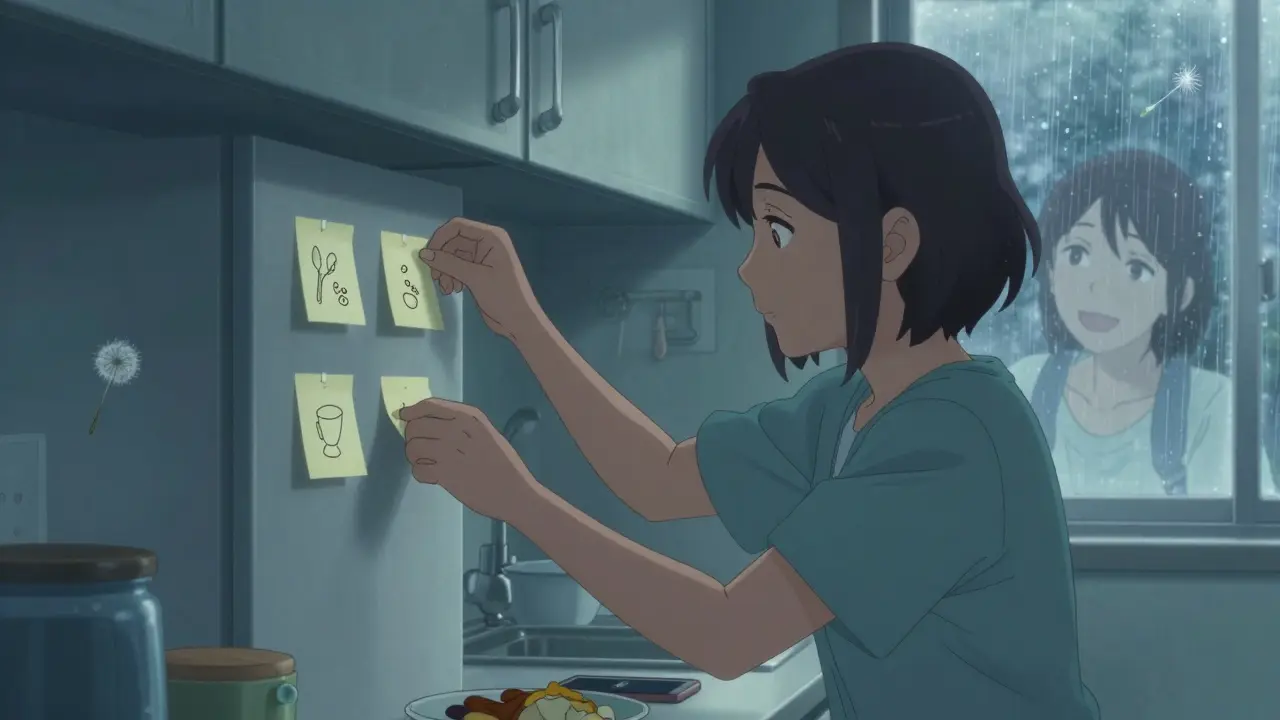
In early stage, caregivers need help setting up systems: labeled cabinets, pill organizers, digital reminders. They need permission to take breaks. Many feel guilty for leaving the house-even for an hour.
In middle stage, safety becomes critical. Door alarms, removing throw rugs, securing the stove, hiding car keys-these aren’t overreactions. They’re lifesavers. Behavioral changes like aggression or hallucinations require training. Validation therapy works: instead of saying, "That’s not true," say, "Tell me more about it." It reduces distress.
In late stage, caregivers need physical help. Lifting someone who can’t move is hard. Pressure sores form fast. Swallowing problems mean pureed food and thickened liquids. Hospice care isn’t giving up-it’s shifting focus from cure to comfort. Medicare covers up to five days of respite care per year for hospice-eligible patients. Most caregivers don’t know this exists.
And then there’s the emotional cost. 39% of caregivers report high emotional stress. 30% say they’re physically drained. Many cry in the car before going inside. Many feel isolated. Support groups aren’t luxuries-they’re lifelines. Online forums, local chapters, even texting a friend who’s been through it-these small connections keep people going.
How to Help Someone With Alzheimer’s-Without Burning Out
Here’s what works, based on real caregiver experience:
- Create routines: Same meals, same walks, same bedtime. Predictability reduces confusion.
- Simplify choices: "Do you want the blue shirt or the red one?" not "What do you want to wear?"
- Use visuals: Pictures on doors-bathroom, kitchen, bedroom-help with navigation.
- Reduce noise: Loud TV or multiple people talking at once overwhelms the brain.
- Focus on feelings: If they’re upset, don’t correct them. Offer comfort. Hold their hand.
- Use music: Familiar songs from youth can unlock calm and joy-even when speech is gone.
And please, don’t try to do it alone. Ask for help. Let someone else take them to the doctor. Let a neighbor drop off groceries. Hire a home aide for a few hours a week. Respite care isn’t selfish-it’s survival.

The Bigger Picture: Why This Matters
Alzheimer’s isn’t just a family problem. It’s a societal crisis. By 2050, 139 million people worldwide will have dementia. The global cost? Over $2 trillion a year. In the U.S., families provide $340 billion in unpaid care annually. That’s more than the entire annual budget of Australia.
And yet, funding for research and support services lags behind. Most clinical trials still focus on drugs, not caregiver training. Most insurance plans don’t cover home modifications or respite care beyond minimal limits.
What’s needed isn’t just better drugs-it’s better systems. Paid family leave. Affordable in-home care. Community programs that connect caregivers. Training for first responders so they know how to handle someone wandering and confused.
Because Alzheimer’s doesn’t just affect the person with the disease. It reshapes families, drains savings, and breaks hearts. The real breakthrough won’t be a new pill. It’ll be a society that doesn’t let caregivers fall through the cracks.
Can Alzheimer’s be prevented?
There’s no guaranteed way to prevent Alzheimer’s, but evidence shows lifestyle choices can lower risk. Regular physical activity, heart-healthy eating (like the Mediterranean diet), staying socially active, managing blood pressure and diabetes, and getting enough sleep all help. Cognitive stimulation-reading, puzzles, learning new skills-also builds brain resilience. It’s not about stopping the disease, but delaying when symptoms start.
Is Alzheimer’s hereditary?
Most cases aren’t inherited. But there’s a rare form called early-onset familial Alzheimer’s, which starts before age 65 and is passed down through specific gene mutations. If a parent has this form, each child has a 50% chance of inheriting it. For the more common late-onset type, having a family history increases risk slightly, but it’s not destiny. Genes like APOE-e4 raise risk, but many people with the gene never develop Alzheimer’s.
How long do people live after diagnosis?
On average, people live 4 to 8 years after diagnosis, but some live up to 20 years. Life expectancy depends on age at diagnosis, overall health, and how quickly symptoms progress. Those diagnosed in their 60s often live longer than those diagnosed in their 80s. The most common cause of death isn’t the disease itself-it’s complications like pneumonia, infections, or falls.
What should I do if I suspect a loved one has Alzheimer’s?
Don’t wait. See a doctor. Start with your primary care provider, who can rule out other causes like thyroid problems, depression, or vitamin B12 deficiency. They may refer you to a neurologist or geriatric specialist. Keep a journal of symptoms: when they started, how often they happen, what triggers them. Bring a family member to the appointment. Early diagnosis gives you time to plan-legally, financially, and emotionally.
Are there any new treatments on the horizon?
Yes. Beyond lecanemab, drugs like donanemab are in late-stage trials and may be approved soon. Researchers are also testing therapies that target tau protein, reduce brain inflammation, and improve brain metabolism. Blood tests to detect Alzheimer’s biomarkers are becoming more accurate and affordable. Within five years, we may be able to screen for the disease before symptoms appear. But access remains a challenge-current tests cost thousands, and not all insurance covers them.
How can I take care of myself as a caregiver?
First, accept that you can’t pour from an empty cup. Schedule regular breaks-even 20 minutes a day. Use respite care services. Join a support group. Talk to a counselor. Eat well, sleep when you can, move your body. Don’t feel guilty for needing help. Caring for someone with Alzheimer’s is one of the hardest jobs on earth. You’re not failing if you’re tired. You’re human.
Final Thought: It’s Not Just About Memory
Alzheimer’s takes memory. But it doesn’t take love. Even when words are gone, presence remains. A hand held. A song sung. A quiet moment beside the bed. Those things still matter. More than any drug. More than any stage. They’re the quiet anchors in a storm that never ends.
And for those who carry that storm? You’re not alone. Help exists. It’s just not always easy to find. Start with one call. One website. One person who’s been there. You don’t have to do it alone.

Comments (13)
Shawn Peck
This is all nice and fancy but let’s be real - most families can’t afford any of this. Lecanemab costs $26k a year and you need a MRI every month? My aunt got diagnosed and the hospital told us to just use adult diapers and call 911 if she falls. That’s the real world.
Beth Beltway
You say 'Alzheimer’s isn’t normal aging' like that’s some groundbreaking insight. Everyone knows that. What you’re not saying is that 80% of cases are preventable with lifestyle changes - diet, sleep, exercise - but no one wants to hear that because it means taking responsibility. Instead we pour billions into drugs that barely work. The system is broken because we’re too lazy to live better.
Kimberly Reker
I’ve been caring for my mom for 6 years now. The part about music? 100% true. She hasn’t spoken in 18 months but last week she started humming 'My Heart Will Go On' when I played it. Didn’t know who I was, but she smiled. That’s the only win we get. Don’t underestimate the power of a song.
Sheila Garfield
I’m from the UK and we don’t have access to half the stuff you mention here. Respite care is a myth unless you’re rich. My mum’s home aide was cancelled because of 'budget constraints'. We’re lucky if we get a social worker once a month. The system’s failing people and nobody’s talking about it.
Sarah Blevins
The statistical claims in this post lack proper citation. For example, the assertion that '11 million unpaid caregivers in the U.S.' is sourced from the Alzheimer’s Association 2022 report, but the 27-hour average is from a 2020 JAMA study with a margin of error of ±3.2 hours. Without referencing primary data, this reads as anecdotal advocacy rather than evidence-based reporting.
Jason Xin
Wow. So we’re supposed to feel bad for caregivers while ignoring that most of them are middle-class women who never had the option to say no? You’re romanticizing burnout. The real issue isn’t lack of support - it’s that we expect women to sacrifice everything and call it love.
Kathleen Riley
The ontological rupture precipitated by neurodegenerative pathology necessitates a hermeneutic reorientation of care paradigms, wherein the phenomenological presence of the Other transcends the epistemic collapse of autobiographical memory. In this light, the tactile communion - the hand held, the lullaby hummed - constitutes not merely therapeutic intervention, but a metaphysical act of resistance against the erasure of subjectivity.
Sazzy De
My dad used to love jazz. Now he just stares at the ceiling. But when I put on Miles Davis he closes his eyes and taps his foot. I don’t know if he remembers me but he remembers that. That’s enough for now
Carolyn Whitehead
You’re not alone. I know it feels like no one gets it but I’ve been there too. Even just one coffee with someone who’s been through it changes everything. You’re doing better than you think
Donna Fleetwood
I’m 72 and I’ve been caring for my husband for 5 years. I work part-time. I take naps on the floor beside his chair. I cry in the shower. But I still make him pancakes every Sunday. He still says 'thank you' even if he doesn’t know why. That’s my victory. Keep going.
Kelly Weinhold
I know it feels like you’re drowning but please hear this - you’re not failing. Every time you hold their hand, every time you sing that stupid song they used to love, every time you laugh even though you’re exhausted - that’s love in action. You’re not just a caregiver. You’re a miracle worker. And you deserve rest. Please, take a day off. You’ve earned it.
Amy Insalaco
The entire discourse around Alzheimer’s is a neoliberal fantasy of individualized burden-shifting. The real pathology isn’t in the brain - it’s in the structural abandonment of elder care infrastructure. The FDA’s approval of lecanemab is a performative gesture to appease biotech shareholders while Medicaid cuts respite hours. The disease is merely the symptom; the disease system is the real diagnosis.
Melissa Cogswell
I’m a nurse in a memory care unit. We have a playlist of songs from the 40s-60s. People who haven’t spoken in months will start singing. One man, 91, sang 'Moon River' every night. His daughter said he hadn’t sung since his wife died in 1987. Music doesn’t fix the brain. But it fixes the soul. For a little while, anyway.