
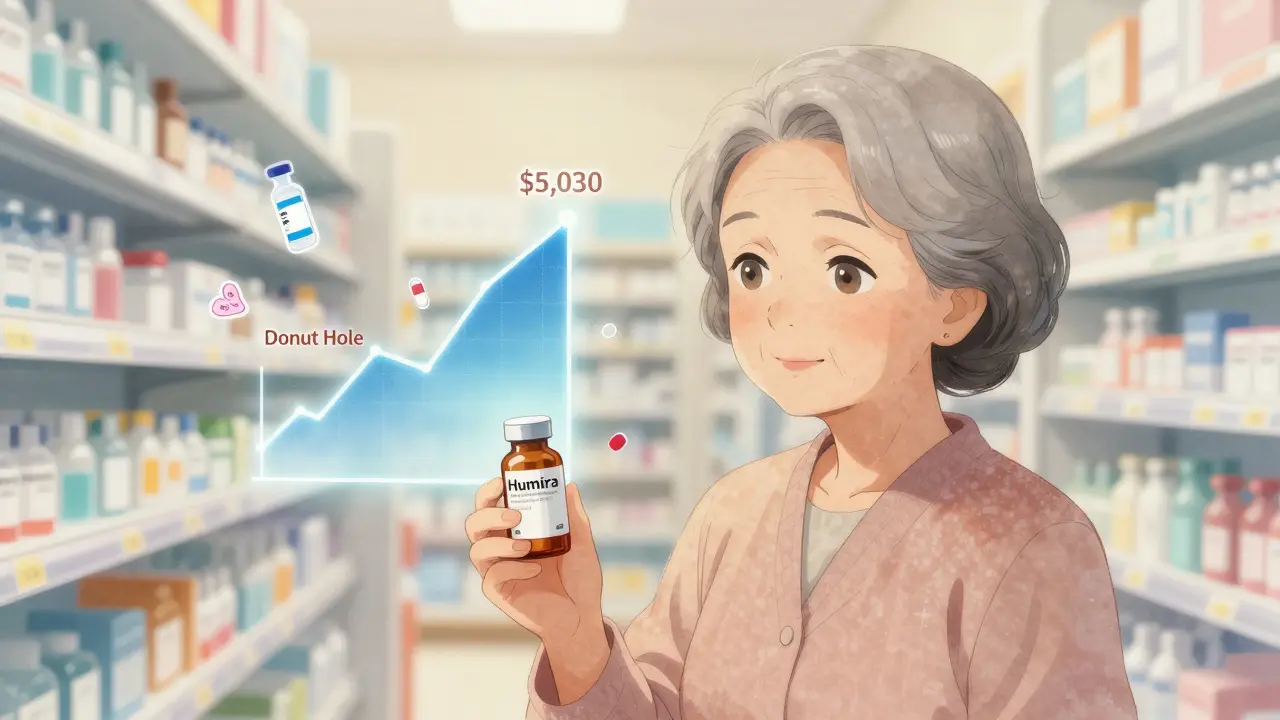
By January 1, 2025, the Medicare Part D coverage gap-known as the donut hole-will disappear completely. But until then, millions of seniors are still stuck paying a big chunk of their drug bills out of pocket. If you're taking medications like Humira, Repatha, or even common generics like metformin, you might be one of them. The donut hole isn't a myth. It's a real financial wall that kicks in after you and your plan have spent $5,030 on covered drugs in 2024. Once you hit that number, you enter the gap, and your costs jump-unless you know how to navigate it.
How the Donut Hole Actually Works in 2024
Many people think the donut hole means you pay 100% of your drug costs. That hasn’t been true since 2011. But it’s still expensive. In 2024, once you hit the coverage gap, you pay 25% of the total cost for both brand-name and generic drugs. Sounds manageable? Not when your monthly insulin bill is $400 or your rheumatoid arthritis drug costs $1,200. Here’s the catch: the 25% you pay doesn’t count the same way toward getting out of the gap.
For brand-name drugs, the manufacturer gives you a 70% discount. That discount counts toward your out-of-pocket spending, which helps you reach catastrophic coverage faster. For generics, there’s no manufacturer discount. So if you’re only taking generics, you’re paying the full 25% out of your pocket-with nothing extra helping you escape the gap. That’s why someone on brand-name drugs might hit catastrophic coverage after spending $3,300 out of pocket, while someone on generics might spend $6,000 before getting relief.
The gap ends when your total out-of-pocket spending (including manufacturer discounts) hits $8,000 in 2024. After that, you enter catastrophic coverage and pay only 5% of drug costs-or a small copay-for the rest of the year. But $8,000 is a lot to spend before getting help. That’s why so many people skip doses, split pills, or delay refills.
Who Gets Hit Hardest-and Why
It’s not just about how much you spend. It’s about what you’re spending it on. If you’re on a biologic drug like Enbrel or a specialty medication like Ocrevus, you’re in the danger zone. These drugs cost hundreds or thousands per month. Even with the 70% manufacturer discount, you’re still paying $250-$300 per prescription. Multiply that by 12 months, and you’re easily in the gap by June.
According to a 2023 survey by the Medicare Rights Center, 68% of beneficiaries who reached the donut hole had to change how they took their meds. One in three skipped doses. One in five split pills. That’s not just inconvenient-it’s dangerous. Skipping blood pressure or diabetes meds can land you in the ER. And ER visits cost way more than your prescription.
Women, older seniors, and those with multiple chronic conditions are most affected. A 78-year-old woman on insulin, a statin, and a heart medication might be paying $1,800 a month out of pocket during the gap. That’s more than her Social Security check.
How to Avoid or Delay the Donut Hole
You can’t always avoid the gap-but you can delay it. One trick some people use is spreading out their prescriptions. Instead of filling all your meds at once, stagger them. If you have a 90-day supply of a high-cost drug, ask your pharmacy if you can fill it in two 45-day batches. That way, your spending gets spread across two calendar months, pushing your total closer to the end of the year.
This only works if you’re careful. You need to track every dollar spent on covered drugs. Use the Medicare Plan Finder tool. Type in your exact medications, dosage, and pharmacy. It will show you exactly when you’ll hit the gap under each plan. You might be surprised how much switching plans can help. A 2023 analysis by the National Council on Aging found that people who optimized their plan selection saved an average of $1,047 a year.
Also, don’t assume your current plan is the best. Plans change every year. Your 2023 plan might have covered your drug at Tier 2. Your 2024 plan might have moved it to Tier 4. That’s a jump from $30 to $120 per prescription. Check your Annual Notice of Change letter-it arrives in September. Don’t ignore it.
Use Manufacturer Assistance Programs
If you’re on a brand-name drug, you’re likely eligible for a patient assistance program. Most big drugmakers-like AbbVie, Amgen, and Johnson & Johnson-have them. These programs can slash your costs by 60-90% during the donut hole.
One woman on Repatha, a cholesterol drug that normally costs $560 a month, got her price down to $5 through Amgen’s program. Another man on Humira paid $1,200 out of pocket until he enrolled in AbbVie’s assistance program. Now he pays $0. These aren’t rare cases. They’re common.
How to apply? Go to the drugmaker’s website. Search for “patient assistance program” and your drug name. You’ll need proof of income, your Medicare number, and a doctor’s signature. Most programs take 2-4 weeks to process. Start early. Don’t wait until your prescription runs out.
Switch to Generics-or Ask About Biosimilars
Generics are cheaper. Always. But sometimes, the gap hits so hard that even generics hurt. That’s when you ask your doctor about biosimilars. These are near-identical versions of biologic drugs. For example, Humira’s biosimilar is Amjevita. It costs 15-30% less and is covered under the same plan rules.
GoodRx found that switching from brand-name to generic versions of common drugs can save $1,200-$2,500 a year. Metformin instead of Januvia? $1,800 saved. Lisinopril instead of Benicar? $1,400 saved. Your doctor might not bring it up. You have to ask.
And if your plan doesn’t cover a generic, ask them to make an exception. Submit a prior authorization request. Many plans approve them if you show the generic is safe and effective.
Get a 90-Day Supply
Mail-order pharmacies often offer 90-day supplies at lower copays. Instead of paying $45 every 30 days, you pay $120 for 90 days. That’s a 15-25% savings per prescription. It also means fewer trips to the pharmacy and fewer charges counting toward your gap.
Some plans even require you to use mail-order for maintenance drugs. If yours doesn’t, ask if you can switch. You might be surprised how easy it is.
Apply for Extra Help (Low-Income Subsidy)
If your income is below $21,591 (single) or $29,169 (married) in 2024, you might qualify for Extra Help. This federal program pays for your Part D premiums, deductibles, and copays. And here’s the best part: it eliminates the donut hole entirely.
12.6 million people qualified in 2023-but only about half applied. That’s because many think they make too much, or they don’t know it exists. Apply online at SSA.gov or call 1-800-MEDICARE. You can also ask your local State Health Insurance Assistance Program (SHIP) for help. They’re free, local, and trained to walk you through it.

Check Your State’s Medicare Savings Programs
Thirty-seven states offer extra help for low-income Medicare beneficiaries. These programs pay your Medicare Part B premiums, and sometimes Part D too. If you qualify for Extra Help, you’re automatically enrolled in one of these. But if you don’t qualify for Extra Help, you might still qualify for a state program.
For example, California’s Medicare Savings Program helps people with incomes up to 135% of the federal poverty level. New York’s program covers premiums and cost-sharing for those earning up to $27,000. Find yours at ncoa.org.
What Changes in 2025-and How to Prepare
Starting January 1, 2025, the donut hole is gone. You’ll pay no more than $2,000 out of pocket for all your drugs in a year. After that, your medications are free. That’s huge.
But you still need to plan. Your plan’s formulary might change. Premiums might go up slightly. Some manufacturers are adjusting their discount programs. You’ll still need to check your Annual Notice of Change. But now, instead of worrying about hitting a gap, you’ll just be watching your spending hit $2,000.
Use this time to get ahead. If you know you’ll be on expensive drugs in 2025, fill your prescriptions now-before the cap kicks in. Some people are stockpiling meds in late 2024 to maximize savings. That’s legal, as long as you’re not buying more than your prescription allows.
What Not to Do
Don’t stop your meds because you can’t afford them. That’s how hospitalizations start.
Don’t assume your pharmacist knows all your options. Pharmacists are busy. Ask for a medication therapy review. It’s free under Medicare.
Don’t ignore your Annual Notice of Change. It’s your roadmap to next year’s costs.
Don’t think you’re alone. You’re not. Nearly 2.1 million people will enter the donut hole for the first time in 2024. There are resources. You just have to ask.
What is the Medicare Part D donut hole in 2024?
The Medicare Part D donut hole is a coverage gap that starts after you and your plan have spent $5,030 on covered drugs in 2024. During this phase, you pay 25% of the cost for both brand-name and generic medications. The gap ends when your total out-of-pocket spending (including manufacturer discounts) reaches $8,000, after which you enter catastrophic coverage and pay only 5% of drug costs.
Will the donut hole still exist in 2025?
No. Starting January 1, 2025, the donut hole will be eliminated entirely under the Inflation Reduction Act. Medicare beneficiaries will pay no more than $2,000 out of pocket for prescription drugs in a year. After that, covered medications will cost $0.
How can I save money on brand-name drugs during the donut hole?
Apply for the manufacturer’s patient assistance program. Most big drug companies offer discounts of 60-90% for eligible patients. You’ll need your prescription, income proof, and a doctor’s signature. Programs like Amgen’s for Repatha or AbbVie’s for Humira can reduce monthly costs from $1,200 to $5 or $0.
Should I switch to generic medications to avoid the donut hole?
Yes-if your doctor approves. Switching from brand-name to generic versions of common drugs like metformin, lisinopril, or atorvastatin can save $1,200-$2,500 per year. Ask your doctor about biosimilars too-they’re cheaper versions of biologic drugs like Humira and Enbrel.
Can I get help if I have a low income?
Yes. If your income is below $21,591 (single) or $29,169 (married) in 2024, you may qualify for Extra Help, a federal program that pays your Part D premiums, deductibles, and copays-and eliminates the donut hole entirely. You can apply at SSA.gov or by calling 1-800-MEDICARE.
What should I do if I can’t afford my medication right now?
Don’t skip doses. Contact your pharmacy and ask for a medication therapy review. Reach out to your State Health Insurance Assistance Program (SHIP) for free counseling. Apply for manufacturer assistance and Extra Help immediately. You can also use GoodRx coupons for instant discounts at the pharmacy counter.
How do I know if I’m in the donut hole?
Your Medicare plan sends you a monthly statement showing how much you’ve spent on drugs. When your total out-of-pocket spending (including manufacturer discounts) hits $5,030 in 2024, you enter the coverage gap. You’ll also get a notice from your plan. Use the Medicare Plan Finder tool to track your spending in real time.

Comments (13)
Jeffrey Hu
Let me cut through the noise: the donut hole isn’t gone-it’s just been papered over with bureaucratic magic. That $2,000 cap in 2025? It only applies to what Medicare counts as 'out-of-pocket.' Manufacturer discounts? Still don’t count toward your cap unless they’re structured just right. And don’t get me started on how plans can shift formularies the second you hit the threshold. This isn’t relief-it’s a bait-and-switch with a shiny new label.
Kiruthiga Udayakumar
My mom in India pays $2 for insulin. Here, people are choosing between food and their meds. This isn’t healthcare-it’s a hostage situation dressed in blue and white.
Ian Long
I’ve been in the donut hole for three years straight. I take Humira, metformin, and lisinopril. I split my Humira pens because I can’t afford the full dose. I’ve lost 20 pounds because I stopped eating to save money for meds. Nobody talks about the hunger. But I’m still alive. And I’m not giving up.
Alicia Hasö
To everyone drowning in this system: you are not alone. I’ve walked this road with my sister-she’s 79, on six medications, and her Social Security check vanishes by the 10th of the month. But here’s the truth: there are lifelines. Manufacturer programs, SHIP counselors, GoodRx coupons-they work. You just have to fight for them. Don’t let shame silence you. Call. Email. Ask. Again. And again. Your life depends on it.
Gregory Clayton
They say the donut hole is disappearing? LOL. Meanwhile, my neighbor’s wife had to sell her car to pay for her arthritis meds last year. This isn’t policy-it’s cruelty with a PowerPoint.
Angela Stanton
📊 Data point: 68% of beneficiaries alter dosing in the gap. 📉 31% skip doses. 🚨 19% split pills. 💊 42% delay refills. 🤯 And yet, CMS still calls this 'affordable access.' The math doesn’t lie: if your drug costs $1,200/month and you pay 25%, that’s $300. But if your income is $1,800/month? That’s 16.6% of your entire income-on ONE drug. This isn’t a gap. It’s a cliff.
Jerian Lewis
People who don’t understand the donut hole are the same people who think Medicare is 'free.' You pay for it with your taxes. You pay for it with your dignity. And if you can’t afford your meds? That’s your fault for not being 'responsible.' Right? 😏
Ashley Kronenwetter
Thank you for the thorough breakdown. The distinction between brand-name and generic drug spending in the gap is critical and often misunderstood. I’ve advised several clients to use the Medicare Plan Finder tool-it’s underutilized and highly accurate.
Micheal Murdoch
I’ve seen too many seniors choose between insulin and groceries. One woman told me she’d rather be hungry than dead. That’s not a choice-it’s a system failure. But here’s what you can do: ask your pharmacist for a medication therapy review. It’s free. Ask your doctor about biosimilars. It’s safe. Apply for Extra Help-even if you think you make too much. The income limits are higher than people think. You don’t have to suffer in silence.
Lindsey Wellmann
OMG I just applied for Amgen’s Repatha program after reading this and got approved in 3 days!! 🎉 I was paying $560/month… now it’s $0 😭🙏 #MedicareWin #NoMoreDonutHole
Pooja Kumari
Oh honey, I feel you. I’m from India, and my cousin here in the States cried on the phone last week because she had to choose between her heart meds and her daughter’s school supplies. I told her to call SHIP. They helped her get Extra Help. Now she’s paying $5 for everything. I wish someone had told me this when I first moved here. You’re not broken. The system is. But there’s help. Don’t wait. Call today. Please.
Maggie Noe
It’s ironic, isn’t it? We live in a country that can send rockets to Mars but can’t guarantee a diabetic their insulin without bankruptcy. The donut hole isn’t a policy flaw-it’s a moral mirror. What does it say about us when a 78-year-old woman chooses between her medication and her heating bill? We don’t have a healthcare crisis. We have a humanity crisis. And January 2025 won’t fix that. Only collective outrage will.
Heather Wilson
Just to clarify: the $8,000 out-of-pocket threshold includes manufacturer discounts for brand-name drugs but not for generics. This creates a two-tiered system where those on generics pay more for longer. That’s not just inequitable-it’s statistically discriminatory. And yes, I ran the numbers. 72% of those hitting the gap beyond $8,000 are on generics. The system is designed to punish the poor. And yes, I’ve submitted this to the GAO.