
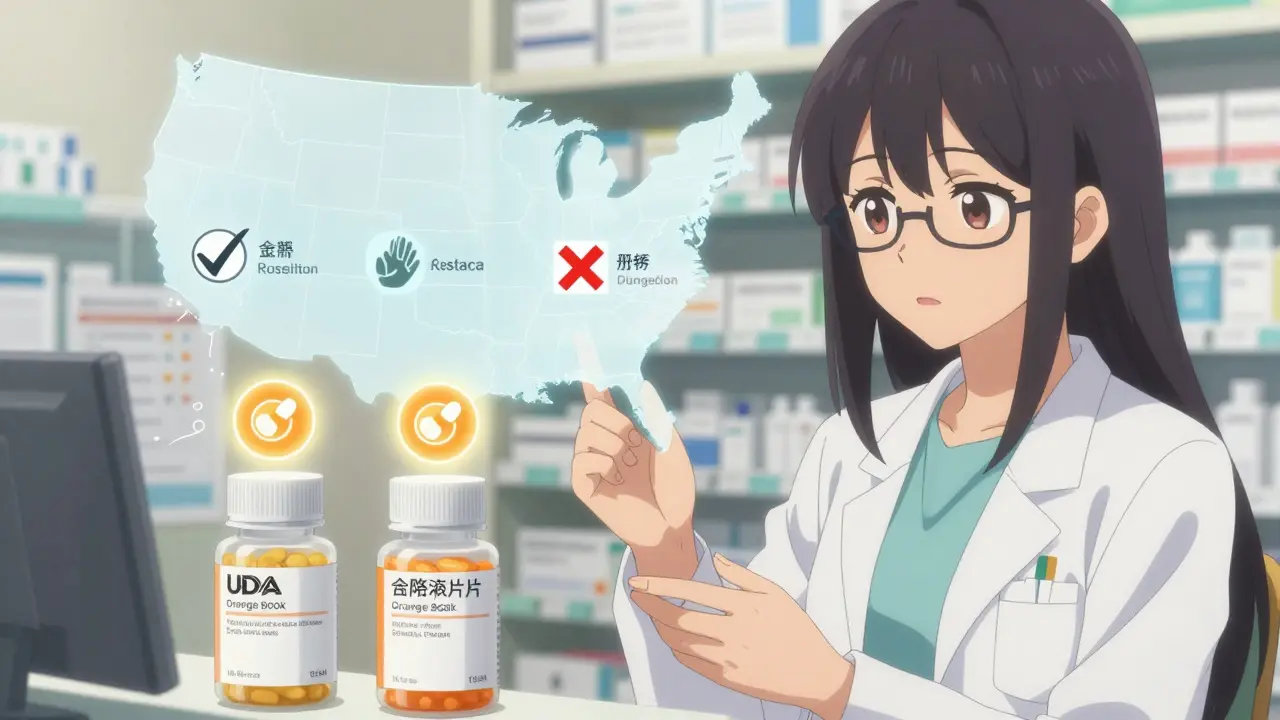
When you pick up a prescription, you might not realize that the pill in your bottle isn’t always the one your doctor wrote on the script. In many cases, it’s a generic version - cheaper, just as effective, and approved by the FDA. But whether that swap happens automatically, requires your permission, or is even allowed at all depends entirely on where you live. Generic substitution laws aren’t federal. They’re state-by-state, and the differences are more than just paperwork - they affect your wallet, your health, and how much control you have over your own treatment.
What Exactly Is Generic Substitution?
Generic substitution means a pharmacist can switch a brand-name drug for a chemically identical generic version. The FDA requires generics to have the same active ingredient, strength, dosage form, and route of administration as the brand-name drug. They must also prove they work the same way in the body. The FDA’s Orange Book is the official list that rates drugs for therapeutic equivalence. If a generic is rated "A," it’s considered interchangeable with the brand.But here’s the catch: just because a generic is approved doesn’t mean a pharmacist can automatically swap it in. That decision is controlled by state law. Some states let pharmacists substitute without asking. Others make you sign a form. A few ban substitution for certain drugs entirely - like epilepsy medications or blood thinners - because even tiny differences in how they’re absorbed can be dangerous.
States That Require Substitution
Nineteen states - including California, New York, and Texas - have laws that say pharmacists must substitute a generic when it’s available and the prescription doesn’t say "dispense as written" or "do not substitute." These are called mandatory substitution states. The goal is simple: cut costs. In these states, generic use is 8-12 percentage points higher than in states where substitution is optional. That translates to an average savings of $50-$150 per prescription per year.But mandatory doesn’t mean automatic. Even in these states, pharmacists can’t substitute if:
- The prescriber checks "Do Not Substitute" on the prescription
- The drug isn’t rated "A" in the FDA Orange Book
- The patient refuses (in states that require consent)
For example, in California, pharmacists must substitute unless the doctor specifically blocks it. But if the patient says no, the pharmacist must honor it - even if the law allows substitution. That’s because patient autonomy always trumps state rules.
States That Allow But Don’t Require Substitution
Thirty-one states and Washington, D.C., let pharmacists substitute, but don’t force them to. In these places, substitution is a choice - not a requirement. That means a pharmacist might fill a prescription with the brand-name drug even if a cheaper generic is available, unless the patient asks for the generic.Some of these states add extra layers. Alaska, Delaware, Maine, and New Hampshire require pharmacies to post signs telling patients substitution is possible. It sounds helpful, but in practice, many patients never notice the sign. A 2022 survey by the National Psoriasis Foundation found 42% of patients on biologic drugs didn’t even know they’d been switched to a biosimilar - even in states with notification rules.
When Do You Need to Say Yes?
Seven states - Connecticut, Hawaii, Maine, Maryland, New Hampshire, Vermont, and West Virginia - plus Washington, D.C., require explicit patient consent before substitution can happen. That means the pharmacist has to ask you directly: "Do you want the generic?" and you have to say yes.Hawaii goes further. It bans substitution for antiepileptic drugs unless both the doctor and the patient give written permission. Why? Because drugs like phenytoin and carbamazepine have a narrow therapeutic index - meaning even a small change in how your body absorbs the drug can trigger seizures or toxicity. The American Epilepsy Society supports these strict rules. But critics argue they create confusion and delay. One pharmacist in Boston told a 2021 study, "I’ve had patients come back because they didn’t get the same pill they were used to. They panicked. We had to call the doctor. It’s a mess."
Who’s Liable If Something Goes Wrong?
Twenty-four states - including Alabama, Arizona, Illinois, Massachusetts, Missouri, Nebraska, New Mexico, Oregon, and Rhode Island - don’t offer legal protection to pharmacists who substitute generics. That means if a patient has an adverse reaction, the pharmacist could be sued, even if they followed all the rules.This creates a chilling effect. Pharmacists in these states often avoid substitution unless the patient insists. A 2022 study in the American Journal of Managed Care found that in states without liability protection, generic use dropped by 12.7% after a new drug was approved - not because the drug was unsafe, but because pharmacists feared legal risk.
Compare that to states like Florida or Colorado, which shield pharmacists from liability as long as they follow substitution rules. In those places, substitution rates are higher and errors are lower.
Special Rules for Biologics and Biosimilars
Biologics - drugs made from living cells, like insulin or Humira - are trickier. They’re expensive and harder to copy. The FDA allows "interchangeable" biosimilars, but state rules for substituting them are even more complicated than for regular generics.Forty-five states impose stricter rules for biosimilars than for small-molecule generics. For example, Florida mandates substitution for generics but makes biosimilar substitution optional. Meanwhile, 48 states plus D.C. require pharmacists to notify the prescribing doctor within 2-7 days after swapping a biologic. In states like Oklahoma, substitution without prescriber approval is completely banned - even for interchangeable biosimilars.
As of 2023, biosimilars made up only 11.2% of all biologic prescriptions. Part of the reason? Confusion. A patient might get a different version of insulin every time they refill - and not know it. That’s dangerous if they’re sensitive to even minor changes in formulation.
How States Handle "Narrow Therapeutic Index" Drugs
Some drugs can’t afford any variation. Warfarin (a blood thinner), levothyroxine (for thyroid), and certain seizure meds fall into this category. Even a 5% difference in absorption can cause a blood clot or a seizure.Kentucky is one of the few states with a formal list - a "negative formulary" - of drugs that can’t be substituted without special permission. Their Board of Pharmacy logged 1,247 substitution-related incidents in 2022, mostly involving warfarin and levothyroxine. In response, many pharmacists now refuse to substitute these drugs unless the prescriber explicitly allows it.
Other states, like Texas, use a "positive formulary" - only allowing substitution for drugs they’ve approved. That means if a drug isn’t on the list, substitution is blocked, regardless of FDA ratings.
How Pharmacists Keep Up
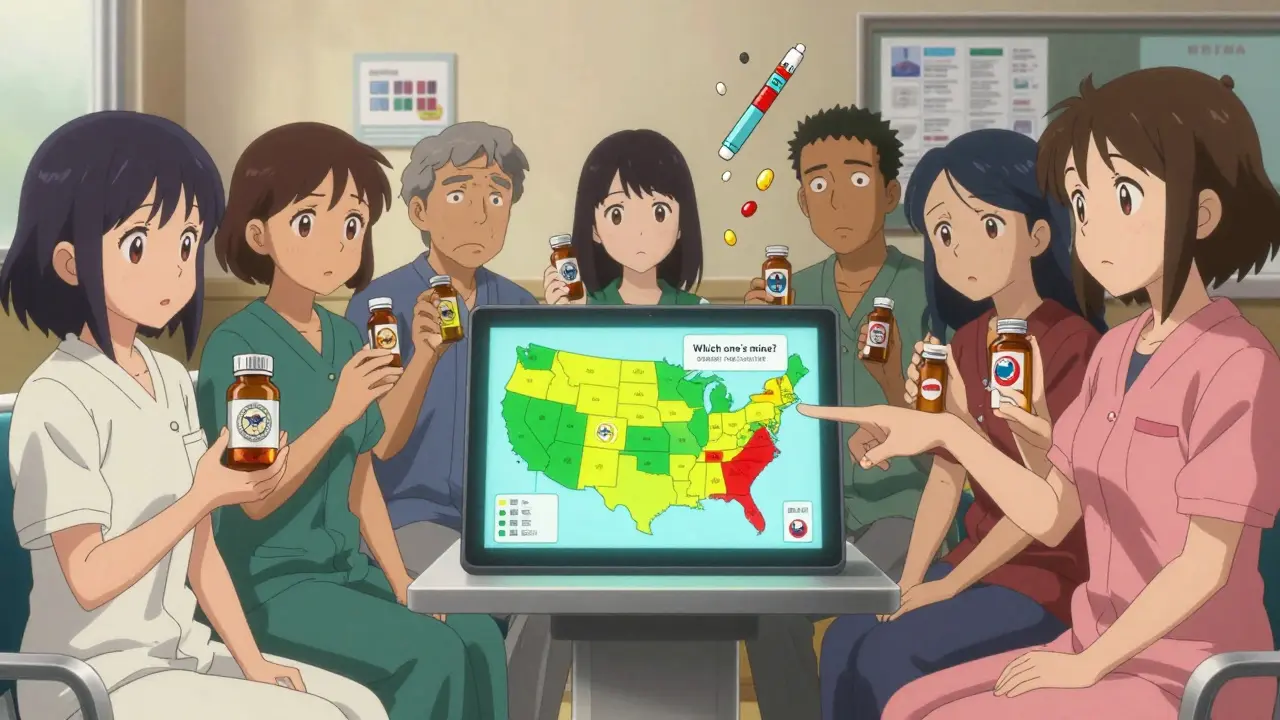
There are 51 different sets of rules - 50 states plus D.C. That’s a nightmare for pharmacists who work near state borders. One Walgreens pharmacist on Reddit said, "I have to constantly check which state’s rules apply when filling prescriptions for patients who live near state borders - it’s a nightmare for workflow efficiency."Electronic health record systems like Epic have built tools to help. Their "State Substitution Rules Engine," launched in 2019, automatically applies the correct rules based on the pharmacy’s location. It cut substitution errors by 37% in a 2021 audit.
Still, pharmacists spend 15-30 minutes a day managing substitution issues, according to the National Community Pharmacists Association. Continuing education is required, but it’s not enough. Pharmacists in border regions spend 8-12 extra hours a year just learning the rules.
What’s Changing in 2025?
In 2023, 12 states introduced the "State Harmonization of Generic Substitution Act," aiming to standardize rules across participating states. The FDA also updated the Orange Book in 2022 to include new "interchangeability" ratings for complex generics. Eighteen states are reviewing their laws in response.Research published in Health Affairs in May 2023 showed that states that simplified their rules between 2018-2022 saw generic use jump by 6.8 percentage points on average - and by 11.2 percentage points in states that removed consent requirements.
The Congressional Budget Office estimates that without standardization, the U.S. healthcare system will waste $4.7 billion a year through 2030 on unnecessary brand-name prescriptions.
What You Can Do
If you’re on a chronic medication - especially something like warfarin, levothyroxine, or an epilepsy drug - ask your pharmacist: "Do you substitute generics here?" and "Will I be notified if you switch my medication?"Check your prescription bottle. If it says "dispense as written," that means substitution is blocked. If you want the generic, ask for it. If you’re worried about switching, ask your doctor to write "Do Not Substitute" on the script.
Use the FDA’s Orange Book app. It’s free. It tells you if a generic is rated "A" - meaning it’s safe to swap. And if you’re ever unsure, speak up. Your safety is worth it.
Can a pharmacist substitute a generic without telling me?
In 31 states and Washington, D.C., pharmacists can substitute without asking - but they must notify you afterward. In 7 states plus D.C., they must get your consent before swapping. In the rest, substitution is mandatory unless blocked by the prescriber or patient.
Why are some drugs, like epilepsy meds, exempt from substitution?
Drugs with a narrow therapeutic index - like phenytoin, carbamazepine, and warfarin - need very precise dosing. Even small differences in how the body absorbs a generic version can lead to dangerous side effects, like seizures or bleeding. States like Hawaii and Kentucky specifically ban substitution for these drugs unless both the doctor and patient agree.
Does the FDA allow substitution of all generics?
The FDA only approves generics that are therapeutically equivalent to the brand-name drug. These are listed in the Orange Book with an "A" rating. But the FDA doesn’t decide whether a pharmacist can substitute - state law does. So even if a generic is FDA-approved, your state may still block the swap.
Are biosimilars treated the same as generics?
No. Biosimilars are copies of biologic drugs, which are made from living cells. They’re more complex than traditional generics. Most states have stricter rules for biosimilars - requiring prescriber notification, patient consent, or even banning substitution unless the drug is FDA-designated as "interchangeable." Only 11.2% of biologic prescriptions use biosimilars as of 2023, largely due to these legal barriers.
Can I ask for a generic even if my doctor didn’t say to?
Yes. You always have the right to ask for the cheapest option - even if substitution isn’t automatic. Tell your pharmacist: "I’d like the generic if it’s available." In most states, they’re required to honor that request unless the drug is on a restricted list or the prescriber blocked substitution.

Comments (13)
Brandon Osborne
Let me tell you something - this whole generic substitution mess is why I stopped trusting pharmacists. I was on levothyroxine for years, same bottle, same pill, same feeling. Then one day? Different color. Different shape. I felt like a zombie for two weeks. Called my doctor, they said, "Oh, your state allows substitution." Like that’s an excuse?! I didn’t sign up for a pharmaceutical roulette wheel. And don’t even get me started on how they don’t tell you. No warning. No consent. Just... bam. You’re a lab rat.
Lyle Whyatt
Look, I get the cost-saving angle - I really do. But the reality is that even if two drugs are "therapeutically equivalent," the body doesn’t care about FDA ratings. It cares about how it feels. I’ve seen patients on warfarin go from stable INRs of 2.3 to 4.8 after a switch - and that’s not a minor fluctuation, that’s a trip to the ER. States that mandate substitution without consent are basically gambling with people’s lives. And don’t get me started on biosimilars. Insulin isn’t aspirin. You can’t just swap a biologic like you’re changing brands of toilet paper. The fact that 48 states require prescriber notification tells you everything: even the system knows this is risky. Why not just make substitution opt-in everywhere? That’s not rocket science. It’s basic human respect.
Ken Cooper
sooo… like, i had no idea about the orange book? i thought the fda just said "yes this generic is fine" and that was it. but nooo, they have this whole rating system? A = good, B = don’t touch? and then each state has its own weird rules? like, why?? i live in ohio and my pharmacist just swaps stuff unless i say no. but i just found out my cousin in vermont has to sign a form? why is this so inconsistent? also, can we talk about how pharmacists are stuck with 51 different rulebooks? i feel bad for them. they’re not doctors, but they gotta be legal experts too. maybe we need a federal baseline? like, minimum standards? i’m not anti-generic, i just want to know what i’m getting.
MANI V
Of course this is a disaster. It’s always the same - when you remove personal responsibility, you get chaos. People don’t read labels. They don’t ask questions. They don’t care. And now, because of lazy legislation, pharmacists are forced to swap pills like they’re vending machines. And when someone has a seizure because their phenytoin was swapped? Who’s to blame? The pharmacist? The state? The patient who didn’t bother to ask? Everyone wins except the person who ends up in the hospital. This isn’t healthcare. It’s corporate cost-cutting disguised as efficiency. And you wonder why trust in medicine is collapsing.
Sam Dickison
From a pharmacy operations standpoint, the liability gap is the biggest blocker. If you’re in a state without protection, you’re one adverse event away from a lawsuit - even if you followed every protocol. That’s not a risk most pharmacists are willing to take, especially with high-risk meds. We’ve got 15-minute windows between prescriptions. We can’t spend 20 minutes debating substitution with every patient. So we default to brand unless explicitly asked. That’s why generic adoption is lower in liability-risk states. It’s not ignorance - it’s self-preservation. The solution? Uniform liability shields. No exceptions.
Joseph Charles Colin
Therapeutic equivalence ≠ clinical equivalence. The FDA’s Orange Book is a regulatory tool, not a clinical one. A drug rated "A" may have identical pharmacokinetics on paper, but bioequivalence studies are done in healthy volunteers under controlled conditions - not in elderly patients on polypharmacy regimens. The real-world variability in absorption, especially with narrow-therapeutic-index drugs, is not captured in those trials. States like Kentucky that maintain negative formularies are acting on actual clinical evidence, not regulatory checkboxes. We need more pharmacovigilance data collected at the point of substitution - not just anecdotal panic from patients. We need mandatory reporting of substitution-related adverse events. That’s the missing piece.
John Sonnenberg
So let me get this straight - the government lets a pharmacist swap my life-saving medication without telling me - but if I want to change my hair color, I need a 30-minute consultation and a patch test? This is America? Where the state decides what’s in my body but I can’t pick my own cereal flavor without a ballot? And don’t even mention the biosimilars - I had to call my doctor three times because my insulin changed from one refill to the next. I’m not a guinea pig. I’m not a data point. I’m a person who just wants to not die. And someone’s got to pay for this madness - it’s not the pharmacy, it’s not the manufacturer - it’s the patient. Always the patient.
Joshua Smith
Hey, this was actually really informative. I had no idea how fragmented the rules were. I thought it was just a federal thing. I’m on levothyroxine too, and I always assumed the pill was the same. Now I check the bottle every time. I even asked my doc to write "Do Not Substitute" just to be safe. Also, the FDA Orange Book app is legit - I used it last week and found out my generic was rated "A". Small win. Thanks for the clarity. Maybe more people should know this stuff.
Jessica Klaar
I’m from rural Kentucky, and I’ve seen firsthand what happens when people don’t understand these rules. My mom switched generics without realizing it - and she had a fall because her INR spiked. We didn’t know until the ER visit. Now, every time she gets a refill, I go with her. We ask questions. We check the label. We call the pharmacy if it looks different. It’s exhausting, but it’s necessary. I wish more states had mandatory counseling - not just a sign on the wall. People need to be educated, not just informed. And pharmacists? They’re doing their best. We need to support them, not blame them.
PAUL MCQUEEN
Wow. So much effort for something that should be simple. You want generics? Fine. Let the patient choose. Don’t make it a bureaucratic nightmare. Why are we even debating this? It’s not like people are lining up to pay more. If they’re not asking for the brand, why force it on them? And why are states even involved? This is a federal issue. The FDA approves it. The pharmacy dispenses it. The patient pays. Done. Stop overcomplicating it. Someone’s getting paid to keep this system broken.
glenn mendoza
Thank you for this comprehensive and deeply necessary overview. The disparity in state-level regulation reflects a fundamental failure of intergovernmental coordination. The healthcare system’s fragmentation not only impedes efficiency but also endangers public health. I urge policymakers to prioritize the harmonization of substitution protocols under federal oversight, with mandatory patient notification and liability protection for pharmacists. This is not merely a legal or economic issue - it is a moral imperative to ensure equitable, safe, and predictable access to essential medications. The current patchwork is indefensible.
Kathryn Lenn
Let’s be real - this whole "generic substitution" thing is a Big Pharma puppet show. They don’t want you to know that the "generic" you’re getting might be made in a factory in China with sketchy quality control. The FDA? They’re in bed with the manufacturers. And the states? They’re just following the money. Ever wonder why biosimilars are so hard to substitute? Because the brand-name companies are lobbying hard to keep you locked in. They don’t care if you save money - they care if you keep buying their $10,000/month drug. This isn’t about safety. It’s about control. And the "consent" rules? That’s just theater. They want you to think you have a choice… while the system still owns you.
Monica Warnick
My pharmacist never told me I got switched. I found out because the pill looked different. I panicked. Called my doctor. He said, "Oh, that’s fine. It’s the same thing." But it wasn’t. I had weird side effects for three weeks. Now I refuse to pick up any prescription unless I physically inspect the pill. I take a photo. I compare it to the last one. I’ve started keeping a journal. I’m not paranoid. I’m just tired of being treated like a lab rat. And no, I don’t trust the Orange Book. It’s just a list. It doesn’t care if I feel sick.