

Breastfeeding Medication Safety Checker
Check Medication Safety During Breastfeeding
Enter a medication name to see if it's safe for breastfeeding based on the L1-L5 classification system.
When you’re breastfeeding, taking a pill for a headache, an antibiotic for an infection, or an antidepressant for your mood isn’t just about you. It’s also about your baby. Every time you swallow a medication, a small amount can end up in your breast milk. The question isn’t whether it happens-it’s how much, and is it safe?
How Medications Get Into Breast Milk
Medications don’t travel to breast milk like a delivery truck. They move through passive diffusion. That means they drift from your bloodstream into the milk-producing cells in your breasts, following concentration gradients. The bigger the drug molecule, the harder it is to pass through. Drugs under 200 daltons (a unit of molecular weight) slip through easily. Most common medications-like ibuprofen, amoxicillin, or sertraline-are well under that limit. Lipid solubility matters too. Fat-soluble drugs slip into milk more readily than water-soluble ones. But here’s the twist: just because a drug gets into milk doesn’t mean your baby absorbs it. Babies have immature digestive systems. Some drugs, like certain antidepressants, are poorly absorbed from the gut, so even if they’re in the milk, very little actually enters the baby’s bloodstream. Protein binding is another key factor. If a drug is tightly bound to proteins in your blood-over 90%-it can’t easily escape into milk. That’s why drugs like warfarin or phenytoin, which are highly protein-bound, rarely cause concern. Half-life also plays a role. Drugs that stay in your system longer, like lithium or diazepam, can build up in milk over time. Short-acting drugs like acetaminophen clear out quickly, reducing exposure. There’s also something called ion trapping. Breast milk is slightly more acidic than blood. Weakly basic drugs-like some antidepressants and antihistamines-can get trapped in milk, leading to higher concentrations. Lithium, for example, can reach milk-to-plasma ratios as high as 10:1. That’s why it’s monitored closely. In the first few days after birth, your milk is colostrum. It’s thick, sticky, and made in tiny amounts-about 30 to 60 milliliters a day. The gaps between your milk-producing cells are wider then, so more drugs can sneak through. But because so little milk is consumed, the actual dose to the baby is still very low. By day 5, your milk volume increases, but the gaps close, balancing things out.How Much Actually Reaches Your Baby?
Most people assume if a drug is in the milk, it’s dangerous. But the numbers tell a different story. On average, infants receive less than 1% of the mother’s weight-adjusted dose. For most medications, that’s far below the therapeutic dose needed to affect a baby. The CDC says fewer than 2% of breastfed infants experience any clinically significant side effects from medication exposure. That’s not zero-but it’s low enough that the benefits of breastfeeding almost always outweigh the risks. Take ibuprofen. A mother taking 400 mg every 6 hours passes less than 0.005% of her dose into milk. That’s about 0.1 mg per day for the baby. For comparison, a newborn can safely take 10 mg per kg per day. So even if the baby drank all the milk, they’d get less than 1% of the safe dose. Antibiotics like amoxicillin or cephalexin? They’re safe. Babies get exposed to them daily through breast milk and don’t react any differently than if they took the same dose orally. Even SSRIs like sertraline, often feared for breastfeeding, show minimal infant serum levels. In fact, sertraline is one of the most studied and recommended antidepressants for nursing mothers.The L1 to L5 Risk System
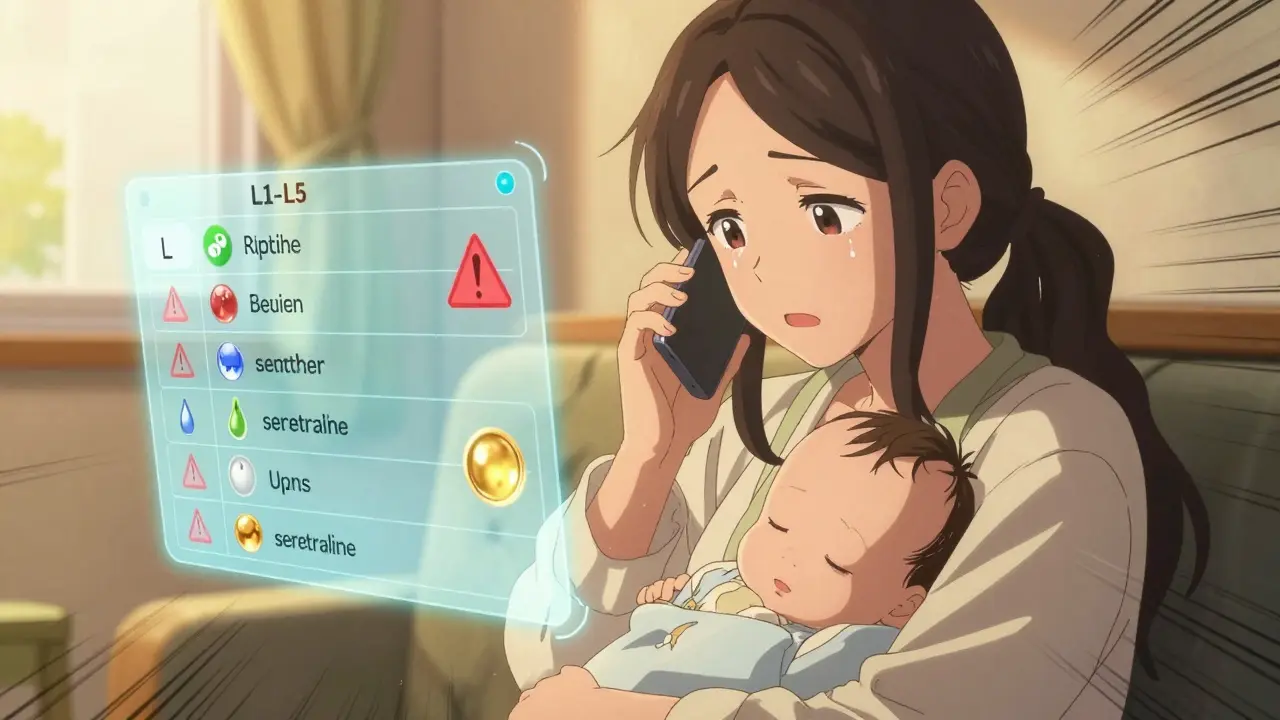
Dr. Thomas Hale, a pioneer in lactation pharmacology, created the most trusted classification system for medications during breastfeeding. It’s called the L1 to L5 scale:- L1 (Safest): No documented risk. Examples: ibuprofen, acetaminophen, penicillin.
- L2 (Safer): Limited data, no adverse effects reported. Examples: sertraline, citalopram, levothyroxine.
- L3 (Moderately Safe): Limited data, possible risk. Monitor baby. Examples: fluoxetine, lithium, diazepam.
- L4 (Possibly Hazardous): Evidence of risk, but benefits may outweigh risks. Examples: carbamazepine, cyclosporine.
- L5 (Contraindicated): Proven risk. Avoid. Examples: chemotherapy drugs, radioactive iodine, ergotamine.

What Medications Are Actually Safe?
Here’s a quick look at common medications and their safety status:| Medication Type | Examples | Category (L1-L5) | Notes |
|---|---|---|---|
| Analgesics | Ibuprofen, acetaminophen | L1 | First choice. Minimal transfer. Safe for newborns. |
| Antibiotics | Amoxicillin, cephalexin, azithromycin | L1-L2 | Low risk. May cause mild diaper rash or fussiness, but rarely serious. |
| Antidepressants | Sertraline, citalopram, fluoxetine | L2-L3 | Sertraline is best studied. Fluoxetine has longer half-life-monitor for irritability. |
| Thyroid meds | Levothyroxine | L1 | Safe. Babies need thyroid hormone too-this supports their development. |
| Antihypertensives | Labetalol, nifedipine | L2 | Generally safe. Avoid ACE inhibitors in newborns-rare risk of low blood pressure. |
| Antihistamines | Loratadine, cetirizine | L2 | Non-sedating ones preferred. Diphenhydramine can cause drowsiness in infants. |
| Birth control | Progestin-only pills | L2 | Estrogen-containing pills may reduce milk supply-avoid in early breastfeeding. |
When to Be Cautious
Some drugs require extra care:- Lithium: Can accumulate in infants. Requires blood level monitoring in both mother and baby. Not usually recommended unless no alternatives exist.
- Chemo drugs: Most are L5. Avoid breastfeeding during treatment.
- Radioactive iodine: Used for thyroid conditions. Must stop breastfeeding for days to weeks after treatment.
- Herbs and supplements: Not regulated. Some, like sage or peppermint, can reduce milk supply. Others, like St. John’s Wort, have unknown effects on infants.
How to Minimize Baby’s Exposure
You don’t need to stop breastfeeding. But you can reduce exposure:- Time your doses. Take your medication right after a feeding, so the baby’s next feed is when levels are lowest. For once-daily meds, take it right before the baby’s longest sleep stretch.
- Choose short-acting drugs. If you have a choice between two meds, pick the one with the shortest half-life.
- Avoid extended-release forms. These keep drug levels high longer. Immediate-release versions clear faster.
- Monitor your baby. Watch for unusual sleepiness, fussiness, poor feeding, or rash. Most babies show no signs at all.
Where to Find Reliable Information
Not all sources are equal. Here are the top three trusted resources:- LactMed: Free, online, maintained by the U.S. National Library of Medicine. Covers over 4,000 drugs and 350 supplements. Used by over 1.2 million people annually. Best for detailed pharmacokinetics.
- Medications and Mothers’ Milk by Dr. Thomas Hale: The go-to clinical guide. Uses the L1-L5 system. More user-friendly than LactMed. Updated every few years.
- MotherToBaby: A service run by OTIS. Offers free phone and chat consultations with specialists. Handles about 15,000 inquiries a year.
What About Newer Drugs?
Biologics-like Humira or Enbrel-are becoming more common for autoimmune conditions. But data is still limited. Only 12 of the 85 FDA-approved biologics have enough breastfeeding data to make firm recommendations. The FDA now encourages including pregnant and lactating women in clinical trials. By 2030, experts predict we’ll be using genetic testing to predict exactly how much of a drug will end up in your milk for each individual. Until then, the rule remains: if it’s safe for the baby to take directly, it’s usually safe through breast milk.Final Takeaway
Breastfeeding and medications aren’t a conflict-they’re a balance. Most drugs are safe. Most babies are fine. The real danger isn’t the medication. It’s the fear that leads mothers to quit breastfeeding unnecessarily. Talk to your doctor. Use LactMed or call MotherToBaby. Don’t assume the worst. Your baby gets more from your milk than nutrients-they get immunity, comfort, and connection. Don’t let misinformation take that away.Is it safe to take ibuprofen while breastfeeding?
Yes, ibuprofen is considered one of the safest pain relievers for breastfeeding mothers. It transfers in very small amounts-less than 0.005% of the mother’s dose-and has been used safely for decades. It’s even given directly to newborns in hospitals for pain control. No special precautions are needed.
Can antidepressants affect my baby’s development?
Studies tracking children exposed to SSRIs like sertraline and citalopram through breast milk show no negative effects on cognitive, motor, or behavioral development. In fact, untreated maternal depression poses a greater risk to infant development than the medication. Sertraline is the most recommended SSRI for breastfeeding because it has the lowest transfer rate and fewest reported infant side effects.
Should I pump and dump after taking medication?
Pumping and dumping is rarely necessary. Most medications clear from your system quickly, and the amount in your milk is tiny. Pumping and dumping doesn’t speed up this process-it just wastes milk and can hurt your supply. The only exceptions are for radioactive treatments or certain chemotherapy drugs, where specific guidelines apply.
Are herbal supplements safe while breastfeeding?
No, not necessarily. Herbal products aren’t regulated like prescription drugs. Some, like fenugreek, are used to boost milk supply but can cause allergic reactions in babies. Others, like sage or parsley, can reduce milk production. St. John’s Wort may cause irritability or colic in infants. Always check LactMed before using any supplement.
What if my baby seems fussy after I take a new medication?
Fussiness alone isn’t proof of a reaction. Babies go through growth spurts, teething, and colic regardless of medication. But if you notice new symptoms-like excessive sleepiness, poor feeding, rash, or diarrhea-track when they happen relative to your medication timing. Call your pediatrician or a lactation consultant. Most often, it’s unrelated, but it’s worth checking.
Can I breastfeed while on antibiotics?
Yes, most antibiotics are safe. Amoxicillin, cephalexin, and azithromycin are commonly used and pose no risk to infants. Some babies may develop mild diaper rash or loose stools because antibiotics alter gut bacteria-but this is temporary and not harmful. If your baby has a true allergy to the antibiotic, you’d see the same reaction whether it came from milk or direct exposure.

Comments (13)
Kinnaird Lynsey
I appreciate how this breaks down the science without fearmongering. So many moms get told to stop nursing over nothing.
Glen Arreglo
The L1-L5 system is gold. I wish every OB would reference it instead of just saying 'ask your doctor' and leaving you hanging.
Matt Davies
This is the kind of post that makes me feel less alone. So many of us are whispering about meds in the dark, terrified we’re hurting our babies. This? This is light.
benchidelle rivera
Pumping and dumping is a myth peddled by formula companies and overzealous pediatricians. The science says otherwise. Stop wasting milk and start trusting your body.
Mike Rengifo
I took sertraline while nursing my twins. Kid #1 was chill. Kid #2? Super fussy for a week. Turned out it was teething. Lesson: don’t blame the med until you rule out everything else.
Andrew Kelly
They say ibuprofen is safe but have you checked the FDA’s 2023 advisory on NSAIDs and infant kidney development? No? Then don’t act like it’s harmless. They’re hiding things.
Anna Sedervay
The LactMed database is statistically underpowered for longitudinal outcomes. One must consult peer-reviewed pharmacokinetic modeling studies from the Journal of Clinical Pharmacology, not crowd-sourced anecdotes masquerading as medical advice.
Ashley Bliss
I stopped breastfeeding after my doctor said SSRIs were 'probably fine.' Two months later, my baby stopped making eye contact. I don’t know if it was the meds or the trauma of being a mom in this world. But I’ll never trust another pill again.
Chris Davidson
The data shows minimal transfer but you can't ignore the cumulative effect over months. Many mothers don't realize they're giving their child a low dose of antidepressants daily for a year. That's not negligible
Dev Sawner
In India, we have seen cases where mothers on antihypertensives delivered infants with hypotension. The Western data is not universally applicable. Cultural and genetic variance must be considered.
shivam seo
This whole thing is just corporate propaganda. Big Pharma wants you to keep breastfeeding so they can sell more pills. Look at the funding behind LactMed.
Moses Odumbe
I took ibuprofen and my baby smiled for the first time 😊 so yeah it’s fine. Trust the science and the smiles. 🤗💊🍼
Isabel Rábago
It’s not about the drugs. It’s about the silence. The stigma. The way mothers are made to feel guilty for taking anything that helps them survive. We’re told to be selfless until we’re hollow. Then we’re told we’re risking our babies. The real danger isn’t in the pill. It’s in the shame.